Tuesday, October 12, 2010

Cured Meat. Spanish Style.

the view from the castle-like farm house.
Our driver was a bit of a nut case. Apparently he had two GPS systems, both of which he apparently refused to use. Our 8am departure was supposed to lead us to a 10:30am meeting but was more around noon.

Squinting into the sunny afternoon, we stood in a field that wafted sweet aromas of mint as we met with a producer of jamon iberico de bellota. This particular producer uses only a little salt as he likes a sweeter taste to the meat - the amount of salt used depends on the size of the leg - but it is also a bit risky for the drying process as salt is the only preservative used. The legs are then washed in cold water and hung in a central room of 10 degrees with 80% humidity. The drying room is oriented towards the sun to follow the natural cycle which coordinates with the natural temperatures to ensure quality control. Wind currents and light are the two most damaging things.

Jamon imberico refers to the breed of the pig, like serrano ham comes from the white pig, but the quality of the ham depends on the feeding:
1. jamon iberico de belloto is the highest grade and the free-range pig is fed a diet of only acorns found seasonally in the forests where they roam.
2. jamon iberico recebo means that the pigs were running around eating acrons in the field but didn't reach the desired or required weight so had to be re-fed with grain feed.
3. jamon iberico cebo extensivo and intensivo are both fed a diet of only grain and can be either free range or kept in stables.


the producer was able to recognize an iberico ham from the space between his fingers when wrapped around the smaller-than-usual calf as well as distinguish a bellota ham just by touch. The hoof is kept on the leg, unlike prosciutto di parma. The hoof, or nail, is typically black in the iberican pig breed and called pata negra, black foot. However, some ibericans don't have the black foot, but all pata negras are iberico.  He explained that some people don't like the look of the foot attached to the ham - I can understand how the thick black hairs can be offputting - but I think that they probably shouldn't be eating the ham anyways - it is important to know where food comes from. right?


piggies running free in the forrest. 
bellota means acorn in spanish.
acorn means squirrel in dutch.

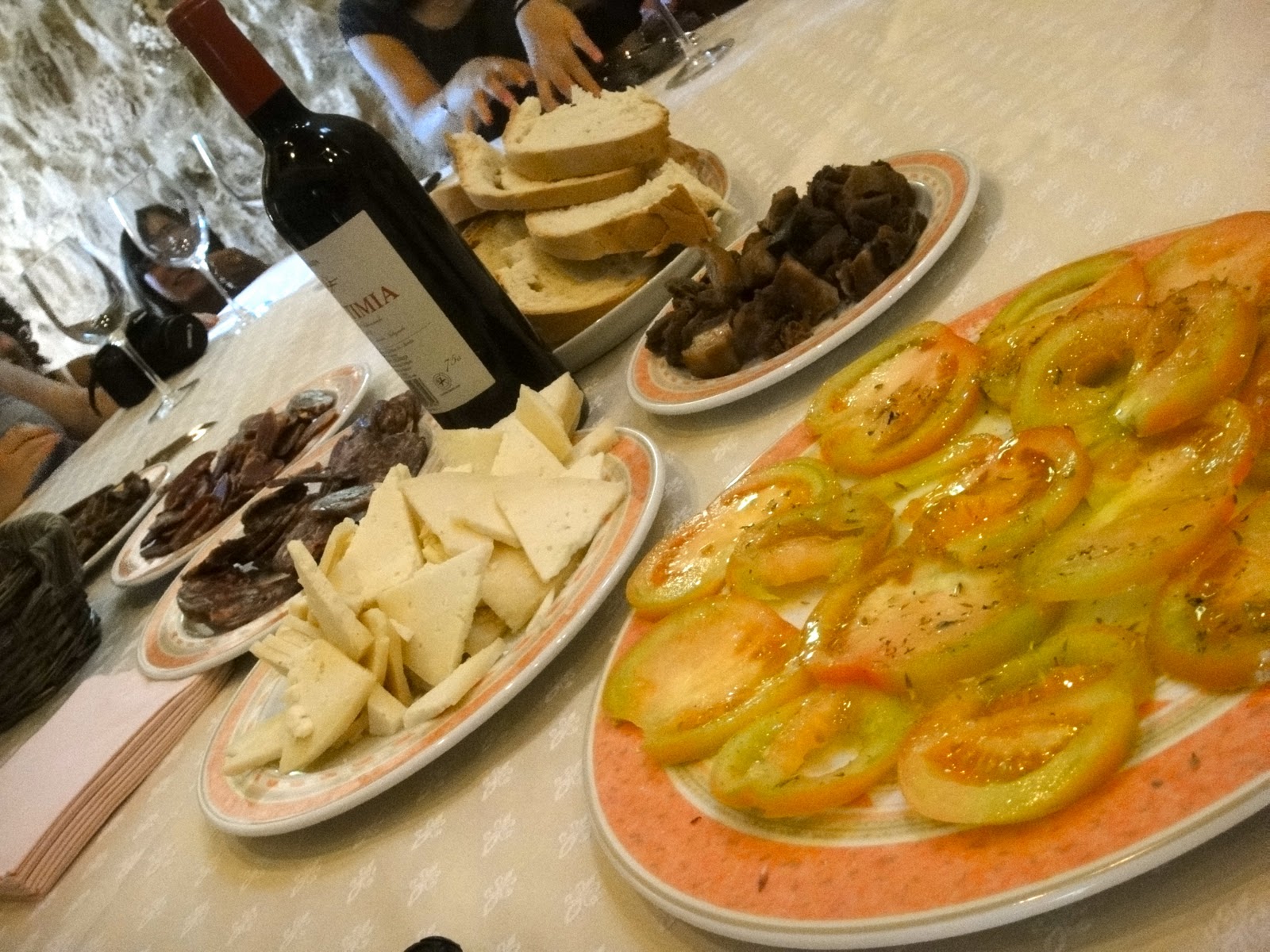
we drove into the forrest as far as the bus could take us until we had to walk onto the dirt road that led us amongst the wild pigs running around in the mud and uphill to the farmer's house. we overlooked fanstastic views of the Andalusian countryside, the sun highlighting all of the country's vegetation and the swimming pool tempting us all to dive in to cool off. We had an appropriate meal based on pork: addictingly salty chicharrones - fried pork rinds, rather-unmemorable salami flecked with whole black pepper, lomo embuchado - a chewy dry cured pork,  a local cheese, slices of tomatoes dressed in olive oil, and of course, jamon iberico de bellota that was carved table-side in front of us. It was sweet in flavour and the fat glistened in the dim light.
the producer


jamon iberico
Sung and Jules carving the leg.
To finish the day's lessons, we ended at Eurocork, a company that produces corks for wine and bubblies.
 If we weren't so tired and if the bus hadn't made us rush through what we could with the delay, it could have been a lot more interesting. Luckily, the guy was nice enough to stay at work a bit longer to give us a quick lecture about the production, while the rest of the employees went home. From mainly around Andalusia, Extremadura, and Portugal, the bark from the cork oak trees - divived into plots so that the bark can re-grow every nine years - is stripped manually with an ax and grinded. The boards of cork are cut into coin sized discs which are then glued together to create the bottle cork stoppers, but better wines will use corks that don't have glue so there is no risk of oxidation.
glued cork
solid cork
will be glued together.
champagne cork. will expand into a mushroom.
That night we had our only group dinner in Ronda - a feast at Sol and Sombra Restaurant. We arrived so late it was dark but I had heard how beautiful the city was. David from the Ronda Rural Development Department gave us a tour around the city pointing out important buildings, sites and historical anecdotes. It really was enchanting and filled with small town charm - old buildings illuminated by the yellow street lights, huge gorges alluding to dark crevices and daring only the brave to look below, and little alleys that intertwine the city like ribbons up and down the cobblestoned hills. It requires a return in the daylight.
Ronda at Night.

"Oh Sherry, Our love holds on"


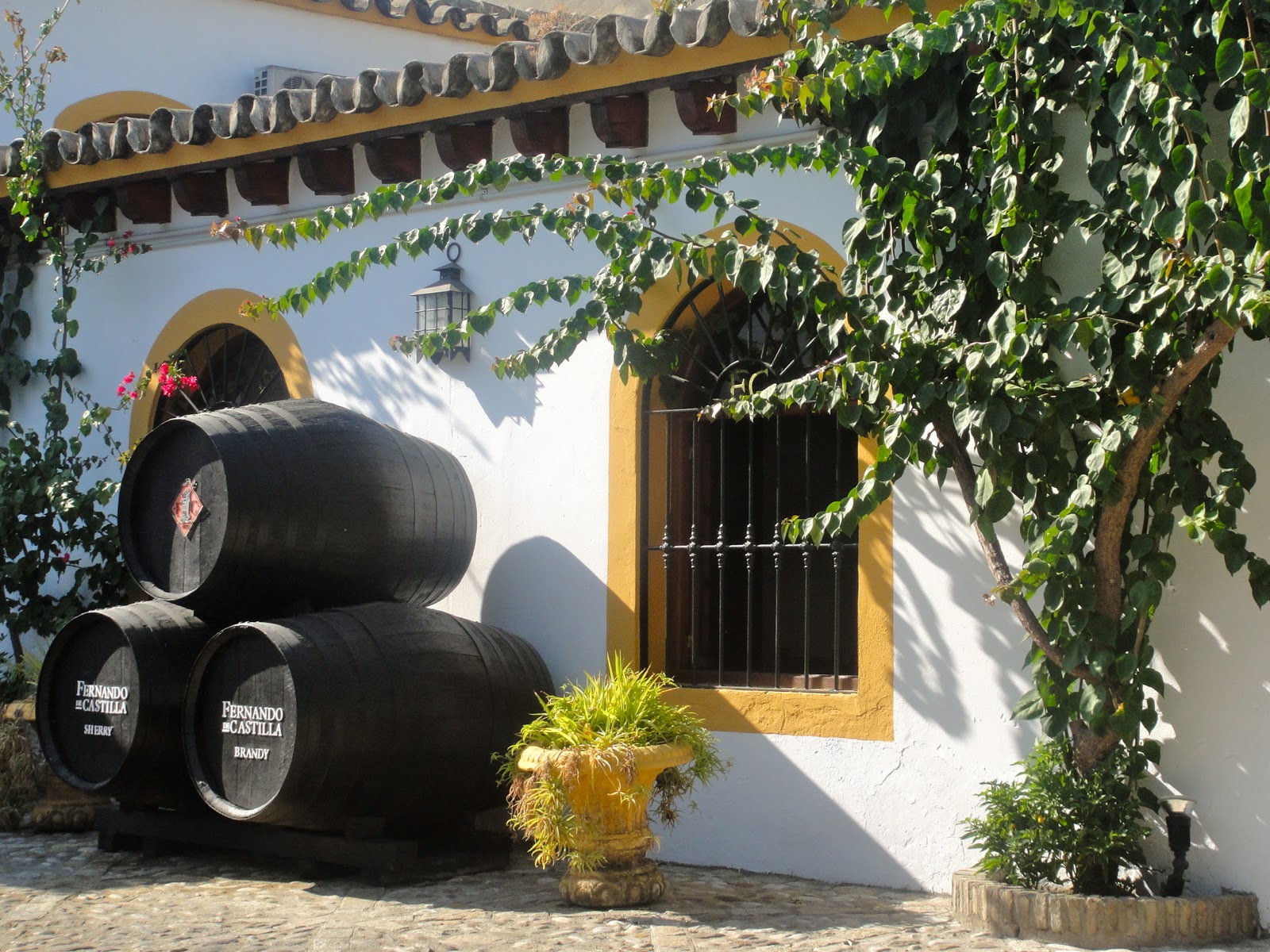
After trying to make plans to go on a fisherman's boat but with no way of getting back to the port and trying to go out fishing from 2am to 6am before realistically thinking how tired we already were and how exhausted we would be the following day, we departed the port for Jerez de la Frontera to visit the immaculate sherry and brandy maker, Rey Fernando de Castillo. Although it is exported to 45 countries, 50% of their production stays in Spain, which we were told a lot of locals will buy their products even if it is more expensive because of the consistently and genuinely good quality. On the other hand, some sherry makers just make sherry to be sold as exports to probably people who enjoy what they know as sherry but haven't really experienced or tasted the real deal.

Sherry is the second Spanish export, following only behind Rioja wines. Sherry is what the Spanish, or at least the Andalusians, call wine or vino de Jerez, whereas most of us would call it just sherry -keeping the classification separate from wine. It is, in fact, a fortified dry white wine meant to be enjoyed with food whereas blended and mass-marketed sherries are generally sweeter and drunk as an aperativo. Because it is aged in oak barrels for  a minimum of 3 years in which the amino acids release umami sensations, sherry is good with and in food. The low acidity also makes it appetizingly-agreeable combined with vinegar as in dishes such as escabece or ceviche.  (HA! appetizingly is an actual word!) Palomina (the main and local grape variety used in sherries that occupies up to 95% of the sherry vineyard area in Spain), along with the area's microclimate (generally warm but often hot and dry but occasionally cooled by the near-ocean winds and the chalky soil), the low acidity, and the cellars conditions (especially the bare floors for the solera system) create a top fermentation. The wooden casks of the dry white wine are only filled to about 75% percent so that as they age and mature, a yeast, or flor, grows on the top of the wine. The flor that naturally grows is not only of a local variety that develops the sherry, but allows the wine to ferment as it stops the oxidation. This allows the sherry to develop a tremendous personality from the layer of locally grown yeast typical of the region's winds. This is terroir at it's best.  It's also why sherry is a D.O.P product that must come from the Jerez region of Spain. The vineyards within the Jerez region must be grown in the ménage à trois of Jerez de la Frontera, Sanlucar de Barrameda and Puerto de Santa Maria. 

  • White sherries like fino are complex, light and dry, whereas manzanilla, a variety of dry fino, are more delicate, fresh, almost salty from the sea, and sold younger. These are 12-13% alcohol and aged 3-4 years. 
  • Brown sherries are 18% alcohol and should be matured 8-10 years otherwise it will taste "unfinished" like biting into an unripe fruit with no aromas. It is one of the driest wines as there is no residual sugars - the bacterias eat it over time. The Rey Fernando de Castillo sherry has no treatment - it goes straight into the bottle so the wine in the glass is the same wine in the cask. This type of sherry is best consumed with consumme soup, mushroom pate or foie gras, or a sharp cheese. 
  • Pedro Ximenez is another type of sherry named after Peter Simmons who brought over this particular grape variety from Germany in the 1700's. Because the grapes came from a cold, humid climate to a hot one, the grapes tended to shrink after they grew because the skin was too thin to protect itself from the heat of the sun. Therefore, this sherry is made from pressed raisins - a unique wine made from sun-dried grapes. It is technically a white wine but appears black in colour. Aged for 30 years, it is extremely sweet with 500g of residual sugar. It is best served slightly chilled with chocolate, ice cream or a non-salty blue cheese. yum. 
tasting the 5 year old and 80 year old
We also tasted their Brandy. Brandy is a distilled wine, but it is made from "whole wine" that has been aged for at least 6 months in oak and isn't a grape-reminant like grappa is, for example. There is also nothing added like sugars in brandy or cognac. The wine is distilled in copper vats over a live fire. The water and the alcohol evaporate, but the alcohol evaporates faster into a tube which then condenses into liquid again at 65% alcohol. It is aged in new American oak which has not been used before and then into a previously used sherry barrel for a minimum of 5 years. The barrels do not move. The solera barrels are the oldest and are the closest to the floor (solera = suelo = floor). The top barrels are refilled from top to bottom so that there is a little bit of harvest in every bottle, creating a uniform consistency in each brandy. Therefore, the younger wines take on certain characteristics of the older wines and all are uniquely blended among age and among the casks. We tasted one from the barrel of 5 years and another more developed and deeper coloured one of 80 years.
"Holanda" indicates top quality. 
At the end of the tour we tasted their sherry vinegar. Sherry vinegar is known as the perfume and soul of Andalusian kitchens. It is a favourite with gazpacho, chickpeas, or as a salad dressing mixed with some extra virgin olive oil and dijon mustard. The sherry vinegar that they produced really surprised me. They only make 2 bottles a year due to it's production process. It is made with "broken" wine-by products, not made intentionally. Rey Fernando de Castillo sherry vinegar takes a least 15 years to become sherry vinegar. Since there are no official rules for vinegar - as a condiment - so many of them are factory based which take days, not years, to produce and these lack the aromas that generate from and develop with age.

Williams & Sonoma buy sherry vinegar directly from Rey Fernando de Castillo for $11 and sell it in America for $45. apparently. I couldn't find it on their website.

After our tasting session, we celebrated Reena's birthday with chocolate cake and bubbly bottles of cava on the hotel's rooftop overlooking the illumiated little town of Conil and the vast blackness that hinted of the sea.


I don't know if love sherry. I know my palate isn't experienced or developed enough to appreciate it as a wine. But I do like Journey.


Oh, you know that there's a fever

(there's a fever I know)
Oh, that you'll never find nowhere else
(nowhere, nowhere else)
Can't you feel it burnin' on and on

Oh Sherrie
Our love holds on
Holds on
Oh Sherrie
Our love holds on

(guitar solo)

Oooh Sherrie  - Journey.

Friday, October 8, 2010

Puerto Canil: Artisinal Fishing.

Puerto Canil was the first stop on our second day's itinerary. It's a small fishing port of the area that still uses artisinal methods - either with a hook or with a net. We learned about the life of the fishermen, who go out on their boats starting anywhere at 1am until 6pm depending on where they are going and what type of fish they are hoping to catch. The fish are "sacrificed" as they are immediately put into buckets of ice, where they die from the cold, to maintain the fresh quality. They fish seasonally and alternate the years of which type of fish they catch so that the fish have a chance to grow.
FISH FACES.
Spain, geographically speaking, is the largest fishing country in Europe. Spain joined the EU in 1986, enforcing them to abide by their laws regarding fishing and farming, but the EU has no specific definition for artisinal fishing. The port's "brotherhood" is concerned with the disconnect between the fishing communities and the EU as the fishing community is part of their identity. They believe that Spain should unite Europe, but Europe shouldn't unite Spain - they should work together rather than taking away the local, regional and national Spanish traditions. 
Each port has it's own public fish auction, which we witnessed, where the fish go to local restaurants, fish mongers and occasionally larger national markets, but not usually - most of the fish here, stay local. They are the first project to integrate farming and artisinal fishing and consumers are only able to buy what's available, the fishing is not done to meet consumer's demands. Therefore, their fishing is based on respect: for the envirornment and for sustainability. Normally viewers have to watch the auction from behind windows, but we were allowed to be part of the action. Buyers and fishermen trickled in as crates of caught fish were put into boxes filled with ice and then onto a conveyer belt to be weight, surveyed and bid on. Huge lobsters (33 euro for a kilo and half), silvery eels, octopus with their tentacles clinging for life onto the plastic bucket, red fish, tunas, shark relations, slippery squid, and all types of fish I wouldn't have a clue on being able to name.
the auction. biders above. biding below.
We had lunch at the port with hungry expectations of freshly caught fish. We started with olive oil-marinated and paprika-dashed potatoes with bits of tender and tough octopus marbled mulberry and pearly white. Then we had saffron-yellow paella with mixed seafood: firm bits of rice with shrimp, clams, and mussels mingled in. Lastly was a large platter of fried fish, which I was happy of my allergies to pass on, despite the inclination to want to try the fish cheek and the tapioca sized eyeball.


Spain: Our Last Int'l Stage

3am. The bus was leaving Piazza Garibaldi in Colorno on Monday morning at 3am. We were assured that any other way, or any other flight, would have been chosen if it were possible, but apparently not,  as we quietly took our places on the bus in the dark, chilled night. I think it kinda set the mood for the rest of the trip. I don't think any of us caught up on our exhaustion. We slept-walked (sleep-walked?) through the Bergamo airport, onto the plane, until we stepped out into the warm Spanish sun in Malaga. Back on the bus. Our first destination: lunch - 2 hours away. We were off to La Duquesa to try the Andalusian specialty: rabo del toro. We started with bits of potatoes glowing florescent yellow in Spanish olive oil with colourful flecks of herbs and red onion.
We had plates of fleshy pink lomo smothered in thick lard as though they were slices of birthday cake coated in creamy layer of vanilla frosting. The lomo was a bit tough so the smoothness of the lard was quite complimentary - if you are able to get over the gleaming white paste staring back with caloric, pure-fat intensity.
Then there was a spring-green block of airy asparagus pate served with a dollop of mayonaise and a plate of roasted mushroom caps on a simple bed of shredded iceberg lettuce. Then came the bull tail. We each got a plate of two, with a pile of gravy-absorbing french fries on the side - and looking around, there must have been nearly 30 of us. That's a lot of bull tails. Bull tails honour the tradition of bull fighting in the region but there's no way we each had 2 bull tails. Maybe they were oxtails. Maybe the part that looked like the end of the tail was really a cartilage disc from different parts of the spine.
The meat was tender and fell easily off the bone, snuggled amongst gelatinous fat, as it was slow cooked it what seemed to be a sauce made of carrot coins, minced garlic, chopped onions, regional red wine and probably a meat broth. It was nice to try as a cultural and regional specialty, but it wasn't anything extraordinary. We didn't see a bull fight nor did we stay for dessert as we were off to our next destination: Aromasdemedina, an artisinal pastry company.
We tasted their handmade pastries - many made with almonds and, surprisingly, animal fat. We overlooked the production facility room where women were folding each of the pastries into paper wrap one by one with their hands. Talk about artisinal. It looked like a perpetual monotonous activity that it made me appreciate the value and effort encompassed in the term artisinal, but feeling almost sorry for the work of these women I wondered if it was better than machine processes.

Back on the bus through the arid waving brown hills patterned with avocado bushes, cotton fields, and olive oil trees. The stretches of wind-powered generators that extended into the cloudless horizon weren't a necessarily pleasant addition to the landscape's natural scenery but provoked an encouraging ecological promise to the future. It seemed as though we were in the middle of the desert, in the middle of the Iberian penninsula, but we arrived in Conil with promises of the sea side. As we walked to the beach, this contradiction continued as the desert land behind us opposed the bright blue sea in front of us, the lighthouse on the coast in the distant reminded me of New England and the town filled with clean white, square houses nestled on top of each other behind the beach looked like the postcards I've seen of the Greek Islands. Maybe my exhaustion was getting the best of me, but I felt all sorts of confused.
Greek Islands or souther Spanish coast?
Desert-like.
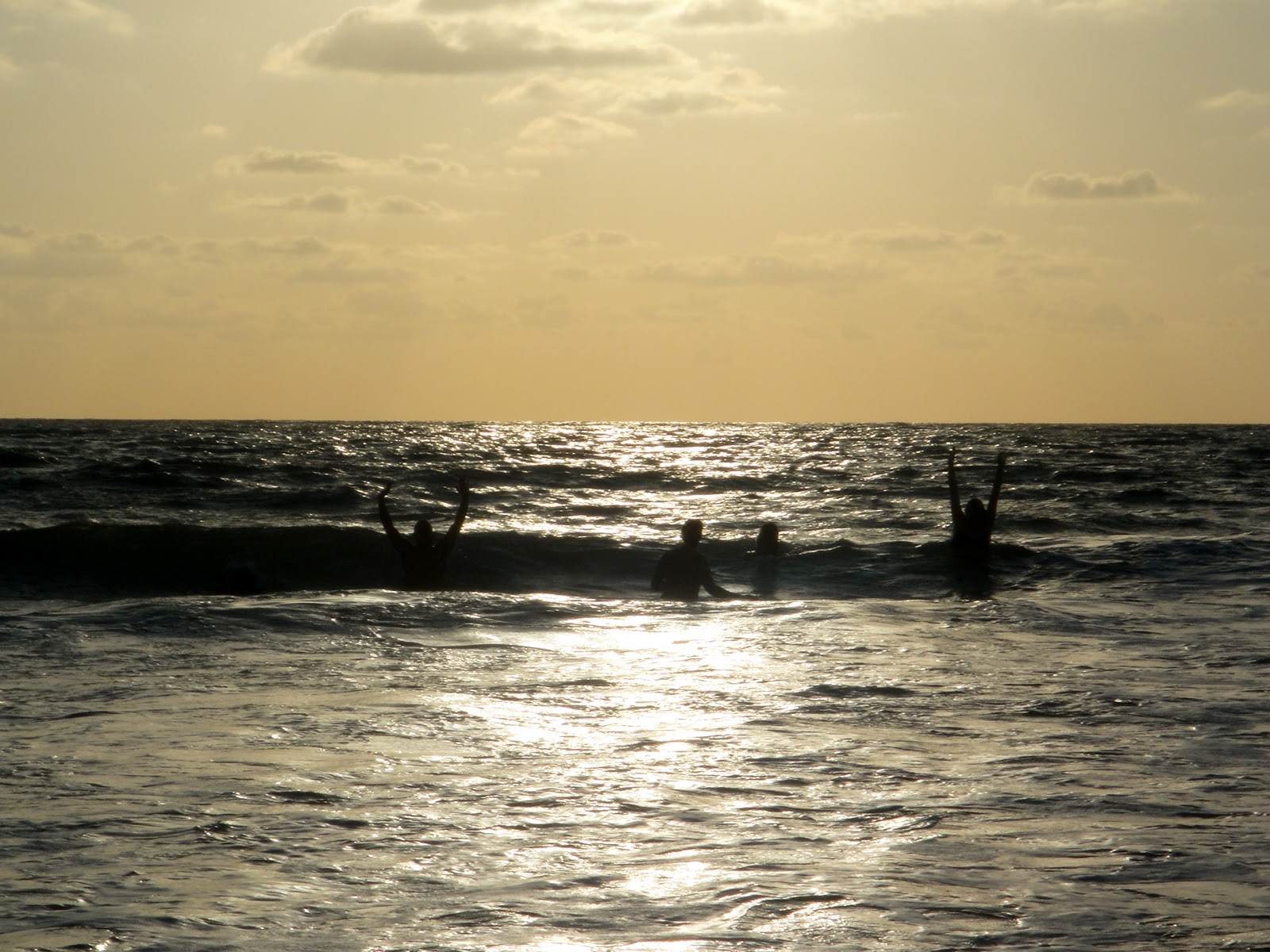
The sun set in front of us as some of the students swam in the salty sea and I tried in my best Spanish to ask and understand what the men on the shore were trying to catch with their nets. Razor clams was what I understood and I watched as they peered into the oncoming waves for the first sighting of the razor clams poking out of the crashing waves. Despite their lack of luck while we were there, Asher was sure he'd be back in the future with a camper parked on the beach and selling grilled razor clams to hungry beach-goers.
brave swimmers. too salty for my skin.
razor clams?
bonita. 
Naturally, it was time for some Spanish tapas and a cold Cruzcampo, or CruTHcampo. The beer, and wine, appropriately mirrored the size of the tradiational tapas: bite size and enough for a satisfying taste. Conil is a cute town, lined with little streets and tapas bars catering to the locals and the tourists. We passed some that lit the street from the halogen lighting, baring the sparsely decorated interiors filled with old men. adorable. We went to Los Hermanos, on a triangular corner like the Flat Iron Building, which was packed - always a good sign - and we shimmed our way to the back to place our order. 
We were adorned with plates of fried seafood, jamon y queso, and discs of tortilla camarone which tasted like the prawn crackers found at thai restaurants - except these were freshly hot and the little hairs of the shrimp sprouted out with each bite.

 Needing something more than fried food and some fresh air, we went to another place, La Gloria, where we had mushroom croquettes, mousaka, patatas bravas, patatas calabrales, and ricotta and spinach canneloni. It wasn't traditional Spanish food, but it was ok because if every tapas bar and restaurant served the same traditional dishes, it would get a bit boring. These were their versions and still within the concept of serving tapa-portions.

Needless to say, we effortless fell into a deep slumber that night.

Thursday, October 7, 2010

"Shauna, let's make a promise that in ten years time we will be sitting together, drinking Irish Coffees, and remembering this conversation." - Jules.

"and we will be happy."

Tuesday, October 5, 2010

Arie's first blog post; Cheese, cheese, cheese bllee

Italian tip #7

video chat is way more fun for keeping in touch than talking on the phone.

 <3

Waste Not, Want Not.


In July of 2010, Christien Meindertsma gave a thought-provoking speech about her three years of research and studies following a pig, "05049" to investigate and explore where all of the parts of the pig ended up - besides being meat on a plate. Her talk highlights some of the interesting products that contain pig parts - from soap to beer, to frozen meat to ammunition to heart valves to renewable energy. In her book, she reveals the 185 products that come from this one pig, 05049.

Being surrounded by cured meat in Emilia Romagna, and in Italy in general, and then furthermore in our trip to Spain, I found the talk very provocative, especially when taken into consideration all of our other courses we've had throughout the year about sustainability, the environment, poverty, food policies and regulations, etc. On the one hand, using all the parts of the pig is very practical, very logical, very sustainable. On the other hand, we are blindly supporting industries that we may not want to.

I've tried to take a more vegetarian approach to my diet, more out of environmental considerations (global livestock accounts for nearly 30% of methane emissions, take up a lot of land that could be used for other purposes to feed the hungry, the amount of water they require) than nutritional or ethical reasons. But I do love a juicy rare filet steak, will try the ox tail and am surprisingly not sick of all the cured meat we've been exposed to over these last couple months. And now, despite my love for cheese, I can't help but think about how cheese is connected to the meat industry (granted some of the milk used for artisinal cheeses isn't coming from the huge livestock facilities). We've learned about the different cuts of meat that come from a pig, how salamis are mixes of meats and lards, the intestines/colons/rectums are used as casings, the skin is included in meats like mortadella....but we never heard about where the rest of the pig goes to. never thought to question it. It's fascinating to think how little we know about our food and even where our every day products come from. I wonder where all those leftover cow parts go....

Sunday, October 3, 2010

"I am a true adorer of life, and if I can’t reach as high as the face of it, I plant my kiss somewhere lower down. Those who understand will require no further explanation" - Saul Bellow.


some photographs a la carte of why i love my UNISG classmates:

they go into the fields to pick tomatoes leftover from the harvest.
they publish books. about food.
we cook together. 
we drink together.
they come to class with daily essentials in their bag, even when all you need is a pen.
they buy pasta machines to make fresh pasta. 
they bake fresh, homemade, delicious, and healthy bread.
we invite our professors over for dinner. 
they have promising potential become professional sommeliers. 
they are strong.
yes. they are strong.