With pasta and olive oil already checked off, no UNISG study trip would be complete without at least one visit to a winery. And when in Tuscany, that means one consorzio and five wineries. For two days, we learned all about Brunello di Montalcino. The Consorzio del Vino Brunello di Montalcino gave us a nice presentation about the wine and an introduction to the land. The town of Montalcino sits proudly on a hill (564 metres above sea level) and as the slopes descend to the north and to the south, the soil and temperatures change with the elevation. Because of this, even though the Brunellos are only made with 100% Sangiovese grapes, the different producers can make wonderfully unique Brunello di Montalcino wines depending on where their vineyards are. Talk about terroir. Of the 250 producers (208 are bottlers, the rest only grow grapes), the consorzio boasted that all of them are members even though they don't have to register. The consorzio therefore is able to protect and promote the quality-guarantee of Brunello di Montalcino, Rosso di Montalcino, Moscadello di Montalcino and Sant'Antimo. Brunello and Rosso are both made from the Sangiovese grape, but it is the aging time that makes them different - this is why Rosso is called the "little brother" for its younger age, not inferior quality. The 6,500,000 bottles of Brunello produced each year must be aged in oak wood for at least 2 years and then a minimum of 4 months in bottle (6 months for Riserva).
 |
| completely foggy outside. |
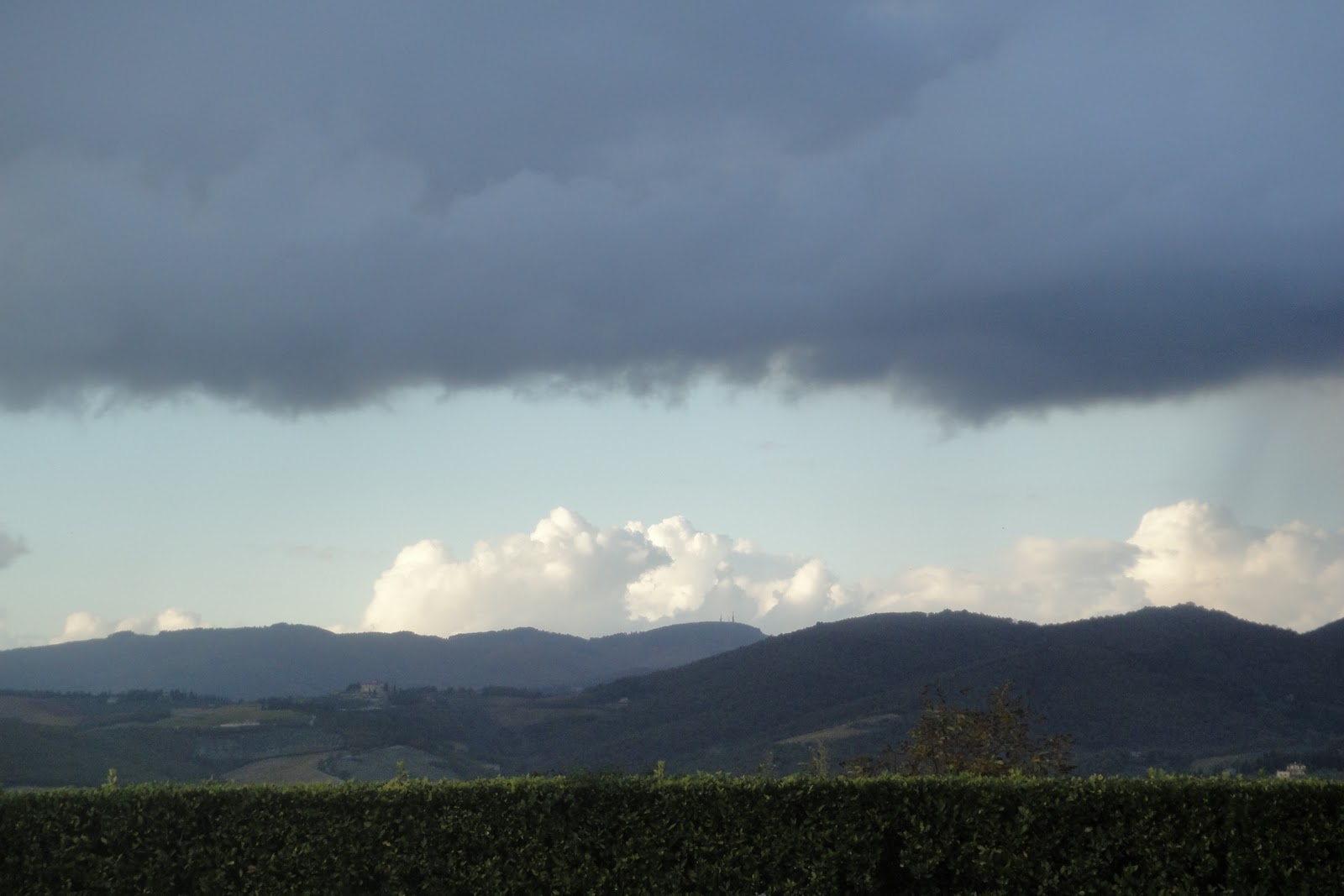
As the thick early morning fog cleared, we were able to see autumn in the Tuscan vineyards. Rows and rows of vineyards sparkled hues of yellow and orange and when the bright blue skies revealed themselves, the countryside was stunning. In a weird way, the patchwork of land laid across the rolling hills reminded me of Ireland, the vast vineyards reminded me of my Italian wine-country experience in Piemonte, and the seasonal colours reminded me of fall in New England. But, no, here we were: 7,000 acres of just Banfiland.
And like all UNISG stages, we usually visit one large-scale place and a small, generally family-run, producer. Banfi was our large scale one. It is owned by an American family with Italian roots who live in Long Island. Banfiland, as we came to refer to it as, is a beautiful, but huge estate - the roads on the property alone add up to 120 miles!
 |
| oak and steel hybrid fermentation |
Everything about this place was extravagant. We were introduced to their "Horizon Project" which is a combination of oak and steel - they wanted the high quality flavours and tannins that come from traditional oak barrels, but also the steel technology to control the temperatures during fermentation. It is a pretty impressive concept - they say the results so far also have show higher quality wines, but it was patented in 2007 and no one can buy a patented idea for 8 years so it has yet to be copied.
 |
| even the lights are made out of barrels. |
In the Banfi cellar - (they had to build a second, temperature-controlled cellar because the original wasn't big enough for all the barrels) we saw soo many barrels that it was almost unfathomable to comprehend how any forest in the world could grow so much wood. It was absurd. One, just one, of the large barrels we were told costs 23,000euros! To think about how much money this family must have, how much money was invested into just the wood alone....unfathomably absurd.
 |
| 23,000euro for this nice barrel. |
The castle, called Poggio di Muro, is beautiful and we had a nice lunch with wine pairing. As Jules and I agreed, sometimes we criticize too much and are not critical enough. The whole estate is pretty self-sufficient and sustainable. Despite it's large scale, they try to respect the environment: they have 9 "fake-lakes" used for irrigation, half of the land is dedicated to forest where wild animals roam, they grow olive trees for their own olive oil amongst other vegetables and fruits, and are in the process of researching and inventing their own energy out of wine leftovers - as you can imagine they have a lot. The romanticized ideal of a family run winery is nice, but it is an expensive endeavor. Banfi might be ostentatious, but if they've got the money to do something good with it, and are environmentally aware, then go ahead, no?
 |
| enormous. i think we could all fit inside. |
The next stop on our Brunello di Montalcino tour was to Ciacci Piccolomini d'Aragona. It was a medium sized family-run estate. What was interesting about this place was that they had a giant concrete tank - 200 hectoliters - where the wine is allowed to rest with no temperature changes, no noise disturbances, and it can find a uniform balance. I have never seen or heard of such a thing.
 |
| tank. |
 |
| tasting wine all day isn't always exhilarating. |
The third Brunello di Montalcino winery was le Potazzine and was even smaller than the last two. Giuseppe, the owner, maker and official wine taster of Sienna joined us on the tour with Michele and shared tasting notes while in the cellar. His barrels were unique too. The ones used for Brunello were oval shaped, specifically designed for him out of Slovenian oak. He chose oval barrels instead of round ones because the Brunello wine is never filtered and the oval shape allows the sediment the right amount of time to settle at the bottom. The smaller barriques for the Rosso were round. As we watched a man clean each bottle, attach the labels, top off the cork covers, and apply the DOCG sticker individually, we learned the meaning of le Potazzine. In Italian, it is the name of typical Tuscan birds and a term of endearment - what the grandmother of Giuseppe's two daughters would call them. A very family oriented winery indeed.
 |
| adding the DOCG labels. |
 |
| label machine. added to our notebooks. |
 |
| bottle top covers. each added one by one. |
 |
| oval. |
 |
| tasting session with the little birdies. |
Appropriately, both lunches and dinners of course were flowing with various bottles of garnet Brunello di Montalcino and ruby Rosso di Montalicino for us to try with the accompanying Tuscan cuisine.