Saturday, November 20, 2010

Artisinal Pasta and Tuscan Olive Oil

Our first stop in Tuscany was to one of (perhaps) eight or so artisinal pasta makers in Italy, Giovanni Fabbri. He still makes pasta the same way his family has made it for four generations. He also uses an old variety of wheat that, as research has shown he said, is tolerable by people with cholesterol problems, diabetes and stomach cancer whereas newer varieties of wheat cause problems for people with celiac disease and glutton intolerances. Interesting. 

Showing us how to test the strength of the wheat
by the quality of the glutton.
Pappardelle di San Lorenzo (the protecting saint of pasta)
drying on racks 33 degrees
Later in the day, we visited another four generation family run business - Pruneti farm - where they produce mostly extra virgin olive oil. We tasted four different types of olive oils that they make: Leccino - a light tasting olive oil of one year; Mariolo - which is a little olive that doesn't absorb much water grown in rocky lands; Viuzzo - a trio-blend which has won top 5 olive oils in Italy; and a bright green blend that was made just 4 days ago. Funnily enough, Samara and I had actually talked to the Pruneti producers when we went to Pasta Trend in Bologna. 

olives waiting to be oil. 
fresh extra virgin olive oil. 
tasting session.
lunch.

Food Porn: Food Network on South Park

Ok, I never watch South Park - I don't even know if I've ever seen a full episode, but I came across this one on NYMag's Grub Street and was tempted into watching it to see how the Food Network was portrayed. I think it would be a good part of our pop culture and media classes...cultural phenomenons, food trends, food porn, media within media...

It's completely inappropriate (mum, don't get mad), but hilarious.

Watch it here: http://www.southparkstudios.com/full-episodes/s14e14-creme-fraiche

Tuesday, November 16, 2010

Monday, November 15, 2010

Tuscany: our LAST stage.

Tuscany was our third Italian study trip and the last of the year's stages. What better way to end it than with a bus ride that didn't correspond to the schedule's timeline, an artisinal pasta maker, an upscale olive oil producer, lunch of cured meat and cheese, a free night to roam the city to find wine and typical regional food, a visit to a family-run large scale winery, a too-many-to-count-course dinner in a quiet cobblestone village, a visit to a family-run small scale winery, a multi-course lunch filled with laughter and wine, a crammed ride in a white van - just like crete, just like friuli, the distinctive-wafty room of hanging homemade cured meats with a cured meat sampling dish to follow, a visit to a luxurious winery with a tour of its village-like compounds - just like crete, followed by a visit to another winery, free time in a small town where we scatter but all end up at the same bar, a visit to a butcher, a visit to a cow farm, numerous olive oil tastings, hundreds and hundreds of oak barrels, multitudes of steel fermentations vats, hours of bus rides for sleeping, reading, laughing and singing karaoke*, an album of food-photos, tear-induced belly-aching laughter, unanswered questions to definitions of vocabulary that have haunted us this entire year, and of course lots of nerdy note taking. oh, aaand a week's worth of unforgettable memories. 
a great way to complete our last UNISG stage together, but hopefully not our last trip together. 

* i have video recordings. 

Sunday, November 7, 2010

Bug: I'm in the Mother F*ing House.

Christian called it a cimicidae, which translates to a bedbug, which I disagree with. Samara called it a shield bug, which I think it could be, and could also mean stink bug. gross.

Despite the window screens being constantly closed, these little critters somehow make their way into our apartment. They're everywhere: in the stairwell, on the floor, fluttering about the lights. They squeal if you hit the screen they are clinging on to and then fly away. They are crunchy (and juicy) if they are stepped on. And they are stupid. I took this video of one who landed on his back and couldn't get up. Amusing for us, maybe not for him. He should learn to stay outside.


i have no idea how they get into the house.

A Herring a Day.

Arina's Second Blog Post.
Silver hair waving in the wind, with goose bumps all over his body, he licks his lips with satisfaction. Big salt crumbs disappear slowly while his stomach rumbles like a whale. He starts to dry himself faster so he can get away from the wet sand on which he is standing. The sea is waving him goodbye. He shivers, it‘s time for coffee and a proper breakfast. The morning ritual is not completed without a “heering” straight from the sea, with freshly chopped onions that still make your eyes tear up. Every day, my grandpa swam in the North Sea before heading to work. A herring a day keeps the doctor away—Arie’s life motto, which helped him live happily for 87 years.

Raw herring with raw onions: eat or hate it. 

It is a warm morning and the sun is just breaking through the clouds. The town of Scheveningen is busy. Today, June 12, 2010, is a special day. Vlaggentjes dag, the day on which the first barrel of new herring is sold, announces that the herring season is officially open, and it starts with the celebration, when all the boats in the harbor are decorated with flags. The history of vlaggentjes dag goes back to 1947, when the first edition was organized. Scheveningen, however, located in the heart of the Dutch coast, has celebrated unofficially since the 18th century. Children take tours on vessels and on fishing boats, while the older generation listens to the havenzanger, a band that plays music from the old days. The season will last until the days become shorter again and the leaves begin to fall. All fish markets and shops have new supplies of the pride of the Dutch sea.

The slippery tail almost slides through her little fingers, the two parts into which the herring has been cut flap dangerously, and some onions hit the ground. The two-year-old girl looks carefully at aunty Arie and at her mom before she follows their example. The Hollandse nieuwe must be eaten properly, as it is a ritual that is passed on by family members. You have to hold the herring by its tail, tilt your neck like a baby bird, arm up and let the herring slowly dive into your mouth. The soft silver texture of the herring has a salty taste; you can feel the sea embrace your cheeks as you chew. The tenderness of its flesh, combined with the hairiness of the bone structure, tickles your tongue while eating. It is not easy to hold the fish when eating. The fat and thickness, which makes the fish so famous for health reasons, makes it difficult to hold on to it after each bite. After three bites the little girl puts the fish down, which is not a bad thing. This way she can dip it into the yellow onions so the bitterness of the fish is well balanced with the crispy onions. The last bite makes her face become like a little silver herring too. My niece smiles happily.


By Arina Van Leenen 
- written for Corby Kummer's Journalism class. 

Peter Piper picked a peck of pickled peppers, A peck of pickled peppers Peter Piper picked. Peter Piper must have been a Masochist.

442. That's the number of pepper varieties that are grown just down the road from us in Parma, at Azienda Agraria Sperimentale Stuard. Only 20% of them are original species, the rest have been cross-bred by Mario Dadomo, making it Italy's, or I think possibly the world's, largest collection of peppers. It is wonderful to see that although many veggies are becoming less diverse and standardized, it is not true for Parma's peppers. Although Italian spicy food may be more associated with Calabria, and hot chili peppers are often associated with India or South America, Parma has the right climatic conditions to grow such diverse varieties of peppers. 


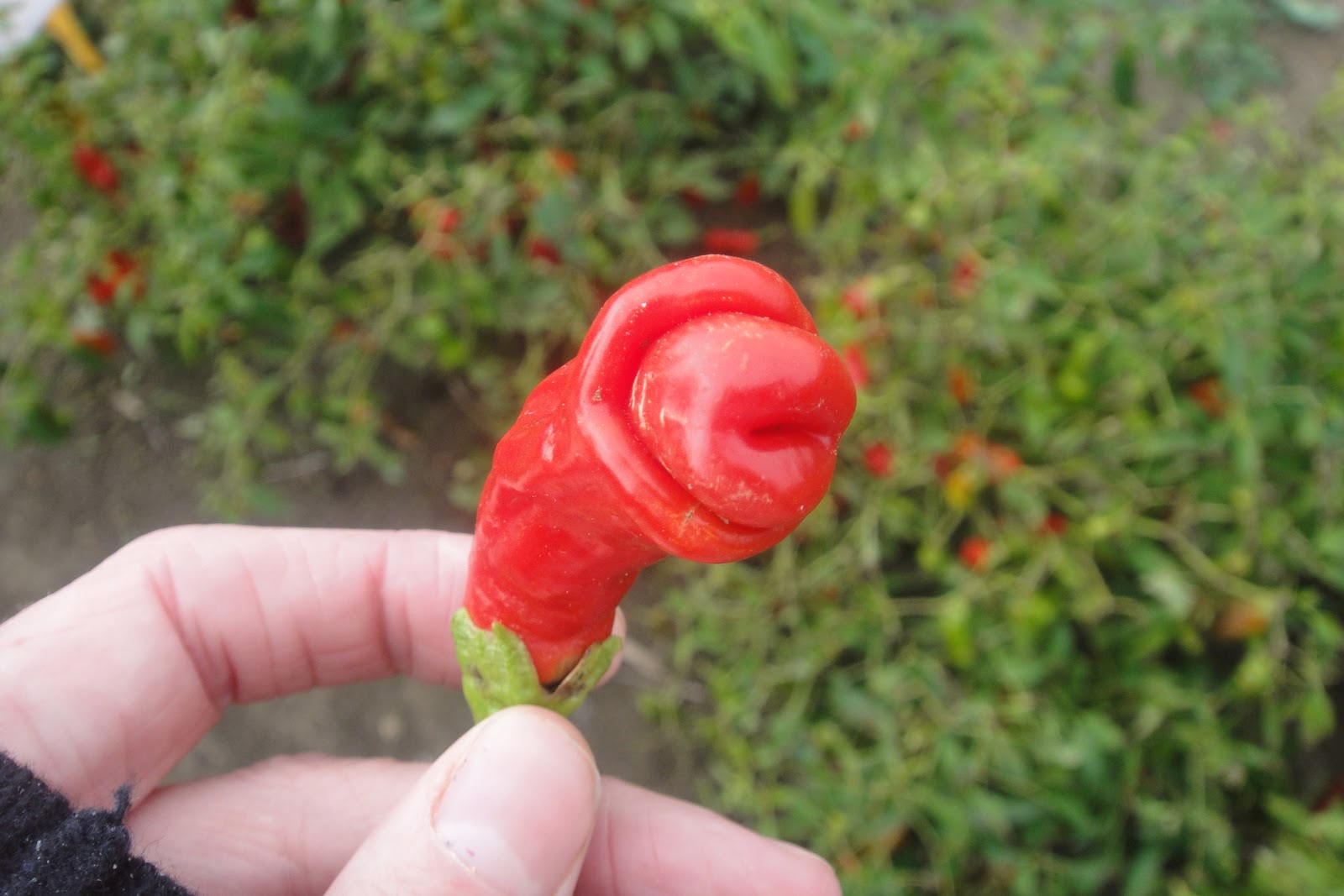
Rows and rows of peppers grow in alphabetical order, with appropriately heated names like Apologize, Ciao, Bodyguard, and Sahara. Red, orange, yellow, purple, green, chocolate-brown, black splattered across the rows of plants like a Jackson Pollock painting. Long, round, fat, wrinkled, split, squat, berry-like, phallic, olive-shaped, and bulbs of strung Christmas tree lights are only a few adjectives to describe the shapes. I especially liked the topepo - a pepper that looks like a tomato - hence tomato + peperoncino. The diversity was overwhelming and fascinating. Some pointed vertically like reprimanding witches fingers. Some sprouted spiky red tubes with a sparse amount of leaves. Some had nearly-black dark purple leaves with green undertones that looked identical to basilico rosso. Some dangled sadly, rotting from the season's cold and dropping easily to the ground. Some were like an open box of Crayola - red, orange, yellow, green and purple begging to be picked. Some looked like marbles or Christmas ornaments, bunched together.

Twinkled like a starry night.
Peter Pepper. mmhmm.
basilico rosso?
grapes? berries? ornaments? peppers?
We followed Mario through the field, stepping over the low rows of plants and burying our feet into the mud saturated by the weekend's rain. Our tongue's burned as we tasted different peppers and we tried desperately to remember not to touch our eyes with our spice-stained finger tips. Despite the balmy autumn weather, Arina's nose is still glowing like rudolph since she touched it yesterday morning. 

taste the habanero's burn.

Mario started growing peppers 15 years ago as a hobby and could tell a story, and/or history, behind every pepper. SiQuiero was grown to mark his wedding with his Spanish wife. Habanero Chocolate is not named brown because that sounds less appetizing. One pepper from Bolivia only grows in the early spring, typical to the weather of the Bolivian Andes. Many people think that it is the seeds that give out the spice in the bite, but it is in fact the membrane - but the seeds are attached to the membrane so the association, although wrong, makes sense. Birds cannot detect the heat from peppers and in this way as they prefer to nibble on the little peppers, the ''shit'' of the birds, as Mario so awkwardly explained, will spread the seeds and create new pepper plants. And of course, the smaller the pepper, the spicier in general.


Mario and his pepper catalogue-bible.
It awe-astounding to see such a field of peppers - really just beautiful against the dreary Saturday morning fog. It is also a pity that it costs about 2,000 euro to register a new variety, so that the majority of his peppers are not protected. He is trying to promote his e-commerce business online and needs help with translating the Italian catalogue into English so that more people internationally can buy the seeds. Arina and I offered to help translate in our spare time, for our own interest in peppers and all that is spicy - tutti piccante - and in exchange, he gave us two plastic bags to fill with our hearts desire from his pepper collection. It reminded me of going apple-picking in the fall, but instead of baking pies, we'll be making hot hot hot sauce. 
and this what's left, even after we gave
handfuls away at Caro's brunch.

Thursday, November 4, 2010

Colorno nearly Flooded...again.

 This is what Colorno is meant to look like:
 This is what Colorno looks like after a weekend full of rain:
and when I say, again, I mean it's not the first time...
 Crossing over the bridge, I thought the stones would surely disintegrate below me and I would be washed away into the murky current of the Parma River. As the rain adamantly continued for the rest of the night, I thought the river would completely overflow and we would have no way of getting to class in the morning. 
Class actually was canceled the next morning, but because the professor called out sick at the last minute, not because of the flooding river. 
The bridge is still standing strong and the walls of the Reggia, although missing a little more paint, have not succumbed to the submerging pressure of the temperamental river. 

calma! 
let's hope it stays this way for the rest of the winter.

Tuesday, November 2, 2010

The End of Terra Madre & Salone del Gusto.

After we wrote up our Earth Workshop reports for Slow Food and finished the last of the Dutch oysters, we witnessed the breakdown of the incredible production space. I cannot even fathom how much time and effort went in to putting all the organization and logistics together.  The huge gates were up as men carried loads of boxes, refrigerators and crates onto trucks docked in the parking lot puddled with rain. Stragglers were being shooed from the Enoteca, sipping the last of the available wines. Desperate pillagers were scouring the empty stalls for any leftovers to snag.

Overwhelmed with tiredness from the 5 days in Turino, we sat in a delirious daze. Looking around the international pavilion, we laughed at the remnants of the different areas of the world:
The Germans remained in their aisle, folding banners neatly, breaking down the stalls,
organizing boxes, rolling out crates of leftover beers.  
South America cleared out with some left over Slow Food Presidia pamphlets lying about
Africa was a mess.
and the Dutch were still partying: cracking open oysters, sipping white wine, making friends with people as they walked by. hooligans. 


Throughout the event, there were designated trash areas with different bins for different materials. Glass, Plastic, Paper, Organic. I would have assumed, and hoped, that everyone who was attending this Slow Food event truly believed in respecting the environment and would recycle properly, especially when they are easily given the choice to distribute their trash. I didn't look in the trash bins, but I did see one lid-open bin by the coffee counter that was filled with plastic water cups, paper espresso cups and labeled organic material. hmm. The Salone del Gusto website calls it an eco-friendly event as they boast the ways they planned setting up stalls, transportation of goods, water and energy use, and waste management with reduced environmental impact. Makes complete common sense - in general and for Slow Food's founding philosophy. However, at the very end of it all, there was this bin. 

INDIFFERENZIATO. 

ha. I don't know if it's one big ironic metaphor. but, hey, at least they tried.

I can't wait to go back in 2 years. Incredible. 

Monday, November 1, 2010

My 15 Minutes of Fame.

or shame. I'm not sure. I blacked out. I couldn't tell you what I said. 

When we were organizing the Terra Madre/Salone del Gusto weekend, we were asked to sign up for our preferences on which meeting we wanted to attend to write a report about. We were also offered the opportunity to pick three different Taste Workshops or Meetings with the Makers in which we were asked to help out. For each of the three, if any, we had to write a little excerpt on why we wanted to participate and what we could contribute to it. I requested Hot! Hot! Hot! (I love spicy food), The Master of Barbaresco: Alberto di Gresy (I love Barbaresco), Luciano Pedettris 257,235 Cheeses (I love cheese).  Apparently I had done complimentarily well on our cheese exam and may or may not have been an influential factor in being chosen by our cheese professor, Cristiano de Riccardis for the Luciano cheese-maker one.  I was thrilled, but I was informed that the meeting was on Sunday at 7pm and the bus was leaving to go back to Colorno at 6:30. An opportunity not to be missed, I decided to stay. A couple days later, I received a hieroglyphic email from de Riccardis, but from what I could decode from the Italglish was that I had to speak in front of the attending audience for 15 minutes. 15 minutes?! me talk in front of people?! about parmigiano reggiano?! holy crap. not only did I have to pay for an extra night in Torino and find my own way home, I had to present in front of people? I thought I would be helping pass out cheese samples and pour some wine. Elbow scratching and hair pulling ensued as I made my way to the library to do some cheesey research. 

Eventually, Sunday arrived. 7pm arrived. I sat up on the little platform stage next to our professor, the cheese-maker and his wife, and a head guy from the Parmigiano Reggiano Consorzio. The crowd trickled in, maybe about 20 or 30 people, mostly middle-aged. As I read over my scribbled notes from the paper I had written in preparation, I laughed at the absurdity of it all.  de Riccardis introduced the cheese maker, who has been making cheese every day for 47 years, except for 6 days when he was sick, and Sunday, his 7th day to attend this meeting. He was so nervous and he's hilarious in his quirkiness, however, it wasn't quite so communicated through the translator.  He also appointed Naama as official photographer and would beckon her over to pose for pictures. Luciano talked about dedication to, pride in, and love of cheese making, then his wife chatted away about how such dedication to cheese making has had its hardships on personal and family life, and then the guy from the Consorzio took over and unfortunately described the tasting session, which is de Riccardis forte - he's the king of cheese and describing what he tastes and smells. Then it was my turn. I remember apologizing for being so nervous and then describing how my opinion of Parmigiano Reggiano has changed since living in Italy. But I don't have a clue what I said. I thought that I was going to go first and was ready to chat away, but going last and watching the audience throughout the hour, I felt as though I had to gage what they wanted to hear from me - regardless of what I had prepared. So, I think I tried to wrap it all together, to make sense of why we were listening to someone talk about his long dedication to cheese making and why I was even invited as a speaker.  de Riccardis was nervous throughout though because many head-of-the-department important people from the Consorzio were there and they wanted the cheese to be portrayed in a certain way so we had to be careful about what we said. I don't know if I said the wrong or right thing - I don't even know what that means in Consorzio terms - but Luciano beamed at me afterwards and invited me to visit his farm. 

being introduced.
Cristiano de Riccardis: Cheese Expert.
Posing.
Luciano Pedrettis: Cheese Maker.
such admirable dedication.
Parmigiano Reggiano and
wines from Camillo Donati in Arola, also near Parma.
hoping the audience is looking at the slide show behind me.
and hoping the translator is reading my paper instead of
translating what i'm blabbering about.

trying to remember to say parmigiano reggiano instead
of parmesan b/c the consorzio wouldn't approve.


Ireland Represents!

Of course I stumbled across the Ireland section of Salone del Gusto on the first day. They had two stalls: one represented by Bord Bia, the Irish Food Board, selling smoked salmon on Irish brown bread, a cheese plate, juicy roast beef and O'Hara's craft beers on tap while the other one was showcasing Ireland's only Slow Food Presidia: Irish Raw Milk Cheeses. Unlike most presidias that are focused on one product, this one covers the entire island and the qualified producers are dedicated to making high-quality artisinal  raw milk cheese coming from their own herds. I instantly made friends with one of the cheese makers, Peter Thomas and his hilariously-flirty friend Sean O'Connor, a chef from Ennis, and went back to visit every day. 

"I've never been to Abruzzo, let's go there," "I want to eat something spicy, let's go to Calabria" or "Let's meet in Ireland at 5" were common phrases during the weekend. Luckily, Ireland was in an easy spot to meet up and a perfect stop for some pints and Irish cheese. After the summer, having talked about Irish cheeses so much, I finally had to opportunity to give my friends a taste. And they loved it! 


The cheeses that are part of the presidium include: Breda Maher's Cooleeney Cheese, Fermoy Natural Cheeses by the Shinnicks which includes the award winning St Gall, Silk Cropp's Corleggy Cheese, Maja Binder's Dingle Penninsula Cheese (one made with seaweed), Durrus Cheese by Jeffa Gill, Peter Thomas' Glydefarm cheese, Lucy Hayes' cheese from Mount Callan Farmhouse, the Tiernan's Glebe Brethan Cheese and a favourite, St Tola organic goat cheese. 
Peter Thomas, the maker of Bellingham Blue, gave Catherine and I each a huge chunk of his two and a half year old blue cheese. Apparently blue cheese that has been aged that long is unheard of in Italy so when he was at the last Salone del Gusto, he told Slow Food that in two years he would bring a two year old blue cheese - and here it was! He told us many stories of people who have sought after the creamy cheese
The Gardeners
The Irish band that played one day - I was so glad we stopped by at the right time to hear - caused a traffic jam in the corner of the pavilion, but it was definitely worth it to get bumped into. They were fantastic. Everyone in the Ireland corner was always so friendly and jolly, most likely drunk; it made me so happy.

I also attended the Ireland regional meeting at Terra Madre. The description was Regional Meeting: Ireland/India and I had no idea how the speakers were going to connect the two or what they had in common.  The only thing I could think of was my friendship with Sindhu, but I hardly think that's what Slow Food had in mind. As I walked in though, the room was divided into the two countries: India at the back by the stage and Ireland sitting in a circle by the door. Looking around, I couldn't help but smile at how Irish they looked. duh. The regional meetings, as I said earlier, were where the conviviums from certain countries could get together to discuss what projects they've been working on, a place to share experiences, swap ideas, network connections, and express an overall feeling of empowered togetherness. For Ireland, the Emerald Isle, they talked about the issues surrounding being a full-force, all-encompassing-of-the-meaning green nation. It is an agricultural/farming island, but the huge multi-national corporations are a huge problem that encourage obesity. The speakers believe that it's not just about telling the youth to eat their veggies, but to get them involved.
Slow Food NE Ireland introduced Lagan College's Radical Dream Canteen. They were also happy that the people from Belfast visited the Ireland regional meeting and not UK.
Valerie O'Connor, a food writer and photograher talking about the importance of the elderly - how they have the knowledge we need to pass on to the youth. In front of her Ciaran Cuffe, Minister of Horticulture and Trevor Sargent of the Green Party.
Darina Allen of Ballymaloe and East Cork convivium of Slow Food Ireland President took notes and help lead the meeting. In the green, Evan Doyle, talked about GYI (Grow It Yourself Ireland) and Marian Byrne

I liked how they talked about Ireland's strong food traditions, that they can feel it in their blood whether they know it or not - they know that carrots are kept in the sand to preserve them in the winter, they know that a cross is cut on the top of brown bread before it's baked - why? they just know. 

Despite popular belief, Ireland has really good regional and local foods - they know it, I know it, maybe the rest of the world doesn't know it, but they need to rediscover it to teach the future generations.

I loved the story Darina Allen told about a meeting she had in Parliament and during the lunch they offered cheeses, but to her horror, none of them were Irish. What a lost opportunity to promote Irish food. Around the circle, everyone shook their head in disbelief, ashamed and deeply agreeing to each other under their breath, "disgraceful." These people know, and believe, how good their cheese is. 

Jules came with me to the meeting. Even though it was a regional meeting that I felt attached to, I said to him, "you don't have to stay," but he did until he had to leave for a tasting work shop. He said it was interesting to hear because even though he knows nothing about Ireland, their problems are universal. We could have been in any regional meeting, the problems would be similar. 

I went up to Darina Allen afterwards to shake her hand and told her what a pleasure it was to listen to her speak. How could I not? I want to get a pair of neon green Converses like hers. It was a great opportunity, whether in this regional meeting or another, for everyone to come together, to connect, share, interact and leave feeling 100% about paving the way of the future. 

Sunday, October 31, 2010

Terra Madre

Terra Madre ran parallel to the Salone del Gusto. Terra Madre is a place where people from all over the world who are concerned with the future in terms of sustainable food production that works within the respect of the environment and for the people. These farmers and producers are united with the consumers and food activists who revolutionize the way the world grows, makes, sells and eats. There were workshops throughout the weekend, rooms to learn about Slow Food Presidia and Projects as well as space for people to sell and share their products. Mats were laid out in rows and all sorts of things were for sale - woven bags, oils, spices in plastic bags, educational posters, jewelry, t-shirt's, patterned clothes, shoes, scarves, a man from Japan weaving flip flops from straw next to a Kenya man not wearing any shoes selling leather bags. There were fruits too that I have no idea how they got through customs. It was really nice to see these products, handmade or not, from all over the world, from places many people will never have a chance to visit, but some of them were selling things as though it were a flea market (random pairs of high heels that could have come from any second hand store) and trying to bargain with the on-looker, offering prices while other products seemed extremely overpriced. Correct me if I'm wrong, but I thought the unification of people here was to share ideas and experiences, trade production methods and techniques, and to meet people to understand their different cultures and preserve native traditions, not to feel pressured into buying something. I don't know... 


The first day was dedicated to critical issues concerning the planet and it's biodiversity. I attended one called Identity and Globalization of Biodiversity. It's focus was looking at how identities are connected with traditions and cultures and understanding what systems are in place for the local/regional to identify with the global community. The most interesting speech was from Logan Smith and Carissa Carmen - two Americans who have been working on Mary Mattingly's Waterpod Project. I'm not exactly sure how it fit into the subject of the workshop, but I found the analogy of their project to relate perfectly to the future of the world. The project is described as a four room village on a barge that floats around the 5 boroughs of NYC. It is not only a sustainable living space or a cultural museum, but it is an artistic vision where science and art merge to engage people towards a vision of the future. Volunteers came together to help because they believed in the same future. Logan and Carissa said that they weren't exactly sure what background experience they could offer, but it was more than just what they knew, it was about collaboration, requiring expertise and partnership to build an autonomous network. Everyone offered what they could, bringing in all sorts of disciplines, backgrounds, and experiences. It was about being an exchange of diversity that could appeal to all, using food as a common language, and to keep it public so that other people can learn and in turn, make their own projects better.  If everyone contributes what they can and can work together, the goal can be accomplished. Think big, think impossible, and make it work. It seemed to be an overall idealistic theme/metaphor for the overall weekend of Terra Madre.

African fruit for sale?
Then there were regional meetings where conviviums from certain countries or areas could get together to discuss what they've been doing for Slow Food, explain problems, share experiences, swap ideas, possible networking, and an overall feeling of togetherness. I attended one on Ireland (next post). There  were also Earth Workshops focused on various sustainable agricultural themes. We each were assigned to attend one and to write a report about for the website. Mine, about Slow Food Education Principles. I also attended one called Honey & the Bees, Less Meat, Better Meat, and tried unsuccessfully to find one called Native Wools (no link, no report. cough cough). 
Slow Food Presidiums around the world.