Wednesday, August 3, 2011

What's in Season: Cucumbers

Buying: Cucumbers are about 95% water which is why cucumbers are often found coated in wax or wrapped tightly in plastic - a more expensive protection - but ways to prolong the loss of moisture. The wax is edible, but rather unpleasant so these cucumbers should be peeled. There are a ton of different varieties of cucumbers in all sorts of shapes and sizes, bumpiness and knobbiness, but they pretty much taste the same - the names are often referred to the way they look or the way they are used. Lemon cucumbers for example are round and yellow, the burpless tasty green is obviously burp-free, pickling cucumbers have a thin skin so since the salt is easily penetrated they are used for pickling, and slicing cucumbers just have a thicker skin - but with a knife it doesn't really make much of a difference! Pick cucumbers that are firm - not soft and water logged - and not wilted from excessive water loss.

Storing: Moisture loss begins as soon as the cucumbers are picked so they should be eaten within 4 days. Because they contain so much water, store them lying flat on an even surface so that the water weight is evenly distributed. Alternatively, a cut cucumber can be stop in a tall jug with a little water at the base. Cukes can be stored in a plastic bag in the fridge, but in the warmest part. If the fridge is too cold or they are kept in the fridge for too long they will no longer be as cool as a cucumber.

Medical: Cucumbers have been known to encourage burping. This, as well as the cucumbers bitterness comes from cucurbitacins. In the plant, it is found in the roots, stems and leaves and becomes more concentrated if it is stressed from heat or lack of water and in the cucumber the compounds are concentrated mostly under the skin, so peel cucumbers if you are susceptible to burping! Many of the cucumbers today are grown in greenhouses to avoid cross-pollination so they are seedless, uniform, and not bitter.

Cukes also contain compounds which avoid water retention which is why they are often applied to lower swelling and cure burns. The high water content also contributes to helping skin appear to have a healthy glow.

Fact: women used to wear cucumbers around their waist if they were hoping to become pregnant.

Cooking: Peeling a cucumber is a personal preference - whether they don't mind the greasy wax coating or if they think there is more flavor in the skin or just like adding a bit of color to the dish. To easily remove the seeds, slice lengthwise and run a teaspoon down the middle.

Recipe:

crunchy crisp cucumber salad with chili chicken ramen with burst-pop-bang tomato salad

pickles!

creamychunky cucumber avocado soupdip

I'm not very good at following recipes - adjusting the measurements to my liking and depending on what I have in the kitchen to use - but the following three recipes were inspired by Ottolenghi's Plenty cookbook - which, although the pictures in the cookbook are seriously mouth-watering and mine definitely are not - I find the dishes turn out better by  using them as inspirational guidance.

Cuke Salad w/ smashed garlic & ginger


3 tbsp rice wine vinegar
1 tsp sugar
2 tbsp extra virgin olive oil
2 tsp toasted sesame oil

1 small red onion, sliced thinly
2 knobs of ginger, peeled and cut
sea salt
3 large garlic cloves, smashed
3 med cucumbers, peeled cut in half and then on an angle into 1/4 slices
sesame seeds
bunch of cilantro tops, chopped

whisk the first four ingredients in a bowl to make the dressing. add the sliced red onion and toss to coat then let sit for an hour to soak and marinate.
add the ginger, salt, and garlic in a mortar and pound with the pestle until it is crushed but not pastey. scrape the mix in with the marinating red onion and toss together. add the cukes (I didn't peel mine but they seemed a bit tougher with the skin on), sprinkle with the sesame seeds and cilantro leaves. stir well and let sit for about 10 minutes. if serving out of that bowl, tip the bowl to get rid of some of the juices, otherwise lift the salad out of the bowl into another one leaving the juices behind.


Green Gazpacho

2 celery stalks
1 green pepper
2 cucumbers
1/2 green chili
4 garlic cloves
1 avocado
sprinkle of sugar
2 handfuls spinach/kale
3 tbsp sherry vinegar
1 cup extra virgin olive oil
3 cups water
2 handfuls ice cubes
salt and pepper

add the roughly chopped celery, pepper, cucumber, chile and garlic into a blender. then add the sugar, spinach/kale, vinegar, oil and water with half the ice cubes and some salt. puree until the preferred consistency and add some more water if needed. taste the soup for seasoning. add some more ice and puree. place in fridge and serve cold.

green goop.

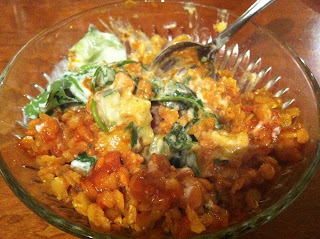
spiced red lentils with cucumber yogurt

1 cup red lentils
1 1/2 cup water
1 bunch cilantro
1 small red onion
2 1/2 inch ginger
4 cloves garlic
1 green chile
2 tbsp mustard seeds
4 tbsp extra virgin olive oil 
2 tsp ground coriander
1 tsp cumin
1/2 tsp tumeric
1/2 paprika
2 bay leaves
1 tin diced tomatoes 
sprinkle of sugar
salt
3/4 cups greek yogurt
2 tbsp extra virgin olive oil
1/2 lime

wash the lentils until cold water and then soak in 1 1/2 cups water for 30 minutes. 
cut the cilantro leaves away from the stems. add the stems to a food processor and keep the leaves separate. add the stalks with the onion, ginger, garlic, and chile. pulse but do not pulverize to a paste. 
put the mustard seeds into a large pot at med-high heat and when they begin to pop, add the chopped mix and the olive oil. simmer for 10 minutes, stirring, and then added the coriander, cumin, turmeric and paprika and bay leaves for another 10 minutes, stirring. 
then, add the lentils and the tomatoes and sugar. simmer for 30 minutes until the lentils are cooked.  
in a different bowl, combine the yogurt, cucumber, olive oil and salt. to serve, dish the lentils into a bowl and top with the cucumber yogurt. top off with some chopped cilantro and a squeeze of lime juice. 


Tuesday, August 2, 2011

What's in Season: Beans


Types: String beans, Common Beans, Pole Beans, Snap Beans, French Beans, Green Beans, Wax Beans, Haricot Verts....!Not all green beans are green. I often hear, "Look at the purple green beans!" (they can't be purple green beans, can they?) Yellow beans lack chlorophyll and keep their ray-of-sunshine colour during cooking. The purple variety, known as Royalty, will actually turn green! I love eating them raw as they are bring green on the inside when you bite into it.

 Buying: Green beans are usually picked immature. You can tell if a bean is past it's prime because the seeds inside will grow to a bulge and the should-be edible pods will become to tough to snap or chew. Make sure that the beans are snappy as a sign of freshness. If bought at a farmers market, you generally will be able to pick through the selection for the highest quality. They should be smooth, firm and without bruises.
 Storing: Try to cook and eat the beans as soon as possible as they will lose moisture after being picked and will quickly show signs of wilting. Keep for about 4 days or in the fridge for a week max. They freeze well, so wash and trim, blanch for 3 minutes, dry and freeze in a labeled plastic bag up to 12 months (unblanched frozen peas will have that rubbery, squeaky mouthfeel to them when thawed. yuck, dad hates that.)

Cooking: When cooked, green beans will turn a deep green as the cell walls break slowly down but they will eventually turn an olive hue when acid (such as vinegar) is added while cooking. The best way to avoid the lovely beans turning to a dreary colour that even a veggie lover would turn its nose up to, is cook with a lot of water (so that the chemicals changing the colours are diluted); after adding the beans to the boiling water bring back to a boil as quickly as possible so that the cooking time isn't prolonged; and to dunk the beans into a bowl of icy water to stop the cooking actions. Make sure to cut off the stems - the tips can be cut off or left on. Wash the beans when ready to be used. 

They can be cooked al dente in salted, boiling water for about 6 minutes - don't cook them until they droop. Don't add the dressing until ready to be served as the acid, as said before, will change the colour.

Fact: fresh seeds are called "flageolets" and dried ones are called "haricots." String beans are actually part of the shell bean family (kidney beans, black beans - any seeds you eat out of the pod) but because these beans are eaten immature, the pods are still edible. 

coffee "beans" are actually the twin stones of a fruit, not a legume and vanila "beans "are the fruit of an orchard not a legume. 

Medical: rich in protein, fiber, iron, and vit c and a. some potassium and folic acid aaand omega-3's! They are rich in beta carotine which is associated with carrots mostly but because of the dense amount of chlorophyll we don't see it. Apparently you can lower your cholesterol levels by 12% from eating a cup of beans a day! Avoid green beans if you have digestion problems such as gallbladder or kidney stones.

Recipe:

escargot with bean salad recipe courtesy of, and now being served at, cava coming soon.....xo

Monday, August 1, 2011

What's in Season: Beets

I suppose I should write about beets since I posted about beet cake (still on my to make list).

Buying: the red varieties are the most common, but look out for golden beets and other varieties. look for beets that are unblemished with fresh looking greens. make sure that they are hard; if they are still hard and the leaves are a bit discolored, they should still be ok.

Storing: Beets can stay in the refrigerator for about 2 weeks. Remove the leaves and place the beets in a plastic bag and the beets within a damp paper towel. Whole beets should not be frozen if they are more than 2 inches across. scrub, boil, skin, cool and then cut into desired slice and freeze in a labeled plastic bag or container for up to 6 months.


Medical: a glass of beet juice every day is good for controlling cancer. beets are great to relieve constipation which is why they are an excellent addition for a cleansing detox. the deep color comes from betacyanin which is not only rich in antioxidants but also calcium, iron, vitamin c and b. this deep color will most likely cause your urine/stools to change color, but this is a positive sign of a healthy digestive system. Beets are high in sugar, so avoid if you have diabetes.

Fact: beets grown near dill or fennel will attract predators to the plant. The leaves have 25% magnesium which is great for compost piles.
Descending from the same sea beet, there is also Mangelwurzel which is used for animal fodder and sugar beets are used to produce sugar.

Cooking: beets are edible both raw and cooked. raw, with all their nutrients still plentiful and un-lost, they are great as a crudite on a veg platter or shredded into a salad. I love the color that they add to dishes, whether it is a deep purpley red, yellow like Burpee's Golden, or orangey with pink woven rings like Chioggia. They can be boiled whole (don't top and tail until after it's cooked). Scrub clean and then boil in salted water for about 2 hours, depending on the size, until a knife smoothly cuts through - but don't test it too many times as the damage will cause bleeding. Beets can also be roasted in tin foil with olive oil for about an hour at 425F. After the beets have been cooked, cut the top and bottoms off and peel under running water. The leaves can be sauteed and cooked just like spinach or eaten raw after washing. beets can also be pickled!

Warning: beet juice stains!! wear cloves and an apron. cutting off the leaves will also cause bleeding sap.

Recipe:

Beet and Black Olive Salad

6 small beets of different varieties/colors
1 Treviso (red chicory)
1/2 small red onion, sliced
5 tbsp black olivles - the dry, wrinkly Greek kind
2 tbsp extra virgin olive oil
1 1/2 tbsp sherry vinegar

Place the beets in a pot of cold water and bring to the boil. Cook until tender and a knife easily goes through - about 1 1/2 hours. Turn off the heat and let the beets cool down. When cool, peel the beets, cut in half and then into wedges. Cut the Treviso into strips and add with the beets in a large bowl. Add the remaining ingredients and toss together. Season with salt and pepper. It's a little bitter and a little salty but playfully colorful with interesting textures.

Quinoa Salad with Roasted Beets, Crumbled Goat Cheese and Beet Greens.

1 bunch beets, scrubbed
Greens from the bunch of beets
2 cups cooked quinoa
2 tablespoons olive oil
2 garlic cloves sliced thinly
2 oz crumbled goat cheese


Preheat the oven to 425F. Place the beets, whole, greens removed, into a tin foil sheet and drizzle with olive oil. Cook until tender, about 30-40 minutes for small beets or about an hour for larger beets. Allow to cool then cut off any remaining stems and peel away the skin.
Heat the olive oil in a large pan and then add the garlic. Stir for about 30 seconds. Add the beet greens and saute so that the greens are coated in the oil and absorbing the fragrant garlic. Add the quinoa and beets and season with salt and pepper. Stir so that the quinoa is warmed, covered in the purple beet juice and everything is evenly distributed. Sprinkle over the crumbled goat cheese (feta cheese would also be a good salty choice) and slightly toss so that it melts a bit. Transfer to a large bowl and serve warm or at room temp. I think i may have even added some fresh dill that I had when I made this.

another idea....beet pasta sauce

i had some roasted beets in the fridge with their beet greens but i didn't have any tomato sauce to have with some frozen ravioli in the freezer. so as the pasta boiled, i added some chopped up onion to heated olive oil, then added the cut up cubed beets until they were heated and added the beet greens until they wilted. it was a delicious pasta sauce topped with some crumbled goat cheese! 

Monday, July 18, 2011

Beet Cake


beet cake from tiger in a jar on Vimeo.

not only do i love the idea of a beet cake, i love this video. the hands-on act of baking is so beautifully showcased here that it compliments the romantic idea of a gorgeously colored beet cake.

Although the recipe is basically in the video, which you should watch, here it is:


Beet Cake
By Matt and Julie Walker
1 cup butter or margarine, softened, cut up
1 1/2 cups packed dark brown sugar
3 eggs
4 squares semisweet chocolate or just 1 oz.
2 cups pureed cooked beets
1 tsp. vanilla extract
2 cups all-purpose flour
2 tsp. baking soda
1/4 tsp. salt
Confectioner's sugar for dusting
In a mixing bowl, cream 3/4 cup butter and brown sugar. Add eggs; mix well. Melt chocolate with remaining butter; stir until smooth. Cool slightly. Blend chocolate mixture, beets, and vanilla into the creamed mixture (mixture will appear separated). Sift together flour, baking soda, and salt; add to the creamed mixture and mix well. Pour into a 9-inch cake pan. Bake at 375 degrees for 40 minutes or until an inserted toothpick comes out clean. Cool in a pan before removing to a wire rack. Before serving, dust with confectioner's sugar.

Real Life Slavery, Pesticides and The Tomato That Would Not Die.

"When I asked Molloy if it was safe to assume that a consumer who has eaten a fresh tomato from a grocery store, fast food restaurant, or food-service company in the winter has eaten a fruit picked by the hand of a slave, he corrected my choice of words. "It's not an assumption. It is a fact."" 


This is an excert from Barry Estabrook's new book, Tomatoland: How Modern Industrial Agriculture Destroyed Our Most Alluring Fruit. He used to be a contributing editor for Gourmet Mag and is also the author of his blog, politicsoftheplate.com. Mum showed me this book review from the NyTimes a while ago and have added it onto my list of books to read. I just came across this excerpt of the book where I copied the above quote from and it made me more excited to read the book - excited in that I am fascinated by it, not by what it's going to actually reveal about the world. Tomatoes are one of those fruits that we find everywhere - so commonplace that it seems like an incomplete salad or sandwich without it, let alone think about the condiment world of ketchup and salsas. I think I will be definitely more aware of where the tomatoes come from and who's picking them for me, if I really need it in the middle of winter, and if it's really necessary to add to a dish if there isn't actually any flavor but just an additional red slice of color.


 scary scary. 

Tuesday, July 12, 2011

What's in Season: Kohlrabi

Kohlrabi is great. It has a funny name, it's fun to look at it and it's fun to eat. 
Kohl means cabbage and Rabi means turnip in German.
It's incredibly versatile and definitely doesn't get the attention it deserves. 
Buying: Kohlrabi varieties come in different shades of green and purple skins with white flesh. Generally, the green varieties are sown midspring to midsummer whereas the purples are available midsummer to midfall. Look for kohlrabi that is about the size of a tennis ball as larger bulbs will be woodier, tougher, and almost inedible. The skins should be firm and wrinkle-free. 

Storing: Kohlrabi is a great for storing. It should be stored in a cool, dark place for up to 2 weeks.  Signs of yellowing on the skin and leaves indicate the vegetable is not fresh. 

Medical: low in calories, high in fiber and potassium, has Vitamin A and C

Eating:  Kohlrabi can be eaten raw or cooked. It has a delicate woody, mild nutty flavor with a lot of crunch.  The taste is commonly described as a mix between that of a turnip, cabbage, and cauliflower. If the kohlrabi is young and small, the outer skin does not need to be peel, but definitely for larger bulbs - you will be able to tell the difference as the skin will be too tough to eat. Trim off the protruding stems and scrub clean. They can be boiled for about 20-30 minutes and then eaten whole, sliced, mashed....put them in some tin foil with some olive oil and seasoning and stick them on the grill. Although the flavor comes out more when cooked until tender, raw kohlrabi is great eaten just as a crunch snack - add it to a crudités platter or grate it onto salads or coleslaw for some shredded crunchiness. 


I like the tentacles. antennas. 

I made this dish using stuff that I had in my fridge, but I really enjoyed it. 

1 kohlrobi thinly sliced, then sliced lengthwise into matchsticks 1/4 inch wide, 2 inches long
1/2 red pepper, sliced into matchsticks similar to the kohlrobi slices
1/4 red onion, thinly sliced - not diced
1/4 green apple, sliced into similar matchsticks 
2 celery stalks, thinly sliced
a couple bunches of fresh dill chopped up
salt and pepper
lemon juice
1/4 cup extra virgin olive oil 
1 garlic clove, crushed
crumbled gorgonzola
a handful of pea shoots

Add all the ingredients except for the pea shoots in a large bowl and mix gently with your hands so that everything is evenly coated and the flavors join together. Let sit for about 10 minutes. Add some of the pea shoots and mix again. Taste the seasoning and add more salt to counteract the lemon if needed. When serving, lift out of the bowl into serving bowls to leave most of the juices in the mixing bowl. Garnish with the rest of the pea shoots. 


Monday, July 11, 2011

Roasted Strawberries.

Mum recently went on a short trip to Chicago and brought me back the Edible Chicago magazine. I love this magazine. The main reason was for a recipe for roasted strawberries - curiously sounds delicious! Thanks Mum!

8 ounces strawberries, hulled aka take the tops off
1 tablespoons maple syrup
1 tablesppoon extra-virgin olive oil
1/4 fine grain sea salt
1/2 tablespoon port wine
a few drops of good balsamic vinegar

preheat the oven to 350 F

use a rimmed baking sheet or large baking dish lined with parchment paper - you don't want the juices running off the sheet onto the oven floor.

cut each strawberry in half or into quarters if larger. add the berries to a mixing bowl. in a separate bowl, whisk together the maple syrup, olive oil, and salt and pour over the strawberries. Toss very gently to coat. arrange the strawberries in a single layer on your prepared baking sheet.

roast for about 40 minutes, just long enough for the berry juices to thicken, but not burn - watch the edges of the pan in particular.

while still warm, scrape the berries and juices from the pan into a small bowl. stir in the port and baslamic. use immeditaly or let cool. can be stored in the fridge for up to a week.


...Adapted by Heidi Swanson's Super Natural Every Day

ok just as I posted this, Mum came down with a bowl of roasted strawberries - way ahead of me!  I just changed the amounts of the syrups in the recipe to half as the original recipe tastes a bit too much of maple syrup and not so much of strawberries - still sweet, the strawberries shrunk and the seeds add a bit of crunch but interesting recipe nonetheless!!

The best part of the magazine was one article titled ChicaGrows....very appropriate for Mum being in Chicago - with her Irish accent she pronounces it like Chicargo. I wonder if she ate any gray-Ham crackers while there ;)

click here for the Edible White Mountains link aka NH

At the Newburyport Farmers Market on Sunday I recommended this recipe to the chef of Enzo in Tannery Marketplace who shops there every Sunday to make a Farmers Market Menu out of what she finds that day and she said this recipe would be better for California strawberries, or those that don't have as much flavour and need the balsamic and syrups and roasting to bring out the juices whereas fresh, peak of the season strawberries are best eaten as they are, in their naturally goodness state. There's only a little less than a week of strawberry season left, so....I agree.

What's in Season: Fava Beans

Follow up to previous post...

Fava beans are also called broad beans, but the fava part comes from the Latin name faba.
Buying:

Storing: Can be kept in a bag for up to a week. Fava beans also freeze well, if washed then blanched for 3 minutes, they can be stored for up to 12 months.

Cooking: They are a pain in the butt to shell - like de-vaining shrimp, the worst! - but they are worth it. They are delicate and tender with a slightly nutty flavour. Fava beans look a bit like shell peas but are much larger and the beans inside are flat, almost like lima beans. They need to be added to boiled water, then re-boiled for a few minutes. Once they have been drained and cooled - drop them in a bowl of ice water if you want - the outer waxy film around the beans needs to be discarded - they will be bitter and fibrous. It is labour-intensive, but grab some friends and hang out in the kitchen for a while!

Medical: Lots of fiber, iron, potassium, Vitamin E and C. Low in cholesterol and sodium.

Fact: beans have a superstitious, uncertain past. They were often associated with the dead with the thought that the souls of dead people are within the beans. This may have something to do with beans causing people to pass wind.....but the real problem is favism, which a very small amount of people are susceptible to in which eating beans causing a slight poisoning - anaemia or jaundice.

Friday, July 8, 2011

Avocado, Fava Bean, Quinoa Salad

I know I posted recently that I hadn't made this salad yet, but I did recently for an ex-pat 4th of July party (great idea) where I was asked to serve/help at. Fava beans aren't very common to find - they are also called broad beans - but I got them at Philbrick's FreshMarket, organic, and they looked as though they were pretty freshly picked. We had some bright orange nasturtiums from Charlie's farm (they are kitty-corner from Applecrest at the Porstmouth farmer's market on Saturday morning) - they are edible flowers that are sweet but have a bit of a tangy, spicy bite at the end - I don't know why some flowers are edible more than others, I think something to do with the pollen, but they are a beautiful addition to salads!

fava beans are much larger than shell peas - make sure to discard the skin from around the shells after peeling. cut the ends off the top and bottom and pull the thread down the middle for easing shelling.

cut the avocado in half. make slices lengthwise and then trace the knife around the skin and squeeze out - cut in half if need to. to take out the pit, hack it with the knife and it should come out easily or follow around with the knife and poke it out.

not the best looking picture - taken in the car on the way to the party - but it was pretty tasty. healthy, crunchy and colourful!


oh, and since I was working I didn't really get a chance to eat so...hopefully it tasted ok!! The hired help may or may not have been seen snacking off one of the guests plate aka mum's...

Thursday, July 7, 2011

What's in Season: Peas

Peas are a legume. A legume is a plant that holds its seeds within a pod.

Buying: Although frozen peas are very popular, when buying fresh peas, look for uniformly bright green pods, in general. All varieties should be firm and look as though they are ready to pop. Snow peas are flat and a little translucent so you can see the outline of the peas inside. Snap peas should be round and.....snappy! Since snow and snap peas are edible whole and raw - the pod is just as sweet as the pea - choose ones that you would want to eat - obviously - whereas English shell peas need to be taken out of the pods. Although snap peas and shell peas often look kinda similar, biting into one can identify the difference between the two - the pod of the shell pea is inedible and you will just keep chewing and chewing and left with some fibrous green strings in your mouth. The pods should not be flimsy, loose, wrinkled, or have turned white.

don't buy.

don't buy with this wrinkled, white look and flaccid feel. i hate the word flaccid. 

Storing: Peas are best kept in a tight container in the cold part of your fridge. Heat will convert the sugar into starch much quicker. They are obviously the best quality when first picked, and it's hard to resist snacking on snap peas - I love seeing kids snack on them like candy. Use them within 3 days. 

Medical: full of protein, carbs, fiber, iron and vitamin C. They are known to lower blood cholesterol and maintain blood sugar levels. 

Tip: a quart of whole shell peas will serve a generous portion for one person. 
Wasabi covered dried peas are delicious!
Peas used to be called "pease"....I wonder if there's any correlation with Pease International Airport!
Peas are technically a fruit because they hold the seeds, but are treated as vegetables when cooking.
My mum used to serve peas with mashed potatoes so they would stick on the fork rather than rolling all over the place!


shell peas

snap peas

snow peas

Recipe: Peas like cooler temperatures which is why they're associated with spring time flavours, but with all the rain the Seacoast has had, they are very bountiful now! Snap peas are crunchy and sweet, whereas snow peas have a subtler flavour. (I can't stop writing with an Irish accent). Although snap and snow peas can be eaten whole and raw, it is also possible to cook with them. Snap peas should be cooked rather quickly - no more than two minutes - and snow peas are delicious sauteed with other vegs in a stir fry ("can I wok with these" was a very awkward, confusing conversation, but yes, you can walk and snack on snow peas as well as cook them in a wok). Peas can be boiled or steamed. Try grilling shell peas and eating them out of the shell like edamame!

peas can be added to salads, curries, soups (pureed pea soup or veg), as a pesto, pureed as a crostini topping, delicious with mint and just raw!

Mushy Peas


Extra virgin olive oil
1 quart English shelled peas, shelled or 1 pound frozen peas
handful of fresh, chopped mint
lemon juice
salt and pepper

Eat the olive oil in a pan and add the shelled peas and mint. Simmer for about 10 minutes then transfer to a food processor or a hand-held blender (best thing ever!) squeeze lemon juice over the peas and season to taste. served great with fried fish and chips!

Peas and Sun-dried Tomato Dip on Endive Spears
- Inspired by Giada

1 lb peas
8 oz sun-dried tomatoes, drained
3 garlic cloves, chopped
1/4 cup extra virgin olive oil
salt and pepper
endive spears for serving

combine the top 3 ingredients in a food processor until finely chopped. add the extra virgin olive oil until mixed in well but not to a puree. mix with salt and pepper to taste then transfer to a bowl. serve along with the endive spears for dipping or for an easy, serve-able dish, place a scoop of the dip onto the endive spear and serve on a platter.

Wednesday, July 6, 2011

What's in Season: Strawberries

Strawberry in Latin is fraga, which refers to it's sweet sweet fragrance. Nothing says summer like the sweet sweet smell of freshly picked strawberries (shipped grocery store kinds don't count). 
buying: plump, firm, dry and blemish-free (take bad ones out to prevent the others from catching molds). the more fragrant, the better tasting they will be. it's always good to smell your produce and strawberries should smell fragrantly candy sweet. the fruit should be completely red - no white bits - and the green cap-hats should not look dried out. shake the box a little to make sure that the strawberries aren't stuck together, which would be a bad sign of mush or mold. remember, bigger isn't always better - it is very often that the small, darker strawberries are much sweeter and more flavorful. 

storing: it's probably not that hard to hold back, especially at the height of a short season, but it's best to eat your strawberries as soon as possible because they begin ripening as soon as they have been picked (local farmer's markets produce are usually picked that morning). don't wash the entire quart - only wash what you are going to eat. the moisture will easily spoil the berries - even if it's a rainy farmers market, keep them out to dry a bit before putting them in the fridge. also - don't take the little green cap-hats off until ready to wash and eat because they will help prevent moisture absorption. Lying them on a single layer is the best way to prevent bruising and on top of a paper towel will absorb excess moisture. strawberries also freeze very well, so laying them flat on a baking sheet to freeze then moving them to a freezer bag is a great way to have tasty strawberries all year round (although nothing tastes more like summer than a freshly picked juicy strawberry!)


strawberries and shortcake galore at the farmer's market.

tips: strawberries taste best at room temperature so leave them out for a bit before eating them. refrigeration kinda spoils the flavor, but they are so delicate that it really is best to eat them the same day.
if you're cooking with strawberries, the colour will turn from red to a deep purple however adding citrus like lemon or orange, or even baking with rhubarb, will preserve the red.

medical: apparently eating strawberries can help whiten teeth!

recipes: i overheard this recipe by a woman who stopped by the farmers market and bought a whole bunch of strawberries for her husband. I asked her what she was going to make with all them - jams? - but she said her husband just loved them and they are just so good at the peak of the summer season she wanted to take advantage. i suggested adding them to spinach salads and told her the night before i had a snack of crackers with goat cheese, sliced strawberry and cracked black pepper, which she loved the idea of. she said the Blue Strawberry, which is now the Black Trumpet, used to serve strawberries with sour cream and brown sugar. each in their own bowl, the strawberries get dunked into the sour cream and then into the brown sugar. everyone loves to dip, what a great combination! 

Like fruity sangria, add strawberries to summer cocktails 


Fact: apparently the seeds on the outside of strawberries are actually the ovaries.
I've also heard a lot of people who have eaten too many strawberries and have become allergic to them.

Sunday, July 3, 2011

What's in Season: Radishes

Easter Egg radishes (above) are a beautiful bundle of colour - they really do look like little Easter eggs. Red, purple, white, and pink on the outside, but white flesh on the inside. They are rather mild and add colour to any salads or veggie tray. 

d'Avignon radishes are long with sprays of bright pink and white with long leafy greens. They are a variety of French breakfast radishes which makes them one of the most mild radishes. 

Red Rover radishes (below) are the most typical red radishes with the spice you'd want from a radish. They are part of the mustard family and the degree of hotness comes from how old the radish is - a longer length of growing time and/or if they are deprived or overwhelmed with weather conditions will make them hotter. They should be bright red with a translucent white flesh. Red rover red rover, send these radishes over!


Storage: twist off the greens. keep unwashed radishes in a plastic bag in the refrigerator. only wash them as you use them as the radishes will absorb the water causing them to deteriorate quickly. 
use within a week, two max. 

Buying: Radishes should be firm.

Handling: When ready to eat, wash radishes and scrub off any of the earth's dirt in the crevices. The tops and roots should be cut off.

Medical: Radishes are low in calories and high in Vitamin C! They are known to relieve indigestion and flatulence. 

Tips: Radishes can be eaten unpeeled, but apparently most of the kick is within the skins, so if they are too spicy, peel them. 
When cutting off the greens, leave about an inch to use as a "handle" or easy to grab top. 
Leave them in a bowl of ice water for about an hour for some extra crispness.

Recipe: Radishes are great eaten raw or slightly grilled with some butter and salt - a great pairing for their peppery kick! (thanks, John Evenlyn)
The leaves can be cooked like spinach. 
Radishes can be eaten whole, raw, shredded or sliced. 
Substitute radish for mustard in sandwiches. 


Mustardy Potato Salad with Crunchy Radishes and Greens.

1 bag baby red potatoes, scrubbed
2 bunches radishes, thinly sliced
extra virgin vinegar
sherry vinegar
2 tablespoons whole grain mustard - or to taste
salt and pepper
2 celery stalks, thinly sliced
radish leaves, julienned

put the potatoes in a pot of cold water and bring to a boil. boil the potatoes until tender, about 20 minutes. drain the potatoes and let cool, then cut them in quarters. to make the dressing, add the extra virgin olive oil, sherry vinegar, mustard and salt and pepper to taste. add the potatoes and celery and coat to dress. Let the salad come to room temperature before adding the radishes and their greens. 


I haven't made this one yet, but I'm obsessed with my Plenty cookbook by London's Yotam Ottolenghi. It looks great! 

Avocado, quinoa, and fava bean salad

1 cup quinoa
3 cups shelled fava beans
2 lemons
2 ripe avocados
2 garlic cloves, crushed
2 bunches radishes, sliced lengthways
1 cup purple radish cress (or purple basil)
1 tablespoon ground cumin
1/3 cup extra virgin olive oil
1/4 teaspoon chili flakes
salt and pepper

place the quinoa in a saucepan with plenty of water and bring to the boil then simmer for 9 minutes. Drain through a fine sieve, rinse under cold water and then leave to dry. 

throw the fava beans into a pan of boiling water, bring back to the boil and then immediately drain in a colander. refresh with cold water and leave to dry. gently press each bean with fingers to remove the skins and discard. 

take the lemons and use a small sharp knife to slice off the top and base. stand each one on a chopping board and cut down the sides, following the natural curve to remove the skin and white pith. over a large mixing bowl, cut in between the membranes to release the individual segments into the bowl. squeeze the juice from the membrane into the bowl with the segments. 

peel and stone the avocados. slice thinly, then add to the bowl and toss to cover in the lemon juice. once the quinoa is dry, transfer it into the bowl. add the fava beans, crushed garlic, radishes, half the radish cress, teh cumin, extra virgin olive oil, chili flakes and some salt and pepper. toss very gently without breaking the avocado. season to taste. plate and garnish with the remaining paste. 


Saturday, July 2, 2011

What I miss #7: Italy Revisited in New York City.

 After my cheese interview, I was craving some and had heard about this Italian food store that was in the area. As Di Palo's came into my view from across the street, I was really excited and even more excited when I stepped in and it was like being back in Italy. The store was filled with a great selection of high quality extra virgin olive oils, real balsamic vinegar, pastas and grains, jarred vegetables and sauces, counters and displays of various cheeses and antipasta dishes, and of course, huge cured meats hanging from the wall. 

 The signs indicated where the meats and cheeses were from in Italy, but the culatello one did not. So, I waited in line until I was able to get assisted by the guy who looked like he was in charge. "Where is the culatello from?" He explained to me that it was their own culatello because they are not allowed to import it from Italy yet due to US regulations. He asked me how I knew it and I explained about UNISG and said that a group from UNISG was just in last week and they were shown how they make their own mozzarella. I was like, wait, I know the tutor who was with them - Sandro! He graduated with me. So he knew all about slow food and UNISG because his brother also graduated from there. He brought me behind the counter to show me the window where they were making the mozzarella - THEY WERE MAKING CHEESE! He kept cracking jokes that I didn't catch on to fast enough (showing two different mortadellas he called male and female. He points to one with pistachios and he goes "you know why this is the male one right?" < insert my confused face, trying desperately not to seem like I didn't know anything after spending a year in Italy > "because this one has nuts." < delayed laugh > It was so fun, I felt like I was on my own stage.
 I asked him how he picked what he carries in his store because it all looked like pretty high-quality producers and he said that his brother and his son go to Italy a couple times a year and selects what they want and also have a Italian-only wine store next door and they know most of the producers - what a cool job! Even though the store was pretty busy, he took the time to talk with me - incredibly knowledgeable about the products and extremely proud of his family and their store. After he showed me a picture of his grandparents and the video of old photographs from the store and of his family, I left with my goodies absolutely delighted with what a great place, just like being back in Italy. I didn't think I'd ever make it out of Little Italy. He even said "ciao" as I left. I can't wait to go back. 
 All sorts of pasta in Little Italy. 
ciao ciao bene!

Come and visit Di Palo's Fine Foods, in the heart of Little Italy, 200 Grand Street in New York City.

M-Sat 9:00 AM- 6:30 PM

Sun 9:00 AM- 4:00 PM

What's in Season.

the Univeristy of New Hampshire has an eco-gastronomy dual major that was started by Dan Winanas who attended the University of Gastronomic Sciences. UNH and UNISG have a close association and an exchange program so I thought UNH, being so close by would be a great place to look for jobs through their resources for their graduates.  I came across a recently posted position for a local farm looking for someone to manage their farmers markets across the Seacoast. I sent off my resume, got a call later in the day and had a successful interview the following day. The job was mine if I wanted it. I toiled with the idea, not sure if i wanted to be in Portsmouth or New York as my big-city sister was the one who had convinced me to stay in America for the summer and I could have accepted a job as a part-time cheesemonger for Saxleby Cheese - have i mentioned that I LOVE CHEESE. Ann Saxelby worked on a farm one summer and learned all about cheese - local artisanal American cheeses that proved to her there was more to American cheese than mass-produced uniform orange squares. So she sells and promotes high-quality farmhouse cheeses - exactly what I wanted to do in Ireland. That was another difficult decision, but ultimately, the farmers market job was a way for me to learn about locally grown seasonal foods, Portsmouth is awesome in the summer (no heat-death-trapped subways), I would be helping support a local farm and assisting in promoting the communities to eat local and seasonal food, and it was impermanent which meant that I had no commitments to stay in America after the fall.

watch out for what else you bring home from the market with your produce!

Applecrest Farm is apparently the largest apple orchard in New Hampshire and the oldest continuously operating orchard in America. It is also where John Irving worked and got his inspiration for the book, Cider House Rules (although the storyline is made up). It is a family run farm and a lot of people I have told that I work there all say that they grew up at Applecrest farm, going to pick strawberries in the summer and apples in the fall with their families. All the food we bring to each of the farmers markets - there are 7, 6 days a week - are picked that morning, as fresh as can be, dirt and bugs all included. The baked goods, including their famous cider donuts, are made fresh every morning. The smell in the morning of sweet cider and dusting sugar fills the loading area and the first couple donuts we serve are still warm. I have learned though, that eating two of their large, ridiculously addicting chocolate chip cookies will give me a serious sugar stomach ache. So far, I feel like I've learned a lot - how to identify different varieties, how to store them, how to handle the produce to make them last longer, the season's patterns, about integrated pest management, the business of organics, meeting other vendors from the area, and all about the politics of farmers markets. So, with that, I am going to write posts about what's in season and what I've learned about the various fruits and vegetables. Maybe I'll even throw in a recipe or two! 

Saturday, June 18, 2011

“Don’t be content to merely survive. You must demand to live in a better world, not just dream about it.” La Finestra di Fronte

Waking up to this view every morning, I don't know why I would want to be anywhere else. Until I came back to America and realized how much I missed my friends and family. 
But now, how can I resist this gorgeous view?