Showing posts with label terra madre. Show all posts

Tuesday, November 2, 2010

The End of Terra Madre & Salone del Gusto.

After we wrote up our Earth Workshop reports for Slow Food and finished the last of the Dutch oysters, we witnessed the breakdown of the incredible production space. I cannot even fathom how much time and effort went in to putting all the organization and logistics together.  The huge gates were up as men carried loads of boxes, refrigerators and crates onto trucks docked in the parking lot puddled with rain. Stragglers were being shooed from the Enoteca, sipping the last of the available wines. Desperate pillagers were scouring the empty stalls for any leftovers to snag.

Overwhelmed with tiredness from the 5 days in Turino, we sat in a delirious daze. Looking around the international pavilion, we laughed at the remnants of the different areas of the world:
The Germans remained in their aisle, folding banners neatly, breaking down the stalls,
organizing boxes, rolling out crates of leftover beers.  
South America cleared out with some left over Slow Food Presidia pamphlets lying about
Africa was a mess.
and the Dutch were still partying: cracking open oysters, sipping white wine, making friends with people as they walked by. hooligans. 


Throughout the event, there were designated trash areas with different bins for different materials. Glass, Plastic, Paper, Organic. I would have assumed, and hoped, that everyone who was attending this Slow Food event truly believed in respecting the environment and would recycle properly, especially when they are easily given the choice to distribute their trash. I didn't look in the trash bins, but I did see one lid-open bin by the coffee counter that was filled with plastic water cups, paper espresso cups and labeled organic material. hmm. The Salone del Gusto website calls it an eco-friendly event as they boast the ways they planned setting up stalls, transportation of goods, water and energy use, and waste management with reduced environmental impact. Makes complete common sense - in general and for Slow Food's founding philosophy. However, at the very end of it all, there was this bin. 

INDIFFERENZIATO. 

ha. I don't know if it's one big ironic metaphor. but, hey, at least they tried.

I can't wait to go back in 2 years. Incredible. 

Monday, November 1, 2010

My 15 Minutes of Fame.

or shame. I'm not sure. I blacked out. I couldn't tell you what I said. 

When we were organizing the Terra Madre/Salone del Gusto weekend, we were asked to sign up for our preferences on which meeting we wanted to attend to write a report about. We were also offered the opportunity to pick three different Taste Workshops or Meetings with the Makers in which we were asked to help out. For each of the three, if any, we had to write a little excerpt on why we wanted to participate and what we could contribute to it. I requested Hot! Hot! Hot! (I love spicy food), The Master of Barbaresco: Alberto di Gresy (I love Barbaresco), Luciano Pedettris 257,235 Cheeses (I love cheese).  Apparently I had done complimentarily well on our cheese exam and may or may not have been an influential factor in being chosen by our cheese professor, Cristiano de Riccardis for the Luciano cheese-maker one.  I was thrilled, but I was informed that the meeting was on Sunday at 7pm and the bus was leaving to go back to Colorno at 6:30. An opportunity not to be missed, I decided to stay. A couple days later, I received a hieroglyphic email from de Riccardis, but from what I could decode from the Italglish was that I had to speak in front of the attending audience for 15 minutes. 15 minutes?! me talk in front of people?! about parmigiano reggiano?! holy crap. not only did I have to pay for an extra night in Torino and find my own way home, I had to present in front of people? I thought I would be helping pass out cheese samples and pour some wine. Elbow scratching and hair pulling ensued as I made my way to the library to do some cheesey research. 

Eventually, Sunday arrived. 7pm arrived. I sat up on the little platform stage next to our professor, the cheese-maker and his wife, and a head guy from the Parmigiano Reggiano Consorzio. The crowd trickled in, maybe about 20 or 30 people, mostly middle-aged. As I read over my scribbled notes from the paper I had written in preparation, I laughed at the absurdity of it all.  de Riccardis introduced the cheese maker, who has been making cheese every day for 47 years, except for 6 days when he was sick, and Sunday, his 7th day to attend this meeting. He was so nervous and he's hilarious in his quirkiness, however, it wasn't quite so communicated through the translator.  He also appointed Naama as official photographer and would beckon her over to pose for pictures. Luciano talked about dedication to, pride in, and love of cheese making, then his wife chatted away about how such dedication to cheese making has had its hardships on personal and family life, and then the guy from the Consorzio took over and unfortunately described the tasting session, which is de Riccardis forte - he's the king of cheese and describing what he tastes and smells. Then it was my turn. I remember apologizing for being so nervous and then describing how my opinion of Parmigiano Reggiano has changed since living in Italy. But I don't have a clue what I said. I thought that I was going to go first and was ready to chat away, but going last and watching the audience throughout the hour, I felt as though I had to gage what they wanted to hear from me - regardless of what I had prepared. So, I think I tried to wrap it all together, to make sense of why we were listening to someone talk about his long dedication to cheese making and why I was even invited as a speaker.  de Riccardis was nervous throughout though because many head-of-the-department important people from the Consorzio were there and they wanted the cheese to be portrayed in a certain way so we had to be careful about what we said. I don't know if I said the wrong or right thing - I don't even know what that means in Consorzio terms - but Luciano beamed at me afterwards and invited me to visit his farm. 

being introduced.
Cristiano de Riccardis: Cheese Expert.
Posing.
Luciano Pedrettis: Cheese Maker.
such admirable dedication.
Parmigiano Reggiano and
wines from Camillo Donati in Arola, also near Parma.
hoping the audience is looking at the slide show behind me.
and hoping the translator is reading my paper instead of
translating what i'm blabbering about.

trying to remember to say parmigiano reggiano instead
of parmesan b/c the consorzio wouldn't approve.


Ireland Represents!

Of course I stumbled across the Ireland section of Salone del Gusto on the first day. They had two stalls: one represented by Bord Bia, the Irish Food Board, selling smoked salmon on Irish brown bread, a cheese plate, juicy roast beef and O'Hara's craft beers on tap while the other one was showcasing Ireland's only Slow Food Presidia: Irish Raw Milk Cheeses. Unlike most presidias that are focused on one product, this one covers the entire island and the qualified producers are dedicated to making high-quality artisinal  raw milk cheese coming from their own herds. I instantly made friends with one of the cheese makers, Peter Thomas and his hilariously-flirty friend Sean O'Connor, a chef from Ennis, and went back to visit every day. 

"I've never been to Abruzzo, let's go there," "I want to eat something spicy, let's go to Calabria" or "Let's meet in Ireland at 5" were common phrases during the weekend. Luckily, Ireland was in an easy spot to meet up and a perfect stop for some pints and Irish cheese. After the summer, having talked about Irish cheeses so much, I finally had to opportunity to give my friends a taste. And they loved it! 


The cheeses that are part of the presidium include: Breda Maher's Cooleeney Cheese, Fermoy Natural Cheeses by the Shinnicks which includes the award winning St Gall, Silk Cropp's Corleggy Cheese, Maja Binder's Dingle Penninsula Cheese (one made with seaweed), Durrus Cheese by Jeffa Gill, Peter Thomas' Glydefarm cheese, Lucy Hayes' cheese from Mount Callan Farmhouse, the Tiernan's Glebe Brethan Cheese and a favourite, St Tola organic goat cheese. 
Peter Thomas, the maker of Bellingham Blue, gave Catherine and I each a huge chunk of his two and a half year old blue cheese. Apparently blue cheese that has been aged that long is unheard of in Italy so when he was at the last Salone del Gusto, he told Slow Food that in two years he would bring a two year old blue cheese - and here it was! He told us many stories of people who have sought after the creamy cheese. 
The Gardeners
The Irish band that played one day - I was so glad we stopped by at the right time to hear - caused a traffic jam in the corner of the pavilion, but it was definitely worth it to get bumped into. They were fantastic. Everyone in the Ireland corner was always so friendly and jolly, most likely drunk; it made me so happy.

I also attended the Ireland regional meeting at Terra Madre. The description was Regional Meeting: Ireland/India and I had no idea how the speakers were going to connect the two or what they had in common.  The only thing I could think of was my friendship with Sindhu, but I hardly think that's what Slow Food had in mind. As I walked in though, the room was divided into the two countries: India at the back by the stage and Ireland sitting in a circle by the door. Looking around, I couldn't help but smile at how Irish they looked. duh. The regional meetings, as I said earlier, were where the conviviums from certain countries could get together to discuss what projects they've been working on, a place to share experiences, swap ideas, network connections, and express an overall feeling of empowered togetherness. For Ireland, the Emerald Isle, they talked about the issues surrounding being a full-force, all-encompassing-of-the-meaning green nation. It is an agricultural/farming island, but the huge multi-national corporations are a huge problem that encourage obesity. The speakers believe that it's not just about telling the youth to eat their veggies, but to get them involved.
Slow Food NE Ireland introduced Lagan College's Radical Dream Canteen. They were also happy that the people from Belfast visited the Ireland regional meeting and not UK.
Valerie O'Connor, a food writer and photograher talking about the importance of the elderly - how they have the knowledge we need to pass on to the youth. In front of her Ciaran Cuffe, Minister of Horticulture and Trevor Sargent of the Green Party.
Darina Allen of Ballymaloe and East Cork convivium of Slow Food Ireland President took notes and help lead the meeting. In the green, Evan Doyle, talked about GYI (Grow It Yourself Ireland) and Marian Byrne

I liked how they talked about Ireland's strong food traditions, that they can feel it in their blood whether they know it or not - they know that carrots are kept in the sand to preserve them in the winter, they know that a cross is cut on the top of brown bread before it's baked - why? they just know. 

Despite popular belief, Ireland has really good regional and local foods - they know it, I know it, maybe the rest of the world doesn't know it, but they need to rediscover it to teach the future generations.

I loved the story Darina Allen told about a meeting she had in Parliament and during the lunch they offered cheeses, but to her horror, none of them were Irish. What a lost opportunity to promote Irish food. Around the circle, everyone shook their head in disbelief, ashamed and deeply agreeing to each other under their breath, "disgraceful." These people know, and believe, how good their cheese is. 

Jules came with me to the meeting. Even though it was a regional meeting that I felt attached to, I said to him, "you don't have to stay," but he did until he had to leave for a tasting work shop. He said it was interesting to hear because even though he knows nothing about Ireland, their problems are universal. We could have been in any regional meeting, the problems would be similar. 

I went up to Darina Allen afterwards to shake her hand and told her what a pleasure it was to listen to her speak. How could I not? I want to get a pair of neon green Converses like hers. It was a great opportunity, whether in this regional meeting or another, for everyone to come together, to connect, share, interact and leave feeling 100% about paving the way of the future. 

Sunday, October 31, 2010

Terra Madre

Terra Madre ran parallel to the Salone del Gusto. Terra Madre is a place where people from all over the world who are concerned with the future in terms of sustainable food production that works within the respect of the environment and for the people. These farmers and producers are united with the consumers and food activists who revolutionize the way the world grows, makes, sells and eats. There were workshops throughout the weekend, rooms to learn about Slow Food Presidia and Projects as well as space for people to sell and share their products. Mats were laid out in rows and all sorts of things were for sale - woven bags, oils, spices in plastic bags, educational posters, jewelry, t-shirt's, patterned clothes, shoes, scarves, a man from Japan weaving flip flops from straw next to a Kenya man not wearing any shoes selling leather bags. There were fruits too that I have no idea how they got through customs. It was really nice to see these products, handmade or not, from all over the world, from places many people will never have a chance to visit, but some of them were selling things as though it were a flea market (random pairs of high heels that could have come from any second hand store) and trying to bargain with the on-looker, offering prices while other products seemed extremely overpriced. Correct me if I'm wrong, but I thought the unification of people here was to share ideas and experiences, trade production methods and techniques, and to meet people to understand their different cultures and preserve native traditions, not to feel pressured into buying something. I don't know... 


The first day was dedicated to critical issues concerning the planet and it's biodiversity. I attended one called Identity and Globalization of Biodiversity. It's focus was looking at how identities are connected with traditions and cultures and understanding what systems are in place for the local/regional to identify with the global community. The most interesting speech was from Logan Smith and Carissa Carmen - two Americans who have been working on Mary Mattingly's Waterpod Project. I'm not exactly sure how it fit into the subject of the workshop, but I found the analogy of their project to relate perfectly to the future of the world. The project is described as a four room village on a barge that floats around the 5 boroughs of NYC. It is not only a sustainable living space or a cultural museum, but it is an artistic vision where science and art merge to engage people towards a vision of the future. Volunteers came together to help because they believed in the same future. Logan and Carissa said that they weren't exactly sure what background experience they could offer, but it was more than just what they knew, it was about collaboration, requiring expertise and partnership to build an autonomous network. Everyone offered what they could, bringing in all sorts of disciplines, backgrounds, and experiences. It was about being an exchange of diversity that could appeal to all, using food as a common language, and to keep it public so that other people can learn and in turn, make their own projects better.  If everyone contributes what they can and can work together, the goal can be accomplished. Think big, think impossible, and make it work. It seemed to be an overall idealistic theme/metaphor for the overall weekend of Terra Madre.

African fruit for sale?
Then there were regional meetings where conviviums from certain countries or areas could get together to discuss what they've been doing for Slow Food, explain problems, share experiences, swap ideas, possible networking, and an overall feeling of togetherness. I attended one on Ireland (next post). There  were also Earth Workshops focused on various sustainable agricultural themes. We each were assigned to attend one and to write a report about for the website. Mine, about Slow Food Education Principles. I also attended one called Honey & the Bees, Less Meat, Better Meat, and tried unsuccessfully to find one called Native Wools (no link, no report. cough cough). 
Slow Food Presidiums around the world.

Saturday, October 30, 2010

Terra Madre & Salone del Gusto: Opening Ceremony


I don't know if I realized how lucky I was to attend UNISG this year until we arrived in Torino for Terra Madre and Salone del Gusto. Sure, next year the students may be able to go to Slow Cheese or Slow Fish, but Terra Madre and Salone del Gusto are by far the biggest and most important for Slow Food and it only happens every two years.

We left early Thursday morning to arrive in time for the Opening Ceremony. I felt a little overwhelmed for not having any idea what to expect from the weekend. Despite our lecture on Salone del Gusto, which really just explained the outline of the event's floor plan, fascinating, there was no way for me to be prepared. I think I am still trying to process the immenseness of the events experienced throughout the weekend.

"I don't need a pass, I'm a pecorino." - J
With passes hung around UNISG lanyards, we walked into the giant arena, Palasport Olimpico, which was originally built for the Olympics. We filled the seats as we watched people from all over the world, wearing their traditional outfits - often shoes and underpants excluded - walking around with suitcases having just arrived, chatting and introducing each other. A rainbow of coloured clothes and skins trickled in as there were kimonos with high heels, headdresses that could easily block the person sitting behind, Middle Eastern robes with Nikes, and we curiously eyed the UNISG students from Pollenzo identifiable by our new school-labeled t-shirts. Whether they were farmers, producers, musicians, educators, fishermen, chefs, students, or supportive guests, everyone was there for the same reason: as Sergio Chiampanino the Mayor of Turin said, to come together to exchange goods and ideas in order to reach a resepct that doesn't only enrich a few people. If we rearrange the hierarchy of values, not material values, we can change the world through how we relate to each other and use Terra Madre as an engine to promote these relations amongst each other. 
The fourth edition of Terra Madre kicked off with 300 school children, "Pequenas Huellas" from all over the world singing with the Orchestra Internazionale Per La Pace. They sang in various languages and played while representatives from Afria, the Americas, Asia, Europe, and Oceana walked in proudly waving colourful country flags.  From each of the five continents was a representative speaker addressing the audience in their native languages.
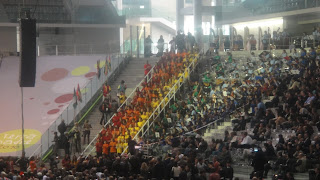
the choir and orchestra.
Malebo Mancha Maze, a Gamo from a mountain area in Ethiopia spoke to us, loud and clear. He animatedly shared an anecdote about 5 bulls and a hyaena: 5 bulls went to the low land where the grass was nice and tasty, spending the whole day grazing. They joined their rears together in a circle with their horns facing out ready to attack. The hyaena came and said to get rid of the white bull and they would be safe forever. So, the white bull was sacrificed. One by one the pack got lighter and it was easier for the hyaena to wipe out the bulls. The lesson is, if all of us, brought together from 150 countries, embrace each other and work together, we can survive.
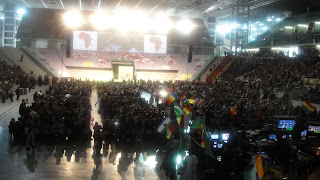
Africa represents.
Adolfo Timotio from Brazil didn't look up once during his speech. He heavily stressed the process of colonization that the Guarani went through from the Spanish, Portuguese, English and Dutch who brought borders, diseases, slavery and genocide. He implored us to recognize the indigenous people and to guarantee the application of the law to them as we all are the custodians of the world - we need to look after it and make sure that all differences are respected. He was so bitter, I wonder what it was like for him to be in Italy - the colonizer.
Americas. North, Central and South.
Albina Morilova, dressed in a traditional Kamchadal headdress, was from the extreme western part of Russia where for 7-8 months of the winter the temperatures are below 40C. Through describing her culture, she discussed the importance of conveying knowledge to new generations. Her indigenous  culture has had to adopt the Russian culture and their traditional language is in danger of extinction as teachers nor youth are interested in learning or preserving it. 

Asia.
Ol-Johan Sikku is a Sami, an indigenous group from the area of Northern Sweden, Norway, Finland and the Kola Penninsula of Russia. He too talked of the exploited land that divided his people but hoped for a rivival of language, culture and land through community development. As we have borrowed from Mother Nature, he said, we can no longer live in the same nature, but we have the knowledge to work together to advise the rest of the world on how to protect it. 
Europe. Yay Ireland.
Aunty Beryl Van Oploo from SW New South Wales in Australia also talked about her indigenous culture and about a college of aboriginal culture and cuisine. 
I swear the translator called this part of the world "Oceana"
 Carlo Petrini, the Slow Food International President, supported what each of these indigenous speakers had to say, agreeing that the defense of traditional knowledge gives us the tools to not only create good practices and respect nature, but we can start a dialogue to support those least considered by politics and media: natives, farmers, women, and the elderly. These humble, modest people need to show us the right way towards the future as they are the ones who preserve the earth and give the world common sense. Petrini also strongly addressed the youth in the audience who he believes have a great opportunity to match and combine modern science that we know with the traditional knowledge from our ancestors. To connect these is an extrodinary challenge, the best challenge ahead of us and the best struggle to fight for. Since we (I will consider myself part of the youth) are the subjects and creators of the transformation need, we need to grow and decrease at the same time - not only increase the development of material goods, efficiencies and profits, but to develop the love, friendship and understanding amongst people. His main three points to come away from were to enhance diversity, strengthen reciprocity, and to encourage dialogues and meetings.  For Petrini, and what he wanted us all to understand and feel, was that being here, getting together for the weekend, would prove to be more valuable than all the money in the world as we open each other up to new experiences, beliefs, and languages. It will force us to go home stronger, to not only defend and expand our networks, but to live intensely. 
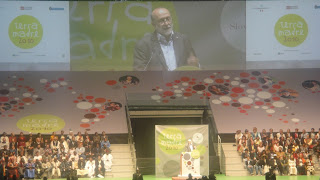
Carlo Petrini: the man behind it all.
It was empowering and encouraging and Petrini's energy could be felt throughout the entire arena. I left feeling like I had every capability to make a change in the world. I also left thinking that it wasn't anything new that I hadn't already read in his book, Terra Madre. Slow Food is a powerful movement but not without its problems and I understand that Petrini's speech was reinforcing the basic foundation and principles of the movement but a slight change in approach could strengthen it - if something isn't working, something can always be altered. I left unsure if I wanted to return again in two years, but the Opening Ceremony still had not prepared me for the weekend to come.

afterwards, the Greeks started dancing and Popi joined in.

(This was all from my notes and observations from the presetation, but more information and Carlo Petrini's translated speech can be found here.)

"Whenever I get gloomy with the state of the world, I think about the arrivals gate at Heathrow Airport. General opinion's starting to make out that we live in a world of hatred and greed, but I don't see that. It seems to me that love is everywhere. Often, it's not particularly dignified or newsworthy, but it's always there - fathers and sons, mothers and daughters, husbands and wives, boyfriends, girlfriends, old friends. When the planes hit the Twin Towers, as far as I know, none of the phone calls from the people on board were messages of hate or revenge - they were all messages of love. If you look for it, I've got a sneaking suspicion... love actually is all around." - Hugh Grant as Prime Minister in Love Actually.

Monday, July 26, 2010

"I would feel more optimistic about a bright future for man if he spent less time proving that he can outwit Nature and more time tasting her sweetness and respecting her seniority." Letters of E.B White, E.B White

a recent scroll through facebook led Arina to finding a local event in Amsterdam: the Youth Food Movement NL's fourth Eat-In event. According to their facebook page:

"The Youth Food Movement is a network of young farmers, cooks, artisans, activists and students with the shared goal of bringing more food that is good, clean and fair to their communities. The Youth Food Movement is a Slow Food youth activity that provides a communications platform for young people and Slow Food members around the world to communicate their projects. YFM serves to highlight the diverse range of ways that young people can become involved with Slow Food." 
red or green, asher?


we rang up asher, a member of the YFM NL branch, who was delighted to hear we wanted to go. we were going to make a bean salad with ingredients from home but he advised us not to as he had bought an enormous 10 kilo's worth of meat - organic, eco-friendly, biologica, sustainable meat, mind you. although we impatiently didn't read the driving directions correctly, the rain had cleared and it turned out to be a nice day and a fun event. everyone had to bring food and wear green for vegs or red for meat. there were a ton of pasta and green salads, an impressive platter of cheeses, loaves of bread, dips, and multiple bbq's grilling veggies on skewers, seafood grilled in tinfoil, and all kinds of meat cuts - including an entire wild boar that was shot by the chef to keep nature in balance. we met a woman who is going to organize Terra Madre in the Netherlands as well as a girl who has applied to UNISG and wanted to know all about it, and a guy who is going to start his own salami production in Holland (it is Dutch pigs that make all the prosciutto in Italy after all...) but other than that there seemed to be a little disconnect in the networking participation. maybe it's because i don't speak a word of dutch. ok, one word. 

having only started a year ago, the YFM NL group seemed to be very enthusiastic, involved, and has had a lot of good promotional press. 150 people was a great turn-out. and the dj was fantastic. we were in the running for a long time for first place for best dish, however, in the end we came in 3rd. we talked about maybe organizing an Eat-In Colorno, which might be better than the free hugs campaign idea (re: old men and foreigners). even on summer holidays when we're not in school, we're still active and talking about it. UNISG REPRESENT.


a small donation for a priceless pic.                      
do you accept student cards or do you want my autograph?


Friday, March 12, 2010

Eat Less, Eat Better, Eat All.

today we met Carlo Petrini, on Italian time of course, who is the founder of the Slow Food Movement and also the founder of the University of Gastronomic Sciences.It was an honor to meet him, and he came in and shook every single one of our hands, looked us in the eye and said Ciao. he doesn't speak english, so we had a translator who spoke into our headphones, but you could still see his expressive italian gestures at the front of the classroom a few seconds ahead of what we were hearing. i thought what he had to
say was very interesting and i have a ton of respect for him, so i will re-write some of my notes in the following:

gastronomy is not just cooking, techniques and recipes portrayed on tv - that type of food in media is what he calls gastronomic pornography. gastronomy encompasses science and humanities, and we have to look at it and understand it at every complex interdisciplinary aspect (anthrophologically, historically, sociologically, economically, technologically). agriculture, biodiversity, weather, landscape, and metabolism are all taken into account when we try to understand food as well as try to explain the dynamics and systemics of the consumption mode. this year is not about culinary school: i most likely won't be opening a restaurant when i come back like some people think this is why i'm here - that is if i come back :o)

the breath of life should be in harmony with the breath of nature.

the planetary crisis we are living in is financial, environmental and energy based. we focus ("fuckus" in an italian pronounciation...) on the price of food rather than it's value and think of it as just a commodity. our interest in hyperproductiveness makes more food then there are people in the world to eat it, yet so many people are still starving. the intense animal farming and production due to the demand of food also causes a loss of biodiversity and losing species is just like losing a bit of history for generations to come. did you know that a cattle farm create more C02 pollution than a city?

do you ever wonder why we are here on earth? what is the point of working until you have earned enough to retire then you are too old to enjoy it and have wasted your youth on working? to create a synco-relationship of work + leisure and to look for the meaning of life doesn't necessarily mean work less, but to like what you do. we deserve to have the right to pleasure - and it should be everyone's right. when the Slow Food movement started in 1989, they believed good food should be available for everyone to choose, not just for the rich.

it's interesting how much more expensive cheap food is if you take into account the total cost: on the environment, the packaging, the CO2 emissions, the transportation, and the medical health bills due to obesity, diabetes, heart disease etc. good food can be cheaper and healthier if you take into account 6 principles:
  1. local agriculture and local production - global transportation is pricey
  2. seasonality - healthier, tastier, local
  3. decrease consumption - don't buy 3 for 2 deals, don't have full shopping carts, use more wisdom
  4. fight against waste - don't buy what you will throw away (calls the refrigerator a family grave b/c half will be thrown into the garbage which is comparable to throwing away your relationship with nature)
  5. cook leftovers - some italian dishes are made with leftovers: ribollita with day-old bread, his favorite of his grandmother's was stuffed pasta (but ummm why don't italians believe in doggy bags?? they looked like we had 3 heads the other day, but hey, we enjoyed our dinner the next night immensely..)
  6. eat less - costs for gyms, personal trainers - should learn to be your own...inside laugh
another holistic approach to food is the basis of Terra Madre (the most important Slow Food network, which we are attending in October!!) which is principle and concept of reciprocity. we all live on mother earth together, and should live for freedom, equality and fraternity. there have been wars over freedom and equality, but not fraternity, which is important to have to even enjoy the others so that we understand and respect each other. the concept of reciprocity is not an equivalent exchange (producer/consumer, what the economic market is based on) nor is it philanthropic (purely altruistic, like non-profits) but it is a gratuitous gift with an expectation attached. if i give you something for free, then you offer what you can even if its not an equivalent value. philanthropy shows that i'm strong and you're weak because of what i can afford and you will benefit from my power, but reciprocity generates new energy to be passed along. when applying this concept to the world of food, don't think of it as a political theory, but a fundamental approach to food where we can create a tangible, concrete utopia that exchanges wisdom and knowledge that can change the food process. if we sow utopia, we will harvest reality.