Showing posts with label abroad. Show all posts

Thursday, February 9, 2012

Why Do People Travel?

I've recently been wondering: what am I doing here. Every now and then, aside from the beach and the summertime weather, the food and drinks and laughs, and the freedom during the day, I get a little time to think, to realize, to put myself in the real time situation, and I wonder: what am I doing? And I have no idea. NO IDEA. Why do people travel? It's like: why do people go to the beach and sunbathe? They're just lying there. Doing nothing. Just absorbing the sun. I've always found that odd, even if I like to do it. What do people absorb when they are traveling? Besides developing a nice tan of clustered freckles, seriously, what am I doing here?

I went to downtown Perth for the first time yesterday. I arrived off the train and got off, looking lost. Did people realize I was lost, I thought to myself. I felt lost. I felt as though I looked lost. I started following the crowds, not knowing what else to do, looking around at city life, and eventually found a tourist information booth where I picked up a map and some local pamplets. I normally don't like to look like a tourist...but why is that? When I was in Dublin last spring, I wasn't living there, but I had a ton of people come up to me and ask me questions and directions - I loved that, I loved feeling like a local. Anyways, I was wondering around Perth, following the map, following my instincts, not really sure what to do with myself. I found the Bell Tower and snapped a picture, covered every inch of North Bridge, maybe twice, felt at home and loving all the British food in London Court, but as I was doing what I thought I should be doing, I thought wouldn't it be nice to have someone to share this with? I'm wandering around the city, checking off the things to see on my list, but am I seeing them because I want to or because I feel that's what I'm supposed to do? Sure, there is an enormous satisfaction in finding your way on your own, stumbling upon little side streets that aren't mentioned in the tourist books, striking up conversations with locals and other wanderers, having the absolute freedom to take a left if everyone else is going right, but would I miss it if I didn't know it was there?

Downtown Perth 

 As I was meandering around the Bell Tower, looking for a photo opp along the river, (like I'm supposed to..?) I came across a booth offering ferry rides to Rottnest Island. It's supposed to be beautiful, white pristene beaches.... - AND there's a place to see PENGUINS - isn't that why I always wanted to come to Australia? yes - so as I was checking out prices, the guy in the booth started talking to me. Immediately, in the back of my head I hear his Irish accent and pick up on it. I start talking, sounding like I'm from a weird part of Donegal - it confuses people. Where are you from he asks. Ummm, I decide to go with America; where are you from? Ireland. Duh, what part? Dublin. Ahh my dad's from Arklow! Strike up a conversation GO. I just love it - I love the conversation, love the interaction, the thrill of meeting new people, especially from Ireland! I dont even know his name, but I feel connected, or maybe just love hearing his accent. He had just arrived the week before as well, over with some friends and I immediately want to be friends with them, want to meet people, want to have that abroad experience that we're searching for - that's why we're here, right?
The Bell Tower

I've been staying in the suburbs, hanging out with myself during the day and starting to miss the interactions and stories that I came here for. Sure, I kinda secretly like playing the semi-house wife making dinner for my rent, but the city life just excited me and I couldn't wait to go back for more. So, no, I have no idea what I'm doing here, what I'm supposed to do, what's expected of me. I enjoyed my first two weeks of "holiday" but now, now I want, I need, something more, but I think I'm intimidated that I don't know what that is or don't know how to get it, especially on my own. I couldn't possibly be more grateful for the hospitality that I've been given, its been unbelievable, and I don't know how to repay the thanks, but I can't expect anything more, can't ask for anything more, and certainly don't want to intrude more than my welcome.* Maybe there could have been something more, there's great potential for it, but there isn't, and I almost want to apologize, almost feel as though it's my fault, although there is nothing I can do about it. So, on to find a job, find out why I'm here. It was easy going across the world to someone that I know. But leaving that, leaving to the unknown, is absolutely terrifying. Like wandering alone, it's nice to have someone to do things with. Leaving might be the scariest thing I've done in my life. Terrifying. I'm not exactly worried as I know it will turn out the way it's supposed to, and everything so far in my life has turned out pretty ok, but I've never been in this position before, never had to put myself out there before. I guess this is why I'm here.


*since writing this post last week, I have been back in the city, met more people, and have been kindly requested to get my shit together. 

Friday, November 4, 2011

"Once a journey is designed, equipped, and put in process, a new factor enters and takes over. A trip, a safari, an exploration, is an entity...no two are alike. And all plans, safeguards, policing, and coercion are fruitless. We find after years of struggle that we do not take a trip; a trip takes us." John Steinback, Travels with Charley.

I woke up this morning to an email forwarded from Mum for a 20% discount at Barnes & Nobles. Overwhelmed from spending all day yesterday cooking soups and trying to use up farm produce in the fridge before they go bad - at least we now have a freezer full of end-of-season deliciousness - I decided to take advantage of a trip out of the house. I went with the intention of wanting to buy Yotam Ottolenghi's other cook book but no such luck. I stood and stared in the cookbook section for at least half an hour, my head tilted trying to read the vertical titles of the tightly packed shelves of books and trying to figure out how they were ordered. The labels said by author, but it seemed like by subject....anyways and actually, I wasn't really that impressed with their book selection. Some of the books I wanted to buy just as "staples" of good cookbooks, some I wanted to buy to write down the recipes at home then return but they are probably online anyways, and other than that I felt a little seen-that, done-that. I wandered away, not empty handed though - one cheese book I have since become infatuated with that I couldn't resist buying, 20% off yah!! and another one I cannot disclose in case a certain someone is reading this and might receive it as a gift.

So, as I clearly have enough food at home to not need any more stimulating recipe incentives, I reconfigured my (financial) priorities and dragged myself away from my usual B&N spot to the travel section. Quickly, a new sense of exhilaration came over me as I browsed these shelves and my arms filled up with books with titles like Living Abroad in Australia, Only Pack What You Can Carry, In A Sunburned Country, The Songlines, A Woman Alone, Good Girls Guide to Getting Lost, Wanderlust, Tales of a Female Nomad, Never Trust a Thin Chef (ok that one was about Italy)...I wanted to not only learn and be inspired by these books' trips and stories, but I had this intoxicating excitement that I too would be able to write and narrate my own, full of my own future trips and stories. I couldn't possibly afford all these, and why would you when there is such thing as a library? Off I went (cheese book and gift book in the bag) to the Portsmouth Library. Their collection wasn't quite as good as B&N but enough to get me started.

It's funny how 2 months can feel so far away, thinking about all the days in between that have to occur before that anticipated day arrives (regardless of all the little logistical things to do in between) but then standing in between stacks of bookshelves of endless stories makes you just wish time could slow down so that you could have enough time to read, learn, absorb, and be inspired by all that surrounds you? Wanting two impossible things at the same time is quite astounding.

I came across a book I had read over a year ago when I was in Portsmouth trying, again, to find where to go and what to do with my life. I guess with a year of travel experience and confidence behind me, the book, Vagabonding: An Uncommon Guide to the Art of Long-Term World Travel, stuck out and seemed a bit more relevant. (Unfortunately the book about how to travel lightly did not resonate so well. For all those study trips and stages in Italy where I had a shoulder bag and everyone else lugged suitcases behind them, this information was just common-sense wordage on a page to me. I tried desperately to take reasonable notes in pre-trip preparation: passport copies, suitcase lock, int'l converters....ummmmm!) Luckily, the author of Vagabonding, Rolf Potts, seemed to read my mind and somewhat related and made sense of all the mumble-jumble in my head that I am trying to sort out and explain, even to justify, to others, and to myself.
Let me see if I can explain. I'm kinda paraphrasing from the book slash incorporating my own thoughts.

Travel, it says, should not be about an escape or boredom, (although those sound like pretty good motivators and I've thought about those justifying grounds myself, questioning my own excuses or reasons for wanting to go to Australia) but it's more about passion, curiosity, and adventure. It's not about making some rebellion against social norms and what I should be doing, but instead trying to make my own sense within this life. Traveling is a personal reflection upon one's own life and I think it's obvious that people get different things out of it (observation from 26 of us traveling/living together for a year). And at the same time, I am not at all making any judgements or thoughtswhatsoever about what anyone else is doing, or not doing. It's not a social wave hello/goodbye or some sort of high ground, it's purely personal that demands a complete reflection upon myself. This is my life and everyone needs to live their own, the way they have to or want to.  I noticed when I left for Italy, and throughout my travels, a lot of people would say how jealous they were and wish they could travel too and were living vicariously through my blog and my facebook pictures.  Everyone has their own life boxes to tick off their priorities, and everyone does what is prevalently, essentially the most important to them. Something led me here.

I don't think I'm being irresponsible or self-indulgent; clearly I openly admit I do not have the financial means to do much, but I have been making little sacrifices, adjustments, and more thoughtful moves and purchases as I walk through these last couple months in a more deliberate, prioritized way. Yes, I've frozen a lot of bread, I've made a lot of soup and stuck it in the freezer to last through these next couple weeks, I don't go out much, I even dyed my hair a boring-librarian color so I wouldn't have to pay for highlight touch-ups in the future. Sacrifices! This has nothing to do with anyone else but my individual feat to...I don't know...hopefully improve my life in relation to myself, not to others. So when I say my goal isn't to move up the corporate ladder, that doesn't mean anything towards you, it's just not me...maybe I can even say not my goal "yet." Who Knows.

Life is too short to passively wait around for unknown circumstances to decide our future. I have no idea what I want to do with my life, with my education, but I like the different stages I've created along the way, learning and experiencing new things, meeting new people, and hopefully they'll all lead to something great. The book says the hardest part is deciding to go at all. I don't know about that. It was pretty easy for me, I was pretty convinced, I think since the 3rd grade - those penguins are calling my name! HA. I've been moving around a lot since I graduated - two years in NYC, 13 months in Portsmouth, 1 year in Italy, 3 months in Ireland, and another 7 months in Portsmouth, I'm antsy for what's next and to be an adult not living at home (love you mum and dad). So, Why Not? Financial logistics and obligations are the hardest thing for me, but since I have decided to go, life starts now with the planning, the researching, the saving, the anticipation. The daring uncertainty, the promising promises, the welcomed enthusiasm, the potential opportunities, the prospective stories are just exhilarating. Embracing those good with the bad makes me feel alive. At the same time it's looking towards the future and what I'll learn abroad (will my Irish accent come out when I hear Australian ones?), cultivating new interests (how long did I linger in the B&N travel section and then on to the library? all in one day? and now I'm writing about it!) as well as facing fears (many) and changing habits (read sacrifices above) to make the future more accessible.

I don't have a plan. I'm down for whatever, I'll make it work. I think I have a starting destination, I hope I do because it would be great despite any unnecessary pressure. I am officially an Australian WWOOF member, so I can live/eat for free in exchange for work ^ Awesome ^ I am ok with not having a plan though. I kinda like the uncertainty, I like having the willingness to be able to improvise, and most importantly, I think I have the confidence to do so. As the book says, having a positive attitude is way more important than having a set itinerary. Agreed. I'm excited about doing something completely on my own, having to figure it out myself, to tick off those spots you must see before you die (I'm not buying that book), trying and seeing new things, and getting excited to do simple things like figuring out the bus  or buying fruit in a stumbled-upon market that are so commonplace but because you're in a new place and did it all by yourself, it'll be like a little kid doing it for the first time. But I'll be 28 and loving life.

So wherever life takes me, wherever Australia takes me, and for whatever reasons brought me there, I'm excited. "The sheer wealth of options may seem overwhelming" - YES but ultimately I hope to find what drove me there (literally, it wasn't a $2,200 custom made limited edition rickshaw bike from Anthropologie), to make the trip for myself and what I believe I must do for my own life, and all the challenges and reasons and obstacles and awesome Instagram photos along the way, I know it's going to be worth it. I'll find this personal growth, awareness, and sensitivity the book talks about.....and if not, I'll be back in a month and figure out something else :)

Friday, October 15, 2010

"It is in the nature of tourism to seek pleasure, not truth; to look for beauty, not mundanity." - Matthew Fort, our professor, and author of "Eating Up Italy: Voyages on a Vespa"

Sevilla was the last stop on our Spain Stage itinerary. We had (mostly) free time (and school time) to: 
 to make friends with the bartenders and drink incredibly cheap glasses of Spanish Riojas....
 to explore the nightlife...
to eat our fair share of tapas....hamburger style and egg....
 to eat our fair share of tapas....mushrooms....
to eat our fair share of tapas....boquerones y espinaca con garbanzo
 to go dancing...
to eat churros for breakfast (second best only to pan con tomato)...
 to eat organic solmorejo (with beets, no bread)...
to eat in a 0 km organic, andalusian-local vegetarian restaurant...
 to not afford to see a bull fight stadium via tour prices, but able to pretend we did...
 to see the beautiful sights around the city...
 to drink homemade martini rosso's and hang out in a tiny religious-themed bar
 to have a belly-aching-from-laughing good time with friends, speaking fluent Spanish of course.

Italian tip #8

Q: What to do when you're not hungry because you've been eating throughout the day and you have a reimbursement to spend? (yes, you will be eating and tasting throughout the entire day while on stages).

A: Order the most expensive bottle on the menu. (well, to the reimbursement limit).

liquid dinner aka a lesson in Spanish "merlot merlot" red wine
 and a nice peaceful chat with the roomie. 

Thursday, October 14, 2010

Marinaleda: Una Utopia Hacia La Paz.

sloppy. hungry. second breakfast.


Another early morning departure led us to a farming cooperative La Humosa in the curiously remarkable town of Marinaleda. We were greeted with a feast of packaged Spanish cured meats, flour dusted loaves of freshly baked bread, La Humosa's own bright yelllow olive oil for dipping, and bottles of a super sweet orange drink and evocative chocolate milk that we chugged like we were seven years old again. The 3,000 acres estate is land which the government seized from the Duke of Infatatdo in 1991 and is devoted to growing olives, artichokes, fava beans, and peppers. 350 hectres are devoted to the olive trees for olive oil production. They have three types of olives: arbincina, picual and hijo blanco. We had a tour of the olive oil production facility and then were chauffeured in vans to the fields. The seemingly endless flat field of pepper plants was like a giant Tutti Piccante! Green and red piquillo peppers grew surreptitiously underneath the dark green leaves, protecting them from the thirsty heat of the sun and our greedy fingers. We ate the peppers in the field - only slightly concerned about their use of integrated pest management, which means that they are not 100% organic but use pesticides only when needed.


The artichokes plants were overflowing with spiky leaves but no sight of the vegetable yet as the artichoke is only harvested from November to May.
We then went to see the jarring facility as all of the vegetables grown here are preserved in jars. With so many fresh vegetables we all wondered why they would "waste" them in jars, whereas to them, they were preserving them. I think it must have something to do culturally and historically where they feel that they need to save the food in case of hard times. It is curious though, that this social-deomcratic (re: Communist?) town is so against Capitalism, yet are producing these jarred products to be sold in large supermarkets, which directly feed into the Capitalist system. At the time of our visit, they were jarring red piquillo peppers. The peppers would come in the truck loads, go into this large tube where they would be quickly fire roasted and then into a vat to be cooled. The first group of women along the conveyer belt, of which was so high they stood on wooden crates, would remove the seeds and skins and then the peppers would be washed again. The next group of women would individually layer and place the piquillo peppers into the jars. The jars are sealed and pasteurized with only water, garlic, and citric acid added. The women were of various ages; the younger ones would giggle and stare at us - even give the middle finger as we all stared back with our cameras in front of our faces. The floor was covered in seeping pepper juice and dotted with little white seeds. The only men, besides manager-like positions, were two men who were gluing the labels onto the jars.
red peppers go from truck to fire roasted to conveyer belt.
woman manually peeling each pepper
the only men doing manual work. painting the labels.
putting the peppers into jars. 
jarred peppers. ready for the supermarket.
I was fascinated by the assembly line and wondered what it would be like to work there - stage?! I wanted to investigate and write about it. So many products that are easily accessible to just grab off the  store's shelf and ready to eat without cooking require this intimate manual labour to appease our culinary hunger and satisfaction - each pepper is individually added to each jar - but we as consumers just take such convenience for granted. A new lesson on where our food comes from. A new appreciation. 
oozy sluicy pepper sewage
Furthermore, to elaborate on the fact that this is a socialist town, we had a lecture by the man who is charge of housing and development and I thought to myself, why are we hearing about this? we are gastronomy students. but none of us expected to be so intrigued by what we were to hear about this small community. Each employee earns 47 euro a day - 5 euro higher than that national minimum - and each employee regardless of position earns the same salary. The workers in the field work for 6.5 hours a day and the workers in the processing plant work for 8 hours a day. Profits are not divided amongst workers as bonuses at the end of the year, but are reinvested into the infrastructure and the creation of new jobs. Everyone is required to build their own house - the state provides the loan and materials, the town provides the land, and the owner builds it (or can hire someone but young people are trained. also, houses are built in groups so that everyone agrees on a design and each help to build the houses as if it was their own and only after they are finished are they allocated.)
language books.
The houses are also not allowed to be sold, but are passed on within families. Therefore, there are no mortgages, they only pay 15 euro a month, and no value can be added or deteriorated from the house. For only 3 euro, the town pool is available to the residents for the 3 hottest months during the summer. The town determines the books to be taught in school as we sat in a room with elementary language-learning books lay on the floor amongst us. I callowly wondered what these students needed to learn if they were to grow up to work in the jarring plant. In a town that was founded on fighting for the rights of the rural poor and to guarantee employment and housing, I think I might have been missing the point. 
the mayor with his typical,
symbolic Palestinian-style scarf.
.
We had lunch at a local restaurant, La Bodega, with the mayor of the town, Juan Manuel Sanchez Gordillo who has been the mayor for the last 30 years. We asked him questions about the fight and struggle they participated in to gain labour rights, land, employment, industry, basic welfare, housing, and agricultural reforms. We asked him about his thoughts on the future and who he looks to for inspiration - Jesus a Communist, he said, was number one. All at once and ever-changing, it sounded creepy, realistic, idealistic, unsustainable in the real world but perfect for their community.


"Así que nos pusimos a conquistar toda y cada una de aquellas cosas que a simple vista nos faltaban" - http://www.marinaleda.com/

Wednesday, October 13, 2010

Guinness in Spain.

Apparently kegs of Guinness are not popular in Spain. Maybe it's not quite the place for the keg-drinking culture. Maybe it's the taste of Guinness that the Cruzcampo-affeccionados are not quite accustomed to. Maybe it's not quite a good enough pairing for the tapas lifestyle - although a pint of Guinness would be a pretty hearty tapa in itself.

Guinness is not drunk enough in Spain for the amount of Guinness drinks poured from a keg to make it worthwhile. The solution? The Guinness Surger.

Cans of thick solid-black Guinness are poured into a pint glass, set onto an electronic device that vibrates, sending ultrasonic waves through the dark drink, and therefore recreating the trademark "surge and settle" effect that develops the garnishing white foam that is so famously characteristic of the Irish favourite.  It sounds like quite the genius marketing idea to solve the problem of not wasting an entire keg of Guinness.
It's quite clever. But it tastes disgusting.
Stick to Cruzcampo, Sherry, Rioja, Sangria....(but maybe not a callimocho)

Tuesday, October 12, 2010

Cured Meat. Spanish Style.

the view from the castle-like farm house.
Our driver was a bit of a nut case. Apparently he had two GPS systems, both of which he apparently refused to use. Our 8am departure was supposed to lead us to a 10:30am meeting but was more around noon.

Squinting into the sunny afternoon, we stood in a field that wafted sweet aromas of mint as we met with a producer of jamon iberico de bellota. This particular producer uses only a little salt as he likes a sweeter taste to the meat - the amount of salt used depends on the size of the leg - but it is also a bit risky for the drying process as salt is the only preservative used. The legs are then washed in cold water and hung in a central room of 10 degrees with 80% humidity. The drying room is oriented towards the sun to follow the natural cycle which coordinates with the natural temperatures to ensure quality control. Wind currents and light are the two most damaging things.

Jamon imberico refers to the breed of the pig, like serrano ham comes from the white pig, but the quality of the ham depends on the feeding:
1. jamon iberico de belloto is the highest grade and the free-range pig is fed a diet of only acorns found seasonally in the forests where they roam.
2. jamon iberico recebo means that the pigs were running around eating acrons in the field but didn't reach the desired or required weight so had to be re-fed with grain feed.
3. jamon iberico cebo extensivo and intensivo are both fed a diet of only grain and can be either free range or kept in stables.


the producer was able to recognize an iberico ham from the space between his fingers when wrapped around the smaller-than-usual calf as well as distinguish a bellota ham just by touch. The hoof is kept on the leg, unlike prosciutto di parma. The hoof, or nail, is typically black in the iberican pig breed and called pata negra, black foot. However, some ibericans don't have the black foot, but all pata negras are iberico.  He explained that some people don't like the look of the foot attached to the ham - I can understand how the thick black hairs can be offputting - but I think that they probably shouldn't be eating the ham anyways - it is important to know where food comes from. right?


piggies running free in the forrest. 
bellota means acorn in spanish.
acorn means squirrel in dutch.

we drove into the forrest as far as the bus could take us until we had to walk onto the dirt road that led us amongst the wild pigs running around in the mud and uphill to the farmer's house. we overlooked fanstastic views of the Andalusian countryside, the sun highlighting all of the country's vegetation and the swimming pool tempting us all to dive in to cool off. We had an appropriate meal based on pork: addictingly salty chicharrones - fried pork rinds, rather-unmemorable salami flecked with whole black pepper, lomo embuchado - a chewy dry cured pork,  a local cheese, slices of tomatoes dressed in olive oil, and of course, jamon iberico de bellota that was carved table-side in front of us. It was sweet in flavour and the fat glistened in the dim light.
the producer


jamon iberico
Sung and Jules carving the leg.
To finish the day's lessons, we ended at Eurocork, a company that produces corks for wine and bubblies.
 If we weren't so tired and if the bus hadn't made us rush through what we could with the delay, it could have been a lot more interesting. Luckily, the guy was nice enough to stay at work a bit longer to give us a quick lecture about the production, while the rest of the employees went home. From mainly around Andalusia, Extremadura, and Portugal, the bark from the cork oak trees - divived into plots so that the bark can re-grow every nine years - is stripped manually with an ax and grinded. The boards of cork are cut into coin sized discs which are then glued together to create the bottle cork stoppers, but better wines will use corks that don't have glue so there is no risk of oxidation.
glued cork
solid cork
will be glued together.
champagne cork. will expand into a mushroom.
That night we had our only group dinner in Ronda - a feast at Sol and Sombra Restaurant. We arrived so late it was dark but I had heard how beautiful the city was. David from the Ronda Rural Development Department gave us a tour around the city pointing out important buildings, sites and historical anecdotes. It really was enchanting and filled with small town charm - old buildings illuminated by the yellow street lights, huge gorges alluding to dark crevices and daring only the brave to look below, and little alleys that intertwine the city like ribbons up and down the cobblestoned hills. It requires a return in the daylight.
Ronda at Night.

"Oh Sherry, Our love holds on"


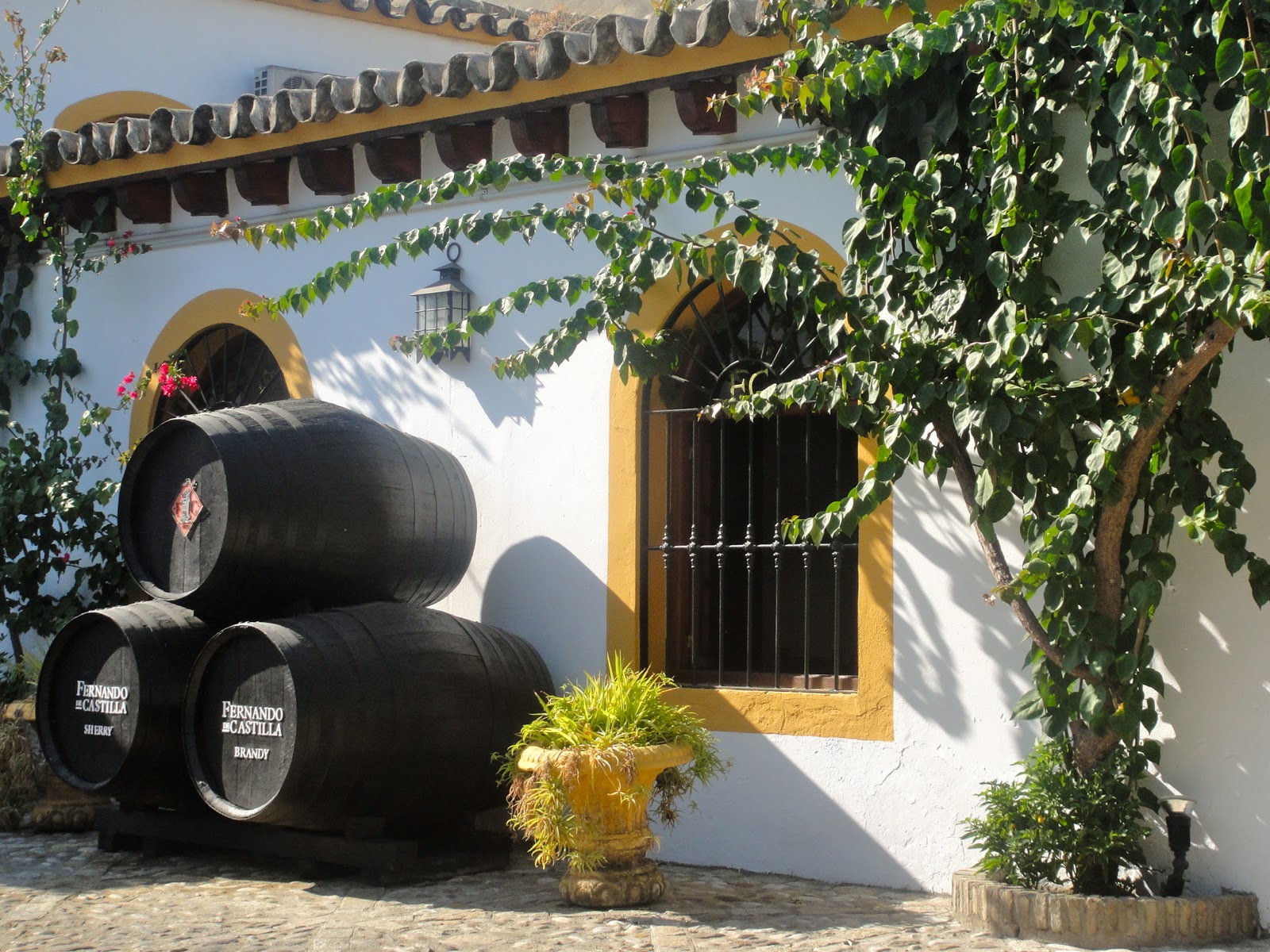
After trying to make plans to go on a fisherman's boat but with no way of getting back to the port and trying to go out fishing from 2am to 6am before realistically thinking how tired we already were and how exhausted we would be the following day, we departed the port for Jerez de la Frontera to visit the immaculate sherry and brandy maker, Rey Fernando de Castillo. Although it is exported to 45 countries, 50% of their production stays in Spain, which we were told a lot of locals will buy their products even if it is more expensive because of the consistently and genuinely good quality. On the other hand, some sherry makers just make sherry to be sold as exports to probably people who enjoy what they know as sherry but haven't really experienced or tasted the real deal.

Sherry is the second Spanish export, following only behind Rioja wines. Sherry is what the Spanish, or at least the Andalusians, call wine or vino de Jerez, whereas most of us would call it just sherry -keeping the classification separate from wine. It is, in fact, a fortified dry white wine meant to be enjoyed with food whereas blended and mass-marketed sherries are generally sweeter and drunk as an aperativo. Because it is aged in oak barrels for  a minimum of 3 years in which the amino acids release umami sensations, sherry is good with and in food. The low acidity also makes it appetizingly-agreeable combined with vinegar as in dishes such as escabece or ceviche.  (HA! appetizingly is an actual word!) Palomina (the main and local grape variety used in sherries that occupies up to 95% of the sherry vineyard area in Spain), along with the area's microclimate (generally warm but often hot and dry but occasionally cooled by the near-ocean winds and the chalky soil), the low acidity, and the cellars conditions (especially the bare floors for the solera system) create a top fermentation. The wooden casks of the dry white wine are only filled to about 75% percent so that as they age and mature, a yeast, or flor, grows on the top of the wine. The flor that naturally grows is not only of a local variety that develops the sherry, but allows the wine to ferment as it stops the oxidation. This allows the sherry to develop a tremendous personality from the layer of locally grown yeast typical of the region's winds. This is terroir at it's best.  It's also why sherry is a D.O.P product that must come from the Jerez region of Spain. The vineyards within the Jerez region must be grown in the ménage à trois of Jerez de la Frontera, Sanlucar de Barrameda and Puerto de Santa Maria. 

  • White sherries like fino are complex, light and dry, whereas manzanilla, a variety of dry fino, are more delicate, fresh, almost salty from the sea, and sold younger. These are 12-13% alcohol and aged 3-4 years. 
  • Brown sherries are 18% alcohol and should be matured 8-10 years otherwise it will taste "unfinished" like biting into an unripe fruit with no aromas. It is one of the driest wines as there is no residual sugars - the bacterias eat it over time. The Rey Fernando de Castillo sherry has no treatment - it goes straight into the bottle so the wine in the glass is the same wine in the cask. This type of sherry is best consumed with consumme soup, mushroom pate or foie gras, or a sharp cheese. 
  • Pedro Ximenez is another type of sherry named after Peter Simmons who brought over this particular grape variety from Germany in the 1700's. Because the grapes came from a cold, humid climate to a hot one, the grapes tended to shrink after they grew because the skin was too thin to protect itself from the heat of the sun. Therefore, this sherry is made from pressed raisins - a unique wine made from sun-dried grapes. It is technically a white wine but appears black in colour. Aged for 30 years, it is extremely sweet with 500g of residual sugar. It is best served slightly chilled with chocolate, ice cream or a non-salty blue cheese. yum. 
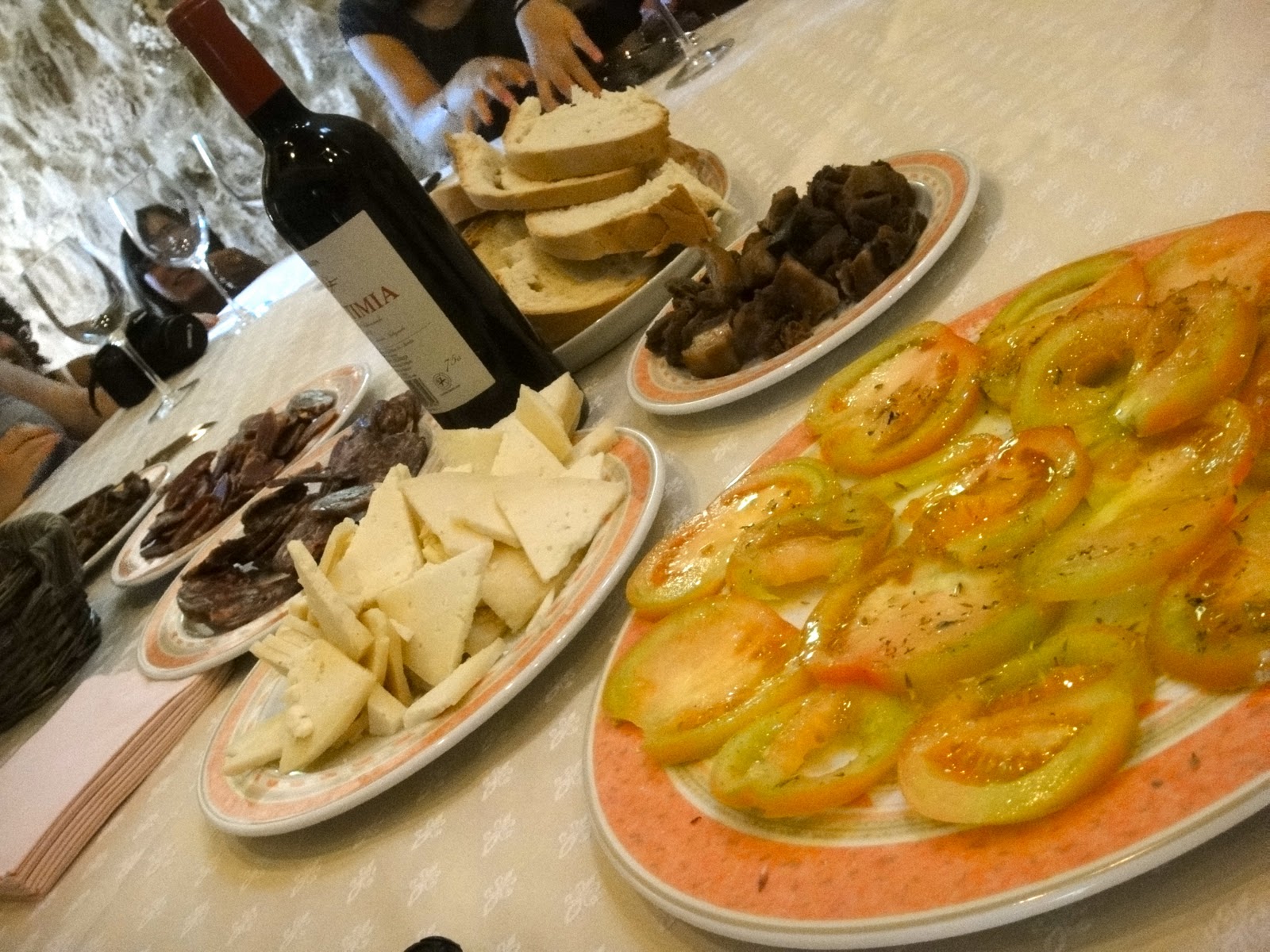
tasting the 5 year old and 80 year old
We also tasted their Brandy. Brandy is a distilled wine, but it is made from "whole wine" that has been aged for at least 6 months in oak and isn't a grape-reminant like grappa is, for example. There is also nothing added like sugars in brandy or cognac. The wine is distilled in copper vats over a live fire. The water and the alcohol evaporate, but the alcohol evaporates faster into a tube which then condenses into liquid again at 65% alcohol. It is aged in new American oak which has not been used before and then into a previously used sherry barrel for a minimum of 5 years. The barrels do not move. The solera barrels are the oldest and are the closest to the floor (solera = suelo = floor). The top barrels are refilled from top to bottom so that there is a little bit of harvest in every bottle, creating a uniform consistency in each brandy. Therefore, the younger wines take on certain characteristics of the older wines and all are uniquely blended among age and among the casks. We tasted one from the barrel of 5 years and another more developed and deeper coloured one of 80 years.
"Holanda" indicates top quality. 
At the end of the tour we tasted their sherry vinegar. Sherry vinegar is known as the perfume and soul of Andalusian kitchens. It is a favourite with gazpacho, chickpeas, or as a salad dressing mixed with some extra virgin olive oil and dijon mustard. The sherry vinegar that they produced really surprised me. They only make 2 bottles a year due to it's production process. It is made with "broken" wine-by products, not made intentionally. Rey Fernando de Castillo sherry vinegar takes a least 15 years to become sherry vinegar. Since there are no official rules for vinegar - as a condiment - so many of them are factory based which take days, not years, to produce and these lack the aromas that generate from and develop with age.

Williams & Sonoma buy sherry vinegar directly from Rey Fernando de Castillo for $11 and sell it in America for $45. apparently. I couldn't find it on their website.

After our tasting session, we celebrated Reena's birthday with chocolate cake and bubbly bottles of cava on the hotel's rooftop overlooking the illumiated little town of Conil and the vast blackness that hinted of the sea.


I don't know if love sherry. I know my palate isn't experienced or developed enough to appreciate it as a wine. But I do like Journey.


Oh, you know that there's a fever

(there's a fever I know)
Oh, that you'll never find nowhere else
(nowhere, nowhere else)
Can't you feel it burnin' on and on

Oh Sherrie
Our love holds on
Holds on
Oh Sherrie
Our love holds on

(guitar solo)

Oooh Sherrie  - Journey.