Showing posts with label farmers market. Show all posts

Wednesday, May 23, 2012

"Though their life was modest, they believed in eating well." — James Joyce (Dubliners)

My flatmate keeps making fun of me for continuously threatening myself with an instant ramen diet.

The first week of living here in Perth after moving up from Frankland, I wandered past the big chains and overpriced gourmet food stores to find myself in a little mart jammed packed with all sorts of foreign Asian goods with no English descriptions on the packaging. The only thing I could comprehend beyond the savory images were the numbers marking the price. Quite content on finding the so-far cheapest bottle of Sriracha in Perth and picking up two differently flavored packages of 5-packet ramens for $5, I thought I had found myself a bargain that my partime salary could compete with.

As I've mentioned before: Perth is a ridiculously expensive city. As I've implied before: to call Perth a city is relative. Let's rephrase: Perth is a ridiculously expensive place. Since living here for the last month - really living here - I have come to understand why.

I type this as the tab for ANZ's Internet banking is open, but I am hesitant to reveal the truth of it's accounts to make my survival until next week's pay day become a stark and dismal reality.

The main reason Perth is so expensive is that it can be. It's like a spoiled only child. Located in the middle of nowhere, the nearest city, Adelaide, is over 2,000 kilometers away; a flight from Perth in the West to Sydney in the East is about 5 hours - the same length for a flight from the American East coast to it's West coast; and driving 10 hours directly north of Perth only covers about 2 inches on a map. Part of this connection between its isolation and its monopoly over exuberant prices is that it is expensive to import things from around the world, let alone transport goods from other parts of the country. Indonesia is closer to Perth than Sydney is. Maybe because of this, and/or maybe they don't have any other choice, I have found that Australia is very proud in selling their own products: most bars serve a majority of Australian beers, most bottle shops predominately sell Australian wines, many bands are local artists, everyone claims to have known Heath Ledger - just kidding.
Another tie in to the expensiveness and remoteness is that Perth is a booming hub for the resource industry. With all the surrounding nothingness, there are a lot of mining jobs to be had with a lot of work to be done. These unfavorable locations and long hours pay a lot of money for these jobs. Called FIFO - fly in fly out - people fly to remote destinations for jobs that will last maybe 2 weeks at a time working hard with nowhere or no time to spend their money, then they fly home to Perth for a week with pockets filled with money to burn. Apparently, part of the lure to bring people to work in these desolate areas is to have tremendously nice facilities. Perth then has to compete with keeping people in all sectors of the economy in Perth. Why work in retail or hospitality when you could have a cleaning job at the mines earning $100,000 a year? How can the schools compete with teachers salaries in the city and providing quality education when the teachers can get more money up north? People are literally changing career paths to earn more money in the mines. With these incredible incomes and salaries, Perth can get away with charging such high prices that people now have the money to spend. I would say that the standard employment pay is relative to the standard of living in Perth, but it's not necessarily fair to the people who do not have jobs in the mining industry who are still trying to survive. This has caused a huge discrepancy between the population. My hourly rate isn't bad, but that doesn't mean I can afford a $16 sandwich for lunch or can buy a round of $10 beers. Once in the night. For two people. It's tempting, really tempting, to go work for $80/hour at one of the mines to put away a couple grand, but at the same time, I would feel like a tremendous sell out. Money can't be everything, it can't be the driving force in life.....oh! but the prospect of the promises that financial security offers is so so tempting. I haven't necessarily ruled it out yet. The ANZ tab is glaring at me, daring me to face reality. But, what would my friends and family think if I worked in a MINE?!

So if Perth is so expensive and I'm trying to save money to travel, you must wonder: why am I living here, currently in fear of my bank account, and with the packets of ramen still uneaten? You must wonder, if it hasn't already pissed you off, why have I resorted to buying terrible ramen noodles like a poor college student, which I never ate in college, when I KNOW how to eat better than that after a year of apparent studying in Italy?

Which brings me to two points I want to discuss:

Despite feeling quite proud in my bargain shopping of cheap ramen, even doing a comparison shopping of different brands and prices and flavors, there is a reason why they are still sitting in the larder. I thought I was doing the right thing, buying cheap food to save my money and thinking this $5 would feed me for at least 10 meals (10 days actually, I don't think I could even attempt to endeavour eating more than one packet in a day). But the more I thought about it, the more I understood how I was dooped into the negative way people think about food these days. I felt, without thinking about it, that I had to buy crap in order to not spend a lot of money. But didn't I just spend a whole year studying the culture of food, the economy of food, the politics of food, the effects food has on the environment and on our health? Why did I immediately think I had to buy instant processed food in order to save money? Shouldn't I be preaching better purchasing decisions and better eating habits to show people that they can buy quality food without breaking the bank? Isn't that what made me so frustrated about customers and their thoughts towards buying foods at the farmers market last summer - didn't I want to prove them wrong? Isn't this what I want to educate people on: how can a 69 cent bag of instant just-add-hot-water food with dehydrated vegetables and high sodium flavoring from Asia actually cost 69 cents? What is the nutritional content of 69 cents (I don't know, it's all in Chinese). Here I was going into "survival mode" of bulk instant ramen - the spicy kind of course, I might add - and getting angry and frustrated at the way food is treated and marketed and even more so, embarrassed at myself.
Instead, I bought bags of red, green, and black lentils, chickpeas, couscous, whole wheat penne, and flour to make homemade bread to slice and keep in the freezer. I'm not sure where the food comes from, but the Subiaco weekend market has terrific prices and all sorts of produce. If you go at the end of the day on Sunday they are literally trying to give away the food for $1 a bag. The little Asian shop down the street in Maylands sells discounted food that most places would throw out because of a few blemishes or is on it's last day on the shelf. My body craves vegetables, not instant food, and despite every purchase being a comparison shop and being conscious about what I want and what I need and what I can afford, I am more aware of the price of the food and wondering how certain bags of carrots or a head of lettuce can be so cheap. I know I shouldn't be complaining because I'm trying not to spend money either - I expected 10 meals from $5 - but it's ridiculous what people expect out of food. How they will pay $4.50 for a small cup of coffee or $3 for a soda, but then complain about the cost of milk or not have any comprehension surrounding the efforts put into production or the cost of transportation or the wages for the labor. *sigh

dilemma. 
6 bottles of cheap wine may seem like a good deal, but 2 bottles of quality good-tasting wine really make a difference. Same goes for olive oil. For local fruits. For vegetables in season. For making homemade bread.
buy less for your budget. buy better for your life. 

I am still tempted to do a full-on ramen diet week - I have the packets already, why let them go to waste (if there even is an expiration date). I've tried already, but once mixed in a jar of kimchi and another time added some sauteed bok choy and cut up tomatoes into it with drizzles of Sriracha. I physically can't bear to empty the packet of powdered flavoring into it, knowing how much sodium is in it, but maybe, just as an experiment, I could see what it's like to really live on a ramen diet.....thoughts?

And so to the second point from that previous discussion:

I like Perth a lot. Despite being one of the most expensive cities in the world, it is also ranked as one of the most livable and one of the highest qualities of living (is there any oxymoron somewhere there?) Just seventeen years short of being 200 years old (!) it reminds me a lot of California. Yes, the sunny weather and beach side proximity do help in this comparison. It's clean, pretty, budding, walkable, manageable.  Sure, there are a lot of ugly buildings, but there's a lot of breath-takingly unique ones. I love the neighborhoods in the suburbs where each house is distinctly different as though each plot of land had its own architect with a freedom to design whatever they wanted and took advantage of that opportunity. I could go on and on about the houses, but I can't find the right descriptive vocabulary right now.
What I like about Perth, and part of the reason why I decided to come to the west coast first, is that despite all the travelers, backpackers, and heavily populated foreigners, there aren't a lot of tourists (differentiation: tourists don't live here). It's kinda its own hidden gem. There aren't a whole lot of touristy sights in Perth in general and maybe that observation has something to do with me making fun of it being called a city. Before I left for Australia, most people I had talked to who had been here had been to the east coast, but said they never made it to Perth or Western Australia as it was too far away. I haven't been to the east coast yet, so I can't say anything about that, but for now, I like Perth. A lot of people rave about Melbourne and say Perth is 10 or even 20 years behind it, but I think Perth has a lot of potential. And for that, I'm rooting for Perth.
For the last couple "moves" I've always had a time frame: a year in Italy, a few months in Ireland, a summer in Portsmouth, a little over a month in Ireland, then a few weeks in Perth before 3 months in Frankland. Now I have no time frame, no future destination or plan, and I kinda like the freedom of it. I applied for a job in a restaurant because I thought it'd be still along the food lines slash hospitality side of things in terms of learning all the in's and out's of the food industry while at the same time being flexible, social, and non-committal so that I could test out the Perth waters to see if I liked it or at least get some cash before deciding where I wanted to go next. But for now, I like it, and think I might look for something a little more serious until something else comes along. I like the paychecks, the routine of work, the rent responsibility, the budgeting of money I've worked for, the "real life" I haven't had in a while. I love my little home with my own room and my flatmate, but living out of a backpack still makes me feel a little "unreal." For now, it's ok. For now, the ramen will be there for cases of starving emergencies in between paychecks and as a reminder that although life can be tough, there's always a lesson to learn from it. Sacrifice may mean learning how to prioritize, but it doesn't have to mean sacrificing the quality of your life or disregarding your standards, no matter where you are.

I have since opened up the ANZ tab. Let's not talk about it. 

Friday, November 4, 2011

The End of the Season...Waste not Want not.

Fall has officially ascended upon the Seacoast. (I started writing this post a couple weeks ago when I felt as though I was getting sick as the seasons were changing and craved a warm soup to clear my congested asthmatic lungs and since then a Nor'easter has also cascaded the area with a thick layer of snow, covering trees that have not lost all of their leaves causing the heavy weight to drop branches upon power lines....before Halloween...it was October, Mother Nature, seriously?) But, within these last couple of weeks with the ending Farmers Markets and CSA season, I have taken home a good amount of food that I have desperately, and creatively, trying to make use of - since the point of taking it home was not to let it go to waste! 


So hence begins this blog post.


The other day I went to work early to organize and manage the CSA pick up. The employees at the mart were there setting up for the start of a busy day. They go through a lot of produce, some of it bought, some of it grown on the farm. People only want good looking food though. So, any spot, crack, blemish, bruise, or imperfection is generally, if not as a rule, removed. The compost goes to another local farm to feed their pigs. I don't know why the farm - sustainably - doesn't reuse it themselves. I also don't understand why they don't use these "bad" bits to make their own pies, jams, jellies, sauces, soups. But what about all the hungry people in the area that could be fed off this locally grown food? While in Italy, I joked about dumpster diving in my fridge to use up the food we had before we went on stages or weekend trips. But, my colleagues and I go through the compost bin daily and find "perfectly good" fruits and vegetables. It's infuriating. But, yesterday, I took home 6 large eggplants with some bruises, a couple bell peppers, a head of cauliflower, and a dozen or so tomatoes that were "unsellable" and going to be thrown out. Next to this box of stuff was another box with perfectly good bunches of celery that I didn't touch, because there was no way those could be thrown out, they were definitely still good. Later in the day, I saw them being thrown out. Unbelievable. As the day progressed, my ability to breathe lessened. I don't know if there was something in the air, but I couldn't grasp enough air into my lungs which decreased my energy levels. It was a beautiful fall day, but I could tell with the changing weather that I was getting sick. What to do other than sit on the couch and watch DVDs than to make soup. So I grabbed those perfectly good bunches of celery, some a-bit-soft-but-perfect-for-soup carrots and decided to make a vegetable broth. I added the bell pepper, mushroom, ripe-ready tomatoes, fresh ginger, onion and spices and was all set to cure my congested lungs with a spoonful of leftover-apparently-unwanted healthiness.


Vegetable Soup
2 onions, chopped
2 carrots, chopped
2 celery stalks, chopped
1 red pepper, diced
2 tomatoes, halved
4 cloves garlic, smashed
2 handfuls button mushrooms, sliced
1 tsp black pepper corns
5 cups water
a pinch of dill and other herbs, optional

Heat some olive oil in a large pan over a medium heat. Add onion, celery, pepper and carrot, tossing to coat and cook, covered and stirring occasionally, until the vegetables are soft and almost golden. Add the remaining ingredients and bring to a simmer. Cook gently for about an hour or until the stock tastes rich and full. Strain stock to make a vegetable stock or blend all the ingredients to make a thicker soup, full of all the tasteful, nutritious ingredients.
Roasted Eggplant Lentil Soup
1 large eggplant, about 1 1/4 lb
extra virgin olive oil
1 onion, diced
1 cup Lentils
3 cups vegetable stock
Preheat the broiler. Place the eggplants in a foil-lined pan tray and prick them a couple times so they don't explode. Broil under they are deflated, about 1 hour. Let cool, then scrape out the flesh.
Meanwhile, place the lentils in a small sauce pan and cover with 2 inches of water. Bring to a boil and then simmer for at least 30 minutes, until tender. Then drain.
In a larger pot, heat up some olive oil and add the onions. Cook until they have soften and turn a golden yellow. Add the lentils and the eggplant and the vegetable stock. Bring to a boil then simmer. Remove from heat and Stir then blend with an immersion blender. Serve with a squirt of lemon juice or sherry vinegar. 
Marinated Eggplant
2 lbs eggplant, sliced into 1/2 inch slices
3/4 cup extra virgin olive oil
1/4 cup red wine vinegar
4 garlic cloves, finely chopped
a handful of fresh mint, torn
2 tbsp freshly ground black pepper
Preheat the broiler. Brush the eggplant with olive oil and place on a baking tray. Broil (or grill) for about 5minutes turning once until golden on both sides. In a bowl, whisk together the vinegar, garlic, mint, and remaining 1/2 cuop olive oil. Pour over the eggplant and season with pepper. Allow to sit for 30 minutes before indulging. 
Apparently, people don't like kale and Swiss chard, or they just don't know what to do with it. Another day, I took home an enormous amount of leftover-been-sitting-there-for-3-days-about-to-be-thrown-out braising greens that has enormous potential. 


Autumn Soup
3 medium carrots, or 6 small, peeled and quartered
2 large tomatoes, quartered
1 yellow onion and 1 red onion, cut into 8 wedges
1 butternut squash, peel, seeded cut into 1/2 inch thick wedges
6 garlic cloves
extra virgin olive oil
10 cups (or more) of vegetable broth
2 bunches of finely chopped kale, washed and stmmed
3 thyme springs
2 rosemary springs
1 bay leaf
salt and pepper
Preheat oven to 400°F. Place carrots, squash, tomatoes, onion, and garlic in a baking dish. Drizzle with olive oil, sprinkle with salt and pepper and toss to coat. Roast vegetables until they are brown and tender, giving the pan a couple good shakes occasionally, about 30-40 minutes. When cool, cut the carrots into 1/2 inch pieces; set aside. Peel garlic cloves and place in food processor with tomatoes and onion; puree until almost smooth. Pour some broth onto the baking sheet to scrape up any browned bits stuck on the bottom. Scrape the vegetable puree into a large pot and add the broth in the food processor to get the rest of the puree on the walls. Add broth, kale, thyme and bay leaf to the pot. Bring to boil then reduce the heat to simmer uncovered until kale is tender, about 30 minutes. Add carrots and squash to soup. Simmer for about 10 minutes to blend flavors, adding more broth to thin soup if necessary. Season with salt and pepper. Discard thyme sprigs and bay leaf.
Kale, Potato and Roquefort Soup
extra virgin olive oil
1 medium onion, chopped
4 garlic cloves, minced
Salt
1 1/2 lbs starchy potatoes (such as Idaho potatoes), peeled, cut into small equal sized chunks
A bouquet garni made with a bay leaf, a couple of sprigs each parsley and thyme, and a Parmesan rind
1 pound kale, stemmed and washed thoroughly, cut into thin strips
1/2 oz Roquefort or blue cheese, more to taste
Freshly ground pepper
Heat some oil over medium heat in a large soup pot, and add the onion. Cook, stirring, until tender, about five minutes. Add the garlic and 1/2 teaspoon salt. Cook, stirring, until fragrant, about 30 seconds to a minute. Stir in the potatoes, the bouquet garni and two quarts of water. Bring to a boil, add salt, reduce the heat, cover and simmer 30 to 40 minutes until the potatoes are falling apart. Remove the bouquet garni. When the potatoes have begun to fall apart,  blend the soup with an immersion blender. Stir the kale into the soup, and simmer 10 to 15 minutes, uncovered until tender. Add the blue cheese and blend (or can leave chunky). Taste, adjust salt and add pepper. 


What to do with kale stalks when a recipe just wants the leaves? 


They are great and super healthy to munch on while cooking! I heated up some olive oil in a pan with some sliced garlic. When they became a bit softer, add the kale stalks and toss to coat. Cook for about 7 minutes until slighly tender then add some strips of red pepper,  a couple black olives, some red pepper flakes, and about a tablespoon of horseradish. Crunchy. Flavorful. Nothing wasted. 
Braised Greens with Olives and Goat Cheese
I made this one up with stuff I had...
1/2 red onion, sliced
2 bunches of braising greens (mix kale, Swiss chard, collared greens) washed, stems removed, chopped
1 red pepper, deseeded and cut into strips
a handful of green olives, halved
crumbled goat cheese
pinch of hot red pepper flakes
salt and pepper
In a large pan, heat some olive oil and add the onion and cook, stirring frequently until soft and translucent. Add the green stems and cook until softened then add the leaves. Toss to coat in the olive oil, adding some white wine or water for more moisture. Add the red pepper and cook until softened. Add the olives, toss to combine then transfer to a bowl. Sprinkle the crumbled goat cheese and red pepper flakes over and toss gently. Season with salt and pepper. 
Curried Cauliflower Manchego Soup
1/4 cup extra virgin olive oil
2 lbs cauliflower florets
1 medium onion, diced
4 cloves garlic
2 bay leaves
squirt of sriracha
1 tbsp curry powder
4 cups vegetable stock
1/2 cup Manchego (or Cheddar) cheese
salt and pepper
In a large pot, heat the olive oil and add the cauliflower. Cook, stirring frequently for about 10 minutes, until tender and light golden brown. Add the onion and garlic and stir in to coat, then add the bay leaves and sirarcha. Stir again and cook for another 5 mintues. Add teh stock and bring to a boil then simmer for about 25 mintues, until the cauliflower is soft. Add some water to replace what has evaporated, add the cheese, and season to taste. Bring to a boil so that the cheese melts and simmer. Blend with an immersion blender. 


....and this was only a couple of the recipes that I made. Mum also made a tasty kale and white bean soup. Full disclosure: I'm really bad at following recipes. My absolute favorite is to read through cook books, but when it actually comes down to using them, I use the recipes as guidelines and kinda make it up as I go....IF you use any of these, I am sure they will be fantabulously delicious, but I trust your own instincts as you go. 

Thursday, October 13, 2011

My. So. Called. Real. Life.

So, "wedding season," or so coined for this summer, is officially over. Well, at least the first wave of weddings - I've heard they go in waves. This summer was packed with showers, festivities, get aways, ceremonies, and parties. As much as I absolutely loved the opportunities to get together with everyone - especially especially after being away in Europe for 15 months - I am ready for fall to settle in and have a little break from all the gift-buying, new dresses (or borrowing really, in my case, thanks Jess), the travel expenses, and the sore dancing feet. The first wedding in May and the last wedding in October were pretty much the reasons why I stayed in America for the summer and put off my post-graduate "Real Life." It certainly wasn't financially possible for me to fly back and forth for each event, nor could I imagine missing any of them. Furthermore, no company was going to hire me and then let me have two separate months off to spend in America. So, originally, the plan was that I was supposed to come back in May and stay for month until my Bucknell 5-year reunion weekend, then spend the summer in Donegal, fly back in September for a month to attend a bachelorette party and then stay for the wedding 3 weeks later. Real Life was pushed back until October 2nd (today is October 12th). I loved being back with my family and seeing my friends again, both in NYC and Portsmouth - especially especially after 15 months apart in Europe - and my sister pretty much convinced me to stay for the summer. A car accident 2 days before I was supposed to get back on a plane to go back to Ireland sealed the deal. Portsmouth eventually won over NYC and I changed my flight back to Ireland to December 1. Real Life would start then. Or, after Christmas when the family goes back to America. Ok, January 2nd. I'll be a day older than 28 and ready to start Real Life. 

I don't regret staying here for the summer. Summer in Donegal would've been filled with a lot of montanaiety (monotonousness?) and alone time. Maybe I would have a lamb for a pet and chickens for eggs every morning and bees making me honey and would have planted a full vegetable garden - but unlikely. Maybe I would've worked up the courage to learn how to surf and not be scared of further-ruining my knees - or was it actually the intimidatingly cute surf instructors that kept me away? Maybe I would've learned how to pour the perfect pint of Guinness - oh wait, I already learned how to do that from living there and working there in the spring. 

Staying in Portsmouth and working for a local farm this summer has been a terrific learning experience. Despite the fact that my friends don't understand what I do at all and my sister thinks that I'm a hillbilly, I don't regret it one bit. I have learned so much not only from the farmers but reading up on the produce so that I can answer questions for customers and write for the farm's newsletter as well as keep up with my own blog. I have a deeper confused-understanding of the pros and cons of organic and conventional farming as well as the reality of it all. Maybe the "confused-understanding" means I don't actually get the reality of it all, but then that blurriness of right and wrong is pretty much the reality of it today. There's so much more that goes into running a successful farm, the politics of farmers markets, and grasping the difficulties of what people eat and what they actually know about where their food comes from is alarming. So much of it people take for granted. Even after this entire summer I have a hard time knowing what to eat or what not to eat: pesticide-ridden but local, morally-righteously but  restaurant-available, eating for the sake of not wasting, or even just having a craving for something when I know I am being hypocritical. 

But all of this has not lead to me to Real Life. The last farmers market ends November 5th. One month in America. Portsmouth? NYC? Then a flight December 1st. One month in Ireland. Can I get a job at Fallon & Byrne again and afford to live in Dublin? Are there even any people in Dunfanaghy in December to possibly find a job? Too many questions, too many unknowns. I'm feeling a little overwhelmed as summer comes to an end. 

Rather spontaneously on a Friday night, I applied for a working-holiday visa to Australia.  Sunday, I was approved. (!!!!!!!!!!!!) The economy in Ireland is too shitty to look for a job. I need to move out of my parents place and be a real 27 year old. I've had my fair share of Portsmouth - love it, but it's time to move on, again. I don't want a corporate job in NYC and any other sort of job will be unaffordable to live there. So, why not Australia? I've wanted to go there since 3rd grade when we learned all about penguins, I fell in love, and learned that there were warm-weathered penguins, the Little Blue Fairy Penguins, living and causing a raucous in Australia. I always thought that a semester abroad would bring me the opportunity to go there, however, a double-major in Spanish taught me that they don't speak Spanish in Australia. 

Lewisburg 4 years. CT 8 months. New York 2 years. Portsmouth 13 months. Italy 1 year. Ireland 3 months. what's next? Australia? why not? my travel lust is calling my name. 

"Why not" probably isn't an acceptable answer. Especially for those who have stable jobs, steady relationships, some sort of career path or even a goal. But for me, I don't. I like taking what life has given me and using it as a learning experience, creating my own stages along the way, and hopefully, it will lead me to where I'm supposed to be. I don't think I'm supposed to know what I'm supposed to do, but I do know that a corporate life is not well suited for mel, and I'm perfectly happy taking what I can get, adjusting and/or improving along the way. I don't have a plan in Australia, yet, just an approved visa. Maybe there was another reason for going to Australia, maybe I lost it. Is it an escape from Real Life going half way around the world or will I find it there? What do I do if I don't go to Australia? Maybe I will miss the next wave of wedding showers, festivities, luncheons, parties, ceremonies, and sore feet from dancing, but I've learned that I can't stick around for those - as much as I may not want to selfishly miss them. I can't put off my Real Life for any one. This is my (so called) Real Life. I've enjoyed this intermediate-pause-on-real-life-but-huge-learning-experience-and-friend-and-family-filled-summer, but I'm ready for "Real Life." Whatever that may be, even if it's half way around the world. 

*I miss you already, but what better excuse than come to visit me?! 

Wednesday, October 12, 2011

What's in Season: Asian Pears


Buying: Asian pears are more crispy than melt-in-your-mouth pears. It can be eaten straight from the tree, with hints of honey and spice. Even though they feel hard will not become as soft as other pears, Asian pears do bruise easily. The skins should be smooth and yellowy-bronze, not green. 


Storage: 
Asian Pears should be refrigerated.

Cooking: 
Asian pears do not need to be peeled, although they have a tougher skin than most pears. If peeled, rub the flesh with lemon to avoid it from turning brown. They would be delicious in salads with cheese and walnuts.

Asian Pear and Grilled Gouda Cheese Sandwich
*From Chow.com
1 tablespoon unsalted butter, softened
2 slices light rye bread
2 ounces thinly sliced young Gouda cheese (aged 1 to 6 months)
5  slices (1/8-inch-thick) Asian pear
Heat a large frying pan over medium-low heat. Meanwhile, spread half of the butter on one side of each slice of bread.Once the pan is warm, add 1 slice of bread, buttered side down, then top with half of the cheese, all of the pear slices, and top with the remaining cheese. Close with the second slice of bread, buttered side up. Cook until the bread is toasted and golden and the cheese is melted, about 6 minutes per side.

Thursday, September 22, 2011

Questionable Health Priorities at Farmers Markets.

"Are these fruits and vegetables organic?"
"No, we are not certified organic."
"Ok I'll pass on those then. Can I get a dozen sugared cider donuts?"


"Can I get a cider donut please?'
"Sure. Would you like plain, cinnamon-sugar, or sugar coated?"
< parent to child > "Do you want sugar or cinnamon-sugar?"

Friday, September 16, 2011

What's in Season: Peaches & Nectarines

Peaches. There is nothing that tastes like summer than biting into a recently picked, perfectly ripe peach that when you bite into it, juice just oozes down your chin and drips down your arm. Pure pleasure.

I am allergic to peaches - they are related to the almond family - so I generally stay away from them. Plus I always thought they weren't that great, a little tasteless and not sweet enough. I thought that I was less allergic when they were a bit hard and under-ripe. However, my interest peaked as everyone at the farmers market started asking about the arrival of the peaches and how they were their favorite part of summer. So when they finally came in season, I couldn't resist to biting into one. Minus the incredibly itchy fuzz which makes me maniacally scratch, they definitely are delicious when juicy and ripe with the juice running down your chin and all over your arms as you try to wipe it off.

Buying: Peaches are either clingstone or free-stone. Clingstone are ones where the flesh is pretty securely attached to the flesh and are usually sent to the canning industry whereas free-stone peaches have pits that hang about the flesh pretty freely. There are a lot of different varieties of peaches and nectarines but realistically, they can be interchangeable. Pay attention to the smell of the fruit as well as the background color. Red, although appealing, doesn't not equate with ripeness or maturity, but with with variety of the fruit.  You can tell the type of peach by looking at the ribbed shoulder on the top of the peach - the little strip will be yellow-orange for a yellow fleshed peach and a lighter yellow for a white flesh skin. Look for pieces of fruit that have an orange or golden, not green, hue to their background. Like tomatoes, always trust your nose and smell your fruit - should be peachy keen!

Storing: If you want to keep peaches for longer, keep them in the refrigerator after they have begun to ripen (do not put under-ripe fruit in the fridge as it will dry out the flesh and turn mealy). If you're looking to eat them sooner, leave them out at room temperature. If you want to eat it even sooner, place it in a brown paper bag with a banana (or any fruit that exudes ethylene) and it will expedite the ripening process. They are very fragile and delicate, any damage or bruising will cause them to start decomposing which is why farmers markets may have boxes of "canning" peaches and nectarines. The juices will cause the other fruits to start to rot prematurely as well so they are separated. These are often ready to eat, fallen, bruised, split-pit, even ugly fruits that are perfect for canning, obviously, or making jams, pies, and tarts. Peaches and nectarines, like tomatoes, are climacteric, which means they will continue to ripen after they are picked. So, if you buy a peach or nectarine from the farmers market that is pretty hard, it is because the farmer knows that you might not eat it right away, so leave it on the counter and it will be excellent to eat in a couple days. I'm not quite sure what to answer when people ask me if the fruit will ripen and become softer....what do you think? It will stay hard or just get harder? Of course it will ripen. However, if you go pick your own peaches and nectarines, follow your nose to find the fruit picked off the tree that is just bursting with liquid sugary syrup that will drip down your arm as you take that first bite......

Split Pits
"she obviously has a lot of respect for you. none of our friends know what a split pit is, let alone be able to talk about it for hours."

What's the difference between a peach and a nectarine? Not too much. 
Fact: peaches and nectarines are so closely related that sometimes a peach seed will germinate a nectarine tree and a nectarine seed with grow a peach tree! There is just one differentiating gene. Because peaches have hair on their surface - which causes all sorts of uncomfortable itching for me - they are considered to be "pubescent" whereas nectarines have no fuzz, just a smooth surface. Although preferred by some, nectarines are firmer than peaches so they don't have that melt-in-your-mouth effect and therefore don't really fall apart messily all over your hand, half in your mouth like a ripe peach often does.

Medical: Lots of Vitamin A & C and potassium. They are virtually fat-free (less than 1 gram), very low in calories (about 40) and the skin is a good source of fiber!

I AM ITCHINIGLY INCREDIBLY ALLERGIC TO PEACH FUZZ! 
....hours of itching at work....

Cooking: When cooking peaches, peel the skin as they will easily peel away throughout the cooking process, however, nectarines do not need to be peeled. To easily peel a peach, put an X with a sharp knife at the bottom of the peach and pop in boiling water to blanch for a couple seconds and then quickly put into a bowl of ice water. The ice water will stop the peach from continuing to cook and the skin will easily peel away. If the fruit is incredibly ripe, blanching is probably not necessary.

If you are using cut fruit, sprinkle some sugar over it to stop it from browning as the exposure to air will cause enzymatic browning.

Recipes:

Peach Bellini
The Bellini is a popular drink in Italy made famous from Harry's Bar in Venice, owned by Giuseppi Cipriani. I always wanted to meet a Giuseppi while I was living in Italy. Anyways, a Bellini is a long drink cocktail served without ice. It is two parts (100mL) prosecco, one part (50mL) white peach puree. The peach puree can be made by blanching a peach to remove the skins, then blending it with a dash of prosecco (a lot of recipes will call for water and lemon juice, but why not prosecco?!). The puree is then added to the glass and topped off with prosecco. A virgin version can be made also by using club soda instead (with the water and lemon juice in the blender).


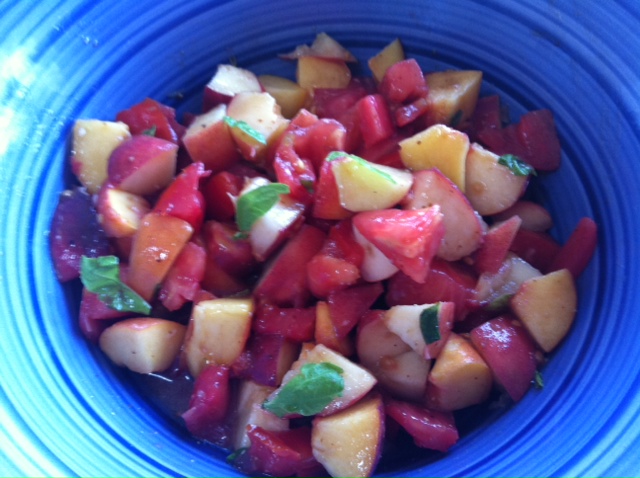
Tomato Peach and Basil Salad
4 Tomatoes (or to match the amount of peaches, depending on the size)
4 Peaches (2 yellow, 2 white)
Basil
1/4 cup balsamic vinegar
1-2 teaspoons dark brown sugar, optional
2 cloves chopped garlic
salt and freshly ground black pepper
1/2 cup quality extra virgin olive oil
1 teaspoon of Dijon mustard

Roughly cut the tomatoes and peaches into bite size pieces. Tear basil into the salad. Whisk together the remaining ingredients to make the vinaigrette. Gently toss and fold into the salad.


Grilled Peach Salad
Dressing:
2 1/2 oz goat cheese, crumbled
Salt and Pepper
5 tablespoons extra virgin olive oil
juice from 1 lemon
1 oz Parmesean, freshly grated

2 large peaches, halved, pits removed
extra virgin olive oil
salt and pepper
2 frisee or endive leaves, washed and dried
small bunch of fresh mint leaves

Put the goat cheese in a pestle and mortar with sea salt and pepper - easy on the salt because the cheese will already be salty. Add the olive oil and lemon juice and mix. Add the parmesean and mix again, but not for too long. 

Friday, August 26, 2011

Ratatouille with Black Quinoa

Every Sunday we go to Newburyport's Farmer's Market. For lunch, I usually go to Revitalive Cafe - vegan, gluten free place - for a quinoa bowl. I usually get their Mexi-bowl which is avocado, homemade salsa, lettuce, hot sauce and some vegan bean dip on top of quinoa. Last week, a young chef obsessed with our donuts stopped by the tent for a chat and we got to talking about quinoa and I realized how versatile it is. Any salad or anything can be mixed with quinoa. So, when I came across a recipe from Alice Waters for ratatouille I decided to mix it with some black quinoa I had. Delicious. and Healthy. 


Alice Waters' Ratatouille from The Art of Simple Food mixed with Black Quinoa
1 cup quinoa
1 medium or 2 small eggplant, cut into 1/2-inch dice 4 tablespoons olive oil, divided, plus more to taste 
2 medium onions, cut into 1/2-inch dice 
4 to 6 garlic cloves, chopped 
1/2 bunch of basil, tied in a bouquet with kitchen twine + 6 basil leaves,chopped 
smattering of dried chile flakes, or to taste 
2 sweet peppers, cut into 1/2-inch dice 
3 medium zucchini, cut into 1/2-inch dice 
3 ripe medium tomatoes, cut into 1/2-inch dice 
Salt to taste

Toss the eggplant cubes with a teaspoon or so of salt. Set the cubes in a colander to drain for about 20 minutes.
Put the quinoa in a small pot and cover with 1 1/2 cups of water. Bring to the boil then simmer for about 20 minutes until the water has evaporated and the quinoa is al dente/soft depending on your preference. Fluff with a fork and set aside. 
Heat 2 tablespoons of olive oil in a heavy-bottomed pot. Pat the eggplant dry, add to the pan, and cook over medium heat, stirring frequently, until golden brown and a bit crisp around the edges. Add a bit more oil if the eggplant absorbs all the oil and sticks to the bottom of the pan. Remove the eggplant when done and set aside.
In the same pot, pour in 2 more tablespoons olive oil. Add onions and cook for about 5 minutes until soft and translucent. Add the garlic, basil bouquet, dried chile flakes, and a bit more salt. Cook for 2 or 3 minutes, then stir in peppers (if using). Cook for a few more minutes, then stir in summer squash. Cook for a few more minutes, then stir in tomatoes.
Cook for 10 minutes longer, then stir in eggplant and cook for 10 to 15 minutes more, until all the vegetables are soft. Remove the bouquet of basil, pressing on it to extract all its flavors, and adjust the seasoning with salt. Stir in the chopped basil leaves and more extra virgin olive oil, to taste. Pour in the quinoa and toss to coat. Serve warm or cold.
* I did not have any sweet peppers. Also, the tomatoes could probably be peeled for aesthetic reasons or personal preference. There were little strips of tomato peels mixed in, which is fine with me, but just came off as the small-diced tomatoes were cooking. To peel tomatoes, cut an x at the base of the tomato, blanch in boiling water then remove as soon as the skin begins to unfold. Dunk in a bowl of ice water to stop the cooking (and for an easy to handle touch) then peel back the skin easily. 

Sunday, August 14, 2011

Farmer's Markets. Some thoughts on hanging out in parking lots.

I'm starting to not understand why people give farmers markets a bad rap for being too expensive. realistically, it is an incredibly better value. 
environmentally, they have less cost on the damage done regarding carbon footprints because the food hasn't been flown across the world, transported from the farm to the distribution center to the store to the home. Farmers market farm vendors are located nearby and everything that they sell has to come from there. I don't understand how many times people ask if the food we have is our own. < < insert snooty comment > > 
nutritionally, the food at the farmers market is the freshest, generally just picked that morning, a smattering of hours before. Many items found in a grocery store are picked unripe, shipped to a distribution center where they sit in a huge room and then sprayed with ethylene when the stores are ready for them so that they ripen and look "perfect" for the customer. 
economically, the prices are usually pretty low for what you're getting quality-wise. I guess it depends on where your priorities are, if you want to spend money on good food, talk with the vendors and know where your food comes from, and support the local economy at the same time, then the prices are worth it. some prices will be cheaper because the farmer is trying to make a living also, has a ton of produce and is trying to get rid of it! sometimes they will be more expensive than buying them at the actual farm because they have to pay for the labor and transportation costs to get to the farmers market. what we call a "convenience charge." 

but then again, is the cheap, nutrition-less and tasteless conventional foods too cheap? who should be setting the standard and what is it? 


 whether or not you think farmers markets are more expensive, the reason i am wondering why people think farmers markets are unaffordable, inconvenient, and stay away from them, is because since I started working there, I have heard a ton of people question the price. After telling them their total, very often they will be thrown off and say: and I have this cookie too. or did you get the 6 ears of corn as well? only 80 cents for this as my dinner side, wow! 2 dollars for this ginormous head of lettuce, really? did you include the peaches too? yup, I saw that, got everything. What I think it is, is that people don't usually have much cash, so when they're emptying their wallets of the few bills they have, they feel as though they can't get much. A lot of people ask if we accept cards. It's the easy way to shop to just hand over the plastic. I did that today actually and my friend who owns the restaurant actually had to tell me that the wrap was on him. I didn't even realize the price as I just handed him my card, blindly and without thinking about the total. You could easily get your weekly shopping at a farmers market, one stop shopping and helping to support various local businesses in your community - obviously depending on the farmers market, they are all unique. It's just the arm carrying capacity and the lack of cash that I think tends to cause people to stay away. Not many people use cash anymore so physically seeing your money I think psychologically makes people think they are spending more. 


the first day of our new van. the start of the spring it wasn't very full. now it's been completely violated. 

 Another observation about farmers markets is that I don't understand the people that bring their own bags, thinking that they're super green, but then ask for the plastic bag for their produce. why does it need to be double bagged?? Pints and quarts I understand wrapping so that the berries don't roll around and get smushed, but other than that, the vegetables don't need to be separated in their own individualized bags, they can all be friends in there! and they should be washed before being used anyways, they're not going to get any dirtier unless your groady bag is dirty, so why all the plastic bags?? it drives me crazy.

 some shots around the portsmouth farmer's market. 


so grab your bags, get out some cash, come hang out in a parking lot, talk to the local businesses, know your fruits and vegs, run into your neighbors, and listen to some live music!