Showing posts with label whats in season. Show all posts

Wednesday, May 23, 2012

"Though their life was modest, they believed in eating well." — James Joyce (Dubliners)

My flatmate keeps making fun of me for continuously threatening myself with an instant ramen diet.

The first week of living here in Perth after moving up from Frankland, I wandered past the big chains and overpriced gourmet food stores to find myself in a little mart jammed packed with all sorts of foreign Asian goods with no English descriptions on the packaging. The only thing I could comprehend beyond the savory images were the numbers marking the price. Quite content on finding the so-far cheapest bottle of Sriracha in Perth and picking up two differently flavored packages of 5-packet ramens for $5, I thought I had found myself a bargain that my partime salary could compete with.

As I've mentioned before: Perth is a ridiculously expensive city. As I've implied before: to call Perth a city is relative. Let's rephrase: Perth is a ridiculously expensive place. Since living here for the last month - really living here - I have come to understand why.

I type this as the tab for ANZ's Internet banking is open, but I am hesitant to reveal the truth of it's accounts to make my survival until next week's pay day become a stark and dismal reality.

The main reason Perth is so expensive is that it can be. It's like a spoiled only child. Located in the middle of nowhere, the nearest city, Adelaide, is over 2,000 kilometers away; a flight from Perth in the West to Sydney in the East is about 5 hours - the same length for a flight from the American East coast to it's West coast; and driving 10 hours directly north of Perth only covers about 2 inches on a map. Part of this connection between its isolation and its monopoly over exuberant prices is that it is expensive to import things from around the world, let alone transport goods from other parts of the country. Indonesia is closer to Perth than Sydney is. Maybe because of this, and/or maybe they don't have any other choice, I have found that Australia is very proud in selling their own products: most bars serve a majority of Australian beers, most bottle shops predominately sell Australian wines, many bands are local artists, everyone claims to have known Heath Ledger - just kidding.
Another tie in to the expensiveness and remoteness is that Perth is a booming hub for the resource industry. With all the surrounding nothingness, there are a lot of mining jobs to be had with a lot of work to be done. These unfavorable locations and long hours pay a lot of money for these jobs. Called FIFO - fly in fly out - people fly to remote destinations for jobs that will last maybe 2 weeks at a time working hard with nowhere or no time to spend their money, then they fly home to Perth for a week with pockets filled with money to burn. Apparently, part of the lure to bring people to work in these desolate areas is to have tremendously nice facilities. Perth then has to compete with keeping people in all sectors of the economy in Perth. Why work in retail or hospitality when you could have a cleaning job at the mines earning $100,000 a year? How can the schools compete with teachers salaries in the city and providing quality education when the teachers can get more money up north? People are literally changing career paths to earn more money in the mines. With these incredible incomes and salaries, Perth can get away with charging such high prices that people now have the money to spend. I would say that the standard employment pay is relative to the standard of living in Perth, but it's not necessarily fair to the people who do not have jobs in the mining industry who are still trying to survive. This has caused a huge discrepancy between the population. My hourly rate isn't bad, but that doesn't mean I can afford a $16 sandwich for lunch or can buy a round of $10 beers. Once in the night. For two people. It's tempting, really tempting, to go work for $80/hour at one of the mines to put away a couple grand, but at the same time, I would feel like a tremendous sell out. Money can't be everything, it can't be the driving force in life.....oh! but the prospect of the promises that financial security offers is so so tempting. I haven't necessarily ruled it out yet. The ANZ tab is glaring at me, daring me to face reality. But, what would my friends and family think if I worked in a MINE?!

So if Perth is so expensive and I'm trying to save money to travel, you must wonder: why am I living here, currently in fear of my bank account, and with the packets of ramen still uneaten? You must wonder, if it hasn't already pissed you off, why have I resorted to buying terrible ramen noodles like a poor college student, which I never ate in college, when I KNOW how to eat better than that after a year of apparent studying in Italy?

Which brings me to two points I want to discuss:

Despite feeling quite proud in my bargain shopping of cheap ramen, even doing a comparison shopping of different brands and prices and flavors, there is a reason why they are still sitting in the larder. I thought I was doing the right thing, buying cheap food to save my money and thinking this $5 would feed me for at least 10 meals (10 days actually, I don't think I could even attempt to endeavour eating more than one packet in a day). But the more I thought about it, the more I understood how I was dooped into the negative way people think about food these days. I felt, without thinking about it, that I had to buy crap in order to not spend a lot of money. But didn't I just spend a whole year studying the culture of food, the economy of food, the politics of food, the effects food has on the environment and on our health? Why did I immediately think I had to buy instant processed food in order to save money? Shouldn't I be preaching better purchasing decisions and better eating habits to show people that they can buy quality food without breaking the bank? Isn't that what made me so frustrated about customers and their thoughts towards buying foods at the farmers market last summer - didn't I want to prove them wrong? Isn't this what I want to educate people on: how can a 69 cent bag of instant just-add-hot-water food with dehydrated vegetables and high sodium flavoring from Asia actually cost 69 cents? What is the nutritional content of 69 cents (I don't know, it's all in Chinese). Here I was going into "survival mode" of bulk instant ramen - the spicy kind of course, I might add - and getting angry and frustrated at the way food is treated and marketed and even more so, embarrassed at myself.
Instead, I bought bags of red, green, and black lentils, chickpeas, couscous, whole wheat penne, and flour to make homemade bread to slice and keep in the freezer. I'm not sure where the food comes from, but the Subiaco weekend market has terrific prices and all sorts of produce. If you go at the end of the day on Sunday they are literally trying to give away the food for $1 a bag. The little Asian shop down the street in Maylands sells discounted food that most places would throw out because of a few blemishes or is on it's last day on the shelf. My body craves vegetables, not instant food, and despite every purchase being a comparison shop and being conscious about what I want and what I need and what I can afford, I am more aware of the price of the food and wondering how certain bags of carrots or a head of lettuce can be so cheap. I know I shouldn't be complaining because I'm trying not to spend money either - I expected 10 meals from $5 - but it's ridiculous what people expect out of food. How they will pay $4.50 for a small cup of coffee or $3 for a soda, but then complain about the cost of milk or not have any comprehension surrounding the efforts put into production or the cost of transportation or the wages for the labor. *sigh

dilemma. 
6 bottles of cheap wine may seem like a good deal, but 2 bottles of quality good-tasting wine really make a difference. Same goes for olive oil. For local fruits. For vegetables in season. For making homemade bread.
buy less for your budget. buy better for your life. 

I am still tempted to do a full-on ramen diet week - I have the packets already, why let them go to waste (if there even is an expiration date). I've tried already, but once mixed in a jar of kimchi and another time added some sauteed bok choy and cut up tomatoes into it with drizzles of Sriracha. I physically can't bear to empty the packet of powdered flavoring into it, knowing how much sodium is in it, but maybe, just as an experiment, I could see what it's like to really live on a ramen diet.....thoughts?

And so to the second point from that previous discussion:

I like Perth a lot. Despite being one of the most expensive cities in the world, it is also ranked as one of the most livable and one of the highest qualities of living (is there any oxymoron somewhere there?) Just seventeen years short of being 200 years old (!) it reminds me a lot of California. Yes, the sunny weather and beach side proximity do help in this comparison. It's clean, pretty, budding, walkable, manageable.  Sure, there are a lot of ugly buildings, but there's a lot of breath-takingly unique ones. I love the neighborhoods in the suburbs where each house is distinctly different as though each plot of land had its own architect with a freedom to design whatever they wanted and took advantage of that opportunity. I could go on and on about the houses, but I can't find the right descriptive vocabulary right now.
What I like about Perth, and part of the reason why I decided to come to the west coast first, is that despite all the travelers, backpackers, and heavily populated foreigners, there aren't a lot of tourists (differentiation: tourists don't live here). It's kinda its own hidden gem. There aren't a whole lot of touristy sights in Perth in general and maybe that observation has something to do with me making fun of it being called a city. Before I left for Australia, most people I had talked to who had been here had been to the east coast, but said they never made it to Perth or Western Australia as it was too far away. I haven't been to the east coast yet, so I can't say anything about that, but for now, I like Perth. A lot of people rave about Melbourne and say Perth is 10 or even 20 years behind it, but I think Perth has a lot of potential. And for that, I'm rooting for Perth.
For the last couple "moves" I've always had a time frame: a year in Italy, a few months in Ireland, a summer in Portsmouth, a little over a month in Ireland, then a few weeks in Perth before 3 months in Frankland. Now I have no time frame, no future destination or plan, and I kinda like the freedom of it. I applied for a job in a restaurant because I thought it'd be still along the food lines slash hospitality side of things in terms of learning all the in's and out's of the food industry while at the same time being flexible, social, and non-committal so that I could test out the Perth waters to see if I liked it or at least get some cash before deciding where I wanted to go next. But for now, I like it, and think I might look for something a little more serious until something else comes along. I like the paychecks, the routine of work, the rent responsibility, the budgeting of money I've worked for, the "real life" I haven't had in a while. I love my little home with my own room and my flatmate, but living out of a backpack still makes me feel a little "unreal." For now, it's ok. For now, the ramen will be there for cases of starving emergencies in between paychecks and as a reminder that although life can be tough, there's always a lesson to learn from it. Sacrifice may mean learning how to prioritize, but it doesn't have to mean sacrificing the quality of your life or disregarding your standards, no matter where you are.

I have since opened up the ANZ tab. Let's not talk about it. 

Thursday, October 13, 2011

What's in Season: Broccoli & Cauliflower


Broccoli is green and cauliflower is white, right? Technically yes, but there are a whole lot of other differences within these Brassicas. Broccoli has one central stalk with sprouting stems that grow immature flower buds. Think of it as bunch of flowers! Cauliflower has a short central stem and many flower buds which are often described as "aborted" as less than 10% will actually ever flower. There's broccoli bianco in Italy, broccolini and brocoletti and purple sprouting broccoli. There's purple and chedder colored cauliflowers. Then there's a cross in between the two, a broccoflower that is a Romanesco.

Broccoli

Buying: The immature flower buds should be tight and unclosed. Discard any that have yellow flowers. If buying organic broccoli, make sure to soak it in cold salted water for about 5 minutes to get any dirt or criters out from inbetween the buds. 

Storing: Broccoli spoils rather quickly so it is best to use it as soon as possible – best if it is used the day of buying it. Broccoli should be treated delicately like lettuce – store it losely wrapped and kept in the crisper drawer of the refrigerator. It still needs room to breathe. Broccoli can be kept in the fridge for up to 5 days and can be frozen if soaked in salted water for 15 minutes, then blanched for 3-4 minutes, drained, cooled and wrapped in a plastic bag.


Medical: high in Vit C, folic acid and iron.

Cooking: Broccoli should be cooked quickly so that it will retain it’s bright green color, it’s agressively green flavor and crisp texture. If broccoli is not used right away and looks a bit tired, soak it in a bowl of ice cold water for 30 minutes to refresh it’s vibrant crispiness. The stalks can also be used, but cook them separately from the head because it is tougher and the cooking times vary. Peel the woody parts of the stalks and cut into slices.  Cut off any leaves and wash before cooking. Nutrtionally-wise, it is best blanched or steamed. It pairs very well with good quality extra-virgin olive oil and a squeeze of lemon. Sautee it with minced garlic, red pepper, capers, and anchovy. If the oil is absorbed too quickly, instead of water, try adding a splash of white wine.

Cauliflower

Buying: Cauliflowers leaves should naturally wrap around the head, protecting its creamy white color. Disregard any with large darkened spots or just cut off. The sun spots are generally a sign of sun expoxure. 

Storing: Cauliflower spoils easily. Wrap it tightly and keep it in the drawer of the refrigerator, using it as soon as possible to when you bought it. Cauliflower can be frozen if blanched for 3 minutes in boiling water with a squeeze of lemon in it.

Medical: good source of Vitamin C, good for colon and stomach cancer reduction risks.
.
Cooking: Cauliflower has a subtle, nutty flavor that intensifies when cooked. The longer the cauliflower is cooked, the more the mustardy compounds will come out so don't cook it for too long or it will become unpleasantly sulphorous. It can be boiled, but steaming is better as it doesn't lose any flavor into the water. The stem can be eaten as well, but since it is not as large as a broccoli stem it is not usually used. Break the florets into pieces.

Recipes: 

Broccoli sauteed in wine and garlic
6 tbsp extra-virgin olive oil
4 cloves of garlic, sliced
3 lbs broccoli, cut into spears; stalks peeled and cut into strips
1 cup dry white wine (used to love making it with Malvasia when I was living in Emilia-Romagna)
1 tbsp hot red pepper flakes (optional)
zest of lemon and orange
Heat the olive oil in a large saute pan over medium-high heat and add the garlic. When it sizzles, add the broccoli stems for 2 minutes then the broccoli heads, tossing frequently and gradually add the wine to keep the garlic from browning and the stalks are tender, about 8-10 minutes. Add the red pepper flakes and zest, tossing well and serve immediately.

Alternatively, I love roasting broccoli (or cauliflower) in the oven with lots of whole garlic cloves, drizzled with extra-virgin olive oil until the broccoli is crispy. Try broccoli with soy sauce and ginger and cauliflower with cumin, coriander and almonds. Great with lemon juice. Yogurt. 

Cauliflower and Cheese Sauce
Me: Do you have that recipe for cauliflower and cheese you used to always make us?
Mum: Yeah. You cook the cauliflower, boil it or steam it. Until it's cooked. Then you make the cheese sauce. Pour it over the cauliflower and broil it until it's all golden and bubbly. 
Me:........I can't write that as a recipe! 

after looking for such recipe that mum could cook without thinking as we grew up eating and loving, she exclaimed that no such recipe existed. 

Joy of Cooking's Cheese Sauce:
Melt 3 tbsp butter in a saucepan. Stir in 3 tbsp flour until blended and then slowly stir in 1 1/2 cups milk. When the sauce is smooth and hot, reduce heat and add 1 cup of mild grated cheese (real cheese?) and season with 1/2 tsp salt, 1/8 tsp paprika, a dash of cayene and 1/2 tsp dry mustard. Stir until all is blended and melted. 

Cream of Cauliflower Soup
2 heads cauliflower (about 4-5 lbs)
4 tbsp unsalted butter
3/4 cup chopped onion
3/4 cup chopped leeks (white and light green parts only)
1/4 tsp curry powder
salt
2 cups milk
2 cups heavy cream
2 cups water

Remove the leaves from the cauliflower and cut out the core. Trim stems, but reserve. Trim 2 cups florests for the garnish and set aside. 
Corasely chop remianing cauliflower and stems into 1 inch pieces so they cook evenly. (need about 8 cups). Melt 3 tbsp butter in a large saucepan over medium heat. Add onion, leeks, curry, and cauliflower with 2 tsp salt then cover and stir occassionally until the vegetables are tender, about 20 minutes. Pour in the milk, cream, water and increase the heat to med-high and bring to a simmer for about 30 minutes, skimming off foam from time to time. Then, puree the mixture until smooth and velvety (either in batches in a food processor or with a hand-held immersion blender). Taste for seasoning and adjust accordingly. 
Bring a pot of salted water to a boil and add the vinegar and reserved cauliflower, blanch until tender about 4-6 minutes. The vinegar keeps the cauliflower white. Drain. 
Melt the remaining butter in a pan over med-high heat until gold brown and add the florets, sauteeing until golden brown. Set aside. 
Heat up the soup to serve, adding some water if the consistency seems too thick. Pour the soup into bowls and top off with the cauliflower florets. Drizzle with a little good-quality extra-virgin olive oil and the cauliflower florets. 

Broccoli &Gorgonola Pie
....I'm making this tomorrow
1 lb puff pastry
1-2 heads of broccoli, cut into florets
2 tbsp extra-virgin olive oil
3 leeks, trimmed, thinly sliced
2/3 cup skim milk
1/3 cup water
1/3 cup tarragon/thyme/oregano, chopped
3 tbsp grainy mustard
1 tsp salt
black pepper
 7 oz Gorgonzola, cut into chunks
1 egg, beaten

Preheat the oven to 400F. Roll out 2/3 puff pastry into a circle, 1/8 thick and enough to cover a 10-inch tart pan. Trim off excess pastry. Roll the remaining pastry into a thinner disc, large enough to cover the surface of the pie and lay it on a plate. Lay both shell and lid in the freezer for 10 minutes. Then, line the pastry in the tart pan with parchment paper and fill with baking beans. Bake for about 15-20 minutes until lightly browned. Remove the paper and beans and cook for another 5 minutes, until golden. Leave to cool. 
Meanwhile, cook the broccoli in a large pan in boiling water for 2 minutes, until tender but firm. Drain and rinse well with cold water. Leave to dry. 
Melt the butter in a pan and fry the leeks for about 10-15 minutes until soft but not colored. Add the cream, water, herbs, mustard, s&p. Stir well then remove from heat. 
To assemble, spread the leek mixture over the bottom of the pastry in the tart pan.
 Scatter broccoli on top and press into the leek mixture gently.
 Scatter the Gorgonzola. 
 Brush the rim of the tart with the beaten egg and place the rolled-out pastry lid over the filling. Press around the edges to attach the lid. Trim any excess. Blaze the lid with the beaten egg and bake for about 30 minutes, until golden brown.
 Allow to cool a little bit before serving.  
Delicious!

Wednesday, October 12, 2011

What's in Season: Asian Pears


Buying: Asian pears are more crispy than melt-in-your-mouth pears. It can be eaten straight from the tree, with hints of honey and spice. Even though they feel hard will not become as soft as other pears, Asian pears do bruise easily. The skins should be smooth and yellowy-bronze, not green. 


Storage: 
Asian Pears should be refrigerated.

Cooking: 
Asian pears do not need to be peeled, although they have a tougher skin than most pears. If peeled, rub the flesh with lemon to avoid it from turning brown. They would be delicious in salads with cheese and walnuts.

Asian Pear and Grilled Gouda Cheese Sandwich
*From Chow.com
1 tablespoon unsalted butter, softened
2 slices light rye bread
2 ounces thinly sliced young Gouda cheese (aged 1 to 6 months)
5  slices (1/8-inch-thick) Asian pear
Heat a large frying pan over medium-low heat. Meanwhile, spread half of the butter on one side of each slice of bread.Once the pan is warm, add 1 slice of bread, buttered side down, then top with half of the cheese, all of the pear slices, and top with the remaining cheese. Close with the second slice of bread, buttered side up. Cook until the bread is toasted and golden and the cheese is melted, about 6 minutes per side.

Corn Silk Tea

Not sure what to do with those pesky strands of corn silk? Make tea! I came across this recipe in the NYC's Union Square Greenmarket the other weekend. It reminded me of an article posted on gilttaste.com and alas, this recipe too was written by the writers of Gourmet. I made it the other day when fall was suddenly postponed and we had a couple of 80 degree days, and despite it being the end of the corn season, it was a pleasant reminder of the taste of summer as autumn slowly falls upon us. 

hairy corn silks in the sink. everywhere.

2 ears corn
1/5 cups water
silk of 2 corns

Cut off the dark corn silk bits at the top of the corn (this is just a sign that the corn is ready to be picked). Carefully remove the husks. Pull of the corn silks – there is one silk for every kernel and each silk is the way that the kernel receives its nutrients from the sun. Put in a small pot and cover with enough water to cover the silks – about a cup and a half to two cups of water for the silks from 2 ears of corn. Bring to a boil and them simmer for about 10 minutes – depending on the flavor you desire. Strain the mixture into a cup to discard the silks. It may look like pale water but it will taste like summer in a cup! It is apparently very good for urinary discomfort and infections, cleaning out the bladder, kidney stones in the gallblader and detoxing the liver.

Thursday, September 22, 2011

What's in Season: Apples


Buying: Look for firm apples without bruising or soft spots. Preference on which variety to choose depends on personal taste for sweet, tart, or mild and what will be done with the apples - eaten raw, made into apple sauce, or cooked with which tart apples are best for retaining their shape and texture.  


Storing: 

Apples should be stored in a plastic bag, or uncovered, in the refrigerator or in a cool, dark place where they can retain their nutritional value for up to 3 months. Warm temperatures will make them lose their crispness. Like all refrigerated fruit, remove them from the refrigerator a couple hours before planning on eating them to restore their flavor. Bruised apples will release ethylene gas and cause other apples in the pack to exponentially ripen, so keep cut and bruised apples separate.  If freezing cut apples, toss with powdered vitamin  to reduce the browning and place on a baking sheet until hard, then store the frozen pieces in a tightly-sealed plastic bag. If not using the frozen apples within a few weeks, blanch them first.


Do not store apples with pears, onions, garlic or potatoes.

Medical: A medium apple is about 70 calories. It aids digestion and prevents fluid retention. High Vitamin C. Eating apple seeds is ok in small amounts, but in large amounts is dangerous as they contain a small amount of cyanide! The inflammatory and antioxidant nutrients in apples are good for decreasing asthma....where's my puffer?

Cooking: To prevent cut apples from browning when they are exposed to air, soak them in 2 tbsp lemon juice with 1/2 cup water. Browning just affects the appearance, not the taste. 


Apples pair excellently with sharp cheddar cheeses and peanut butter.

The best apples to cook with that hold their shape well include Cortland, Empire, Jonagold, Northern Spy, and Rome. McIntosh will become fragile. As they are an early variety, Paula Red and Jersey Red are best for eating fresh off the tree, uncooked.

Thoroughly wash apples before use. 

All About Apple Varieties
Braeburn – Originally from New Zealand, introduced in 1950′s. Spicy and tart with a juicy, crisp texture. Holds well in cooking as well as being a great eating apple.


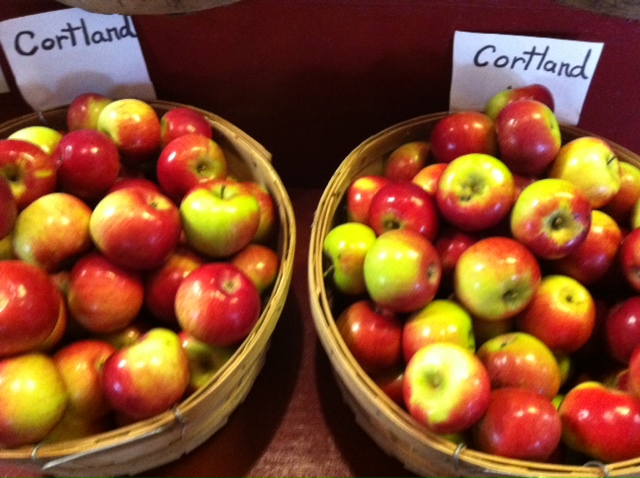
Cortland – large sized apples with mostly red skin and red strips appearing on the lighter areas. They have a mild, tender flavor. Ideal for snacks, salads, and fruit platters because the flesh will remain white even after being cut. They are also good for baking with.

Empire – Native to New York, it is grown almost entirely on the East Coast.  It is a cross between McIntosh and Red Delicious. Medium sized. Distinctive strips. They are great eaten raw, especially right from the orchard. They are good for baking and for making applesauce. The flavor is sweet and the creamy flesh is semi-firm.


Fuji – originally from Japan, it was introduced to the US in the 1980’s and it is now the fourth most widely grown in the US. Large sized. Sweet and crisp. Varies from golden to blushed pink. Holds its shape and texture well when cooked and also stores well.


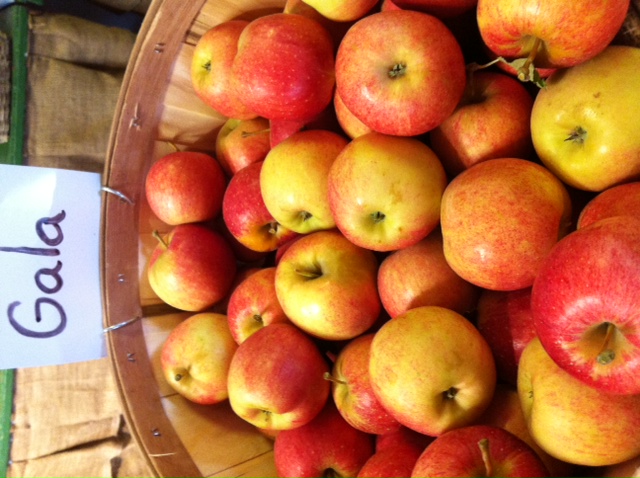
Gala – originally from New Zealand, it was introduced to the US in 11965 but didn’t become popular until the 1980’s.  It is now the third most widely grown in the US. Golden with pinky stripes. It is aromatic and tart. It holds its shape when cooked and great in applesauce. As one of the first harvested apples, it doesn’t keep very well, so don’t buy after early spring.

Golden Delicious – Medium to large sized. Golden yellow in appearance with a elongated shape and a five point bump at its base. The sweet flesh is yellowish-white and crisp. It is good for both eating and cooking.


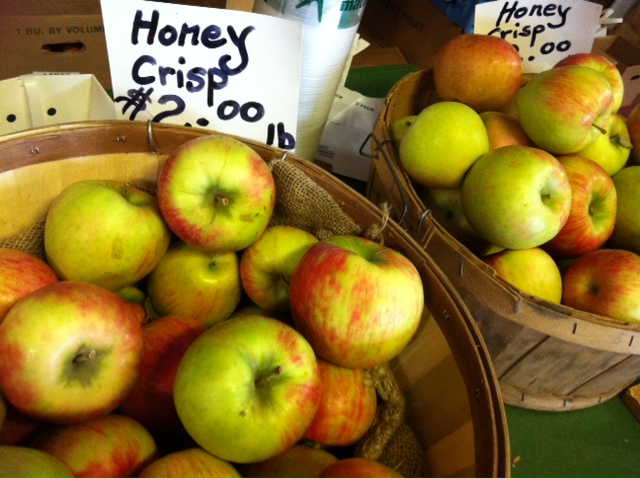
Honey Crisp – Native to the US. Red skin with a golden background. Crisp and sweet. Good for eating fresh but also holds well during cooking.

Ida Red – Native to the US. Good for eating fresh. Great for pies and their texture holds well in baked apple desserts. Sweet and tart flavor.


Jerseymac – a month-early variety of McIntosh. Medium to large size. Uniform shape. The skin is red with green slashes. Good for eating, but not great for baking.


Jonagold – native to New York. It is tangy. It is a bit soft to eat out of the hand, but it is creamy when cooked.


Macoun - from New York. Bright red with purple blush. Firm and juicy with a sweet white flesh. Great for eating fresh in salads or with cheese.


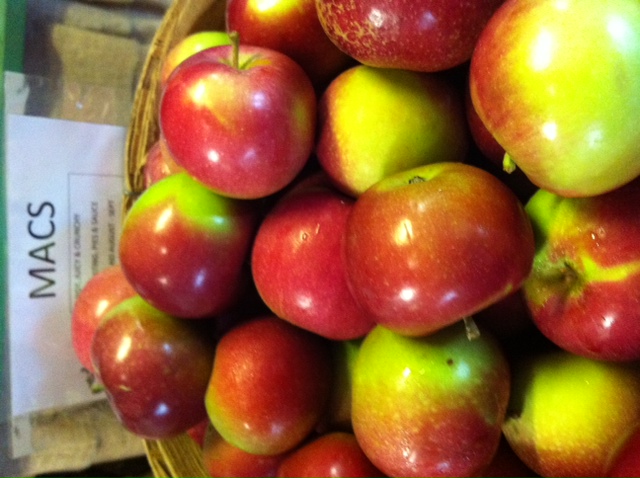
McIntosh – From North America. Medium to large sized. White flesh is sometimes lined with red veins. Skin is greenish with bright red blush.  Slightly tart flavor. They bruise easily as they are tender, but can be stored for 2-3 months in cold storage. They are good to eat or baked in pies and sauces.

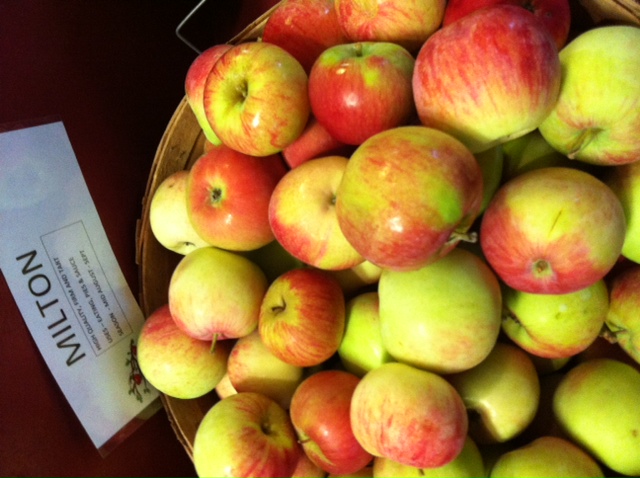
Milton – From the US. Medium sized. Yellow/green with red blush. Firm and Tart. Good for cooking apple sauce and baking pies.

Mutsu – also called Crispin. From Japan. Large and green, it looks almost like a Golden Delicious. Sweet and sharp. Good for eating fresh, holds its shape well for cooking, especially baked apples.


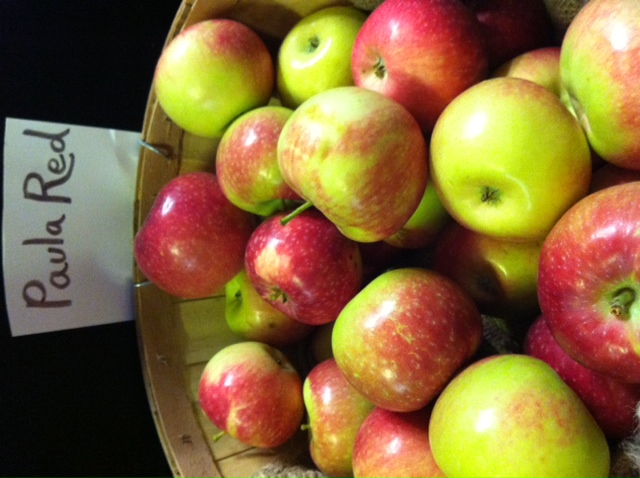
Paula Red – From the US. Bright red. Early season variety. Small to medium sized. Mild taste. Good for eating fresh. Flesh becomes soft when cooked so it’s better for applesauce.

Pink Lady – A trademark name, the variety is actually Cripps Pink. One of the first apples marketed as its brand name rather then variety. From Australia. As the name suggests, the skin is delicate pink. Sweet, honeyed and tart. Best for eating fresh.


Red Delicious – Used to make up almost half of the American apple harvest, but now is only a little more than a quarter. Medium to large sized. Bright red, sometimes with stripes, and have distinctive bottom bumps. Crisp and sweet. Best eaten raw straight from your hand, and is not recommended for cooking.

Friday, September 16, 2011

What's in Season: Peaches & Nectarines

Peaches. There is nothing that tastes like summer than biting into a recently picked, perfectly ripe peach that when you bite into it, juice just oozes down your chin and drips down your arm. Pure pleasure.

I am allergic to peaches - they are related to the almond family - so I generally stay away from them. Plus I always thought they weren't that great, a little tasteless and not sweet enough. I thought that I was less allergic when they were a bit hard and under-ripe. However, my interest peaked as everyone at the farmers market started asking about the arrival of the peaches and how they were their favorite part of summer. So when they finally came in season, I couldn't resist to biting into one. Minus the incredibly itchy fuzz which makes me maniacally scratch, they definitely are delicious when juicy and ripe with the juice running down your chin and all over your arms as you try to wipe it off.

Buying: Peaches are either clingstone or free-stone. Clingstone are ones where the flesh is pretty securely attached to the flesh and are usually sent to the canning industry whereas free-stone peaches have pits that hang about the flesh pretty freely. There are a lot of different varieties of peaches and nectarines but realistically, they can be interchangeable. Pay attention to the smell of the fruit as well as the background color. Red, although appealing, doesn't not equate with ripeness or maturity, but with with variety of the fruit.  You can tell the type of peach by looking at the ribbed shoulder on the top of the peach - the little strip will be yellow-orange for a yellow fleshed peach and a lighter yellow for a white flesh skin. Look for pieces of fruit that have an orange or golden, not green, hue to their background. Like tomatoes, always trust your nose and smell your fruit - should be peachy keen!

Storing: If you want to keep peaches for longer, keep them in the refrigerator after they have begun to ripen (do not put under-ripe fruit in the fridge as it will dry out the flesh and turn mealy). If you're looking to eat them sooner, leave them out at room temperature. If you want to eat it even sooner, place it in a brown paper bag with a banana (or any fruit that exudes ethylene) and it will expedite the ripening process. They are very fragile and delicate, any damage or bruising will cause them to start decomposing which is why farmers markets may have boxes of "canning" peaches and nectarines. The juices will cause the other fruits to start to rot prematurely as well so they are separated. These are often ready to eat, fallen, bruised, split-pit, even ugly fruits that are perfect for canning, obviously, or making jams, pies, and tarts. Peaches and nectarines, like tomatoes, are climacteric, which means they will continue to ripen after they are picked. So, if you buy a peach or nectarine from the farmers market that is pretty hard, it is because the farmer knows that you might not eat it right away, so leave it on the counter and it will be excellent to eat in a couple days. I'm not quite sure what to answer when people ask me if the fruit will ripen and become softer....what do you think? It will stay hard or just get harder? Of course it will ripen. However, if you go pick your own peaches and nectarines, follow your nose to find the fruit picked off the tree that is just bursting with liquid sugary syrup that will drip down your arm as you take that first bite......

Split Pits
"she obviously has a lot of respect for you. none of our friends know what a split pit is, let alone be able to talk about it for hours."

What's the difference between a peach and a nectarine? Not too much. 
Fact: peaches and nectarines are so closely related that sometimes a peach seed will germinate a nectarine tree and a nectarine seed with grow a peach tree! There is just one differentiating gene. Because peaches have hair on their surface - which causes all sorts of uncomfortable itching for me - they are considered to be "pubescent" whereas nectarines have no fuzz, just a smooth surface. Although preferred by some, nectarines are firmer than peaches so they don't have that melt-in-your-mouth effect and therefore don't really fall apart messily all over your hand, half in your mouth like a ripe peach often does.

Medical: Lots of Vitamin A & C and potassium. They are virtually fat-free (less than 1 gram), very low in calories (about 40) and the skin is a good source of fiber!

I AM ITCHINIGLY INCREDIBLY ALLERGIC TO PEACH FUZZ! 
....hours of itching at work....

Cooking: When cooking peaches, peel the skin as they will easily peel away throughout the cooking process, however, nectarines do not need to be peeled. To easily peel a peach, put an X with a sharp knife at the bottom of the peach and pop in boiling water to blanch for a couple seconds and then quickly put into a bowl of ice water. The ice water will stop the peach from continuing to cook and the skin will easily peel away. If the fruit is incredibly ripe, blanching is probably not necessary.

If you are using cut fruit, sprinkle some sugar over it to stop it from browning as the exposure to air will cause enzymatic browning.

Recipes:

Peach Bellini
The Bellini is a popular drink in Italy made famous from Harry's Bar in Venice, owned by Giuseppi Cipriani. I always wanted to meet a Giuseppi while I was living in Italy. Anyways, a Bellini is a long drink cocktail served without ice. It is two parts (100mL) prosecco, one part (50mL) white peach puree. The peach puree can be made by blanching a peach to remove the skins, then blending it with a dash of prosecco (a lot of recipes will call for water and lemon juice, but why not prosecco?!). The puree is then added to the glass and topped off with prosecco. A virgin version can be made also by using club soda instead (with the water and lemon juice in the blender).


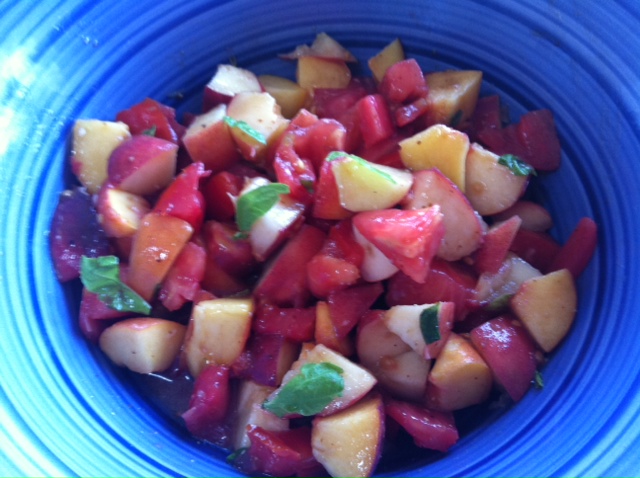
Tomato Peach and Basil Salad
4 Tomatoes (or to match the amount of peaches, depending on the size)
4 Peaches (2 yellow, 2 white)
Basil
1/4 cup balsamic vinegar
1-2 teaspoons dark brown sugar, optional
2 cloves chopped garlic
salt and freshly ground black pepper
1/2 cup quality extra virgin olive oil
1 teaspoon of Dijon mustard

Roughly cut the tomatoes and peaches into bite size pieces. Tear basil into the salad. Whisk together the remaining ingredients to make the vinaigrette. Gently toss and fold into the salad.


Grilled Peach Salad
Dressing:
2 1/2 oz goat cheese, crumbled
Salt and Pepper
5 tablespoons extra virgin olive oil
juice from 1 lemon
1 oz Parmesean, freshly grated

2 large peaches, halved, pits removed
extra virgin olive oil
salt and pepper
2 frisee or endive leaves, washed and dried
small bunch of fresh mint leaves

Put the goat cheese in a pestle and mortar with sea salt and pepper - easy on the salt because the cheese will already be salty. Add the olive oil and lemon juice and mix. Add the parmesean and mix again, but not for too long. 

Monday, September 5, 2011

What's in Season: Cabbage


Buying: Look for cabbages that have tight heads - even if the outer leaves are a bit floppy, they can be discarded. Leaves should not be discolored, damaged or dried out. If buying from a store, avoid those that look like they have been overly tidied up. 


Storing: Cabbage should be kept cold to retain it’s Vitamin C amount. Savoy cabbage will keep for about a week in a plastic bag in the crisper drawer of the refrigerator. A cut, unused part of the cabbage should be wrapped tightly in plastic and placed in the fridge. It should be used quickly as cut cabage will continue to lose its beneficial vitamins.


Fact: The world record for the largest cabbage is ranked at 124 lbs from Wales.


Medical: Cabbage retains the most nutrition when eaten raw. It is said to reduce colonic cancer risk, perk up the immune system, and eradicate bacteria. Cabbage juice is apparently good for preventing and curing ulcers.


Cooking: Remove any tough, fiberous outer leaves. Quarter the cabbage, remove the core, and then cut into the desired size slice, either shredded in a food processor or cut with a stainless steel knife (certain phytonutrients react with carbon, so stainless steel will prevent the leaves from turning black). Only cut and wash cabbage right before using it. After cutting the cabbage, it is possible to soak the leaves in cold water to not only keep it crisp, but to draw out some of those sulfurous chemicals that put many people off cabbage.


Cabbage can be steamed or blanched for 6-8 minutes. After washing, shredding and blanching for 1 minute, cabbage can be frozen in plastic bags. Cabbage can be stir-fried, baked, braised, the thick, waxy leaves of cabbage are great for acting as carb-free sandwich wraps, salad cupping, or for stuffing. Add thin cuts of cabbage to soups to sweeten and thicken the broth.


-------
Cabbage-Not-Iceberg Wedge Salad with Blue Cheese Dressing, Oven-Roasted Tomatoes and Torn Croutons


I was looking through my Ad Hoc at Home cookbook and saw a recipe for the classic Iceberg Lettuce Salad. The quartered lettuce in the picture reminded me of quartered cabbage and decided to make it using cabbage instead. A lot of people from the CSA program choose to swap out their cabbage - either out of distaste, fed up with making coleslaw or just don't know what to do with it so I thought everyone loves Iceberg Salad, there's some reason why it's always on menu's so why not include cabbage as an interesting twist. And what a HIT!


Ok, it looks like a lot of work. And it was. Thomas Keller's Ad Hoc at Home look like easy recipes, but for every ingredient, it's another recipe on another page. I've tried to lay it out below in an easy order.  I love the reward and the therapy of an all-day cook-fest. The remaining aioli can be used for sandwich spreads (I was a little too thrilled with myself at the success of homemade aioli), the garlic confit and oil can be used in other recipes. The blue cheese dressing can be used in salads or for dipping veggies throughout the week.  It might not be the healthiest, but it's a good way to incorporate cabbage into an interesting twist - cabbage is very low in calories - and I left out the bacon. 


Garlic Confit and Oil
2 bulbs garlic, peeled - about one cup
about 2 cups canola oil


cut off the root ends of the garlic cloves. Put in a small sauce pan and add enough oil to cover them by about 1 inch - none should be poking through. POKE. Put the saucepan over med-low heat and cook gently - little bubbles should come up but they shouldn't break the surface - remove from the heat if this happens/adjust heat. Cook for about 40 minutes, stirring every 5 minutes or so until the cloves are completely tender when pierced with a knife tip. Remove from the heat and allow garlic to cool in the oil. Can be refrigerated in a covered container for 1 week. 


Oven Roasted Tomatoes
8 cherry tomatoes, halved (I used a mix of purple cherry and yellow blush tomatoes)
extra virgin olive oil or garlic oil from above
thyme
salt and pepper

Preheat the oven to 400F. Put the tomato halves on a baking sheet and drizzle with the remaining ingredients. Roast for about 15-20 minutes until the tomatoes have softened and look like they are about to burst. Remove and let come to room temperature. 


Aioli
4 large egg yolks
2 cups Garlic Oil (above)
1 tablespoon plus 1 teaspoon lemon juice
2 teaspoon kosher salt


To easily remove the yolks from the whites, crack in half and slowly dip the yolks into a bowl. You can gently put the yolk into your hand and the whites will run through your fingers. Put the egg yolks in a food processor and process to combine. With the motor running, VERY slowly add the oil through the whole in the center, blending until it is emulsified and thick. Add the lemon juice and salt. Stop the motor as soon as the last drop of oil is added - overworking it will cause it to break. Can be refrigerated covered for up to 1 week. 
*Substitute regular canola oil to make plain mayonnaise*
Blue Cheese Dressing
1 cup Aioli (above)
1/2 cup buttermilk
1/2 cup creme fraiche 
1/2 teaspoon onion powder
1/2 teaspoon garlic powder
3/4 teaspoon lemon juice
1 teaspoon parsley
1 teaspoon dill
salt
1 1/2 cups crumbled blue cheese (suggested: Pt. Reyes)
(recipe also calls for 1 teaspoon of both minced chives and mint which I did not have so I added dill which worked great)


Put the aioli in a large bowl then whisk in the buttermilk and remaining ingredients. Additional buttermilk can be used to make it less thick, if desired. Can be refrigerated in a covered container for up to 1 week. 
*Buttermilk can be made by putting 1 tablespoon lemon juice into a 1-cup measuring cup and filling the rest with milk, stir, then let sit for 2 minutes. 
Grilled Cabbage Wedges 
1 cabbage, quartered
extra virgin olive oil
salt and pepper

Preheat the oven to 400F (should be set, from the tomatoes) or light up the grill - which we did. Rub the cut sides of the cabbage with the oil. Put the cabbage quarters on to a large sheet of tin foil, cut side down and drizzle with a little oil and season. Wrap and cover with the foil tightly to seal it.  Bake or grill for about 20 minutes, until the cabbage is tender. Open the foil to let cool. 
Meanwhile...

Torn Croutons
Tear day-old sourdough bread into bite-size pieces. Pour enough Garlic Oil into the bottom of a large pan to cover the bottom. Heat until hot and then add the bread in a single layer. Reduce the heat. Stir the bread in the oil so that it is coated. If you hear sizzling, the heat is too high and the croutons will become too dry - the key is to slow cook them for about 20 minutes so that the croutons absorb the garlicky oil and become crsip and golden brown on all sides. Set aside. 
Arrange the cabbage onto 4 plates or onto a serving dish. Tuck the tomatoes in and around the lettuce (4 haves per person). Sprinkle with the croutons. Spoon some of the dressing over the salad and serve the remaining dressing on the side. 


PHEW!

What's in Season: Melon

Buying: A melon in general should be heavy for it’s size and without bruises. The undertones of the melon should be more yellow than green. Cantaloupe are considered to be netted melons as their surface skin is covered in a web of netted veins. The veins should be pronounced and golden, not green. The inside cavity also contains seeds that are enclosed in a netted web. Knocking on the melon is one way of seeing if it is ripe enough to eat – the cavity inside should sound hollow whereas a honeydew’s seeds will rattle inside when ripe. Like most fruit, trust your nose and smell the fruit, the aroma should be incredibly fragrant. Watermelons are part of the melon family that have smooth skins. They should have a deep, rich skin color and a waxy surface. “Sugar spots” are a good indicator of a good smooth-skinned melon; they are brown flecks that supermarkets usually wash off as imperfections. Crenshaw melons, long and oval in shape, are the most aromatic when ripe and should have a bright yellow skin covering a golden pink flesh. Honeydew should have a smooth, pale yellow-green surface. The blossom end should be rather soft with a slight fragrant aroma. French melons are small and have a grayish yellow-green skin. With its flowery aroma, it is easy to tell when it is ripe as it look as though it is about to burst open.


Storage: An whole, unripe melon should be left at room temperature. Cut melon should not be left out at room temperature for more than 2 or at most 4 hours and for a chilled melon, refrigerate it only overnight. After being picked, a melon will continue to soften, but it will not get any sweeter. Do not put melon in the fridge with strong smelling foods as they will easily absorb those other flavors.

Medical: Watermelon and cantaloupe have a low calorie count (one cup of cantaloupe = 56 calories, watermelon 48 calories). With its orange flesh, cantaloupe is very high in beta-carotene, which is good for your eye sight, so it is very high in Vitamin A, which is good for lung health. It also contains a high amount of Vitamin C which not only acts as an antioxidant, but it protects the immune system by encouraging white blood cells to fight against infections, kill bacteria and viruses, and rejuvenates inactive Vitamin E within the body. Cantaloupe is also high in potassium and dietary fiber. The B Vitamins cantaloupe contains help process carbohydrates and along with the amount of fiber, regulates the flow of sugar into the bloodstream. Watermelon is filled with lycophene which is very strongly preventive of cancer.


Fact: Melons are related to squash, pumpkins, and plants that grow off vines on the ground. What we call cantaloupe in America is actually a muskmelon. The true variety of cantaloupe is found mostly in France. Cantaloupe  were first cultivated in 1700 A.D. in Italy in a town called Cantalup, where its name derives from.


Cooking:
Melon has so much more to offer than just in a fruit salad. I made a refreshing chilled melon soup the other day with half a crenshaw and half a french melon I had pureed with half a cucumber, lime juice, basil, a jalapeno, and water to smooth out the consistency. Juicy melon is great wrapped in salty serrano ham or prosciutto. Melon Salsa. Great for parties: cut a hole in a watermelon and carve out some of the flesh. Stick in a funnel and slowly pour in vodka, it will take time to absorb so do ahead...or cut the melon up, stick it in a bowl and pour the vodka over. 

Melon Salad
About 5 lbs assorted melons, room temperature, cut into any free-form desired shape, slice, cube or ball.
1 head frisee, washed and dried
12 small French breakfast radishes, trimmed and thinly sliced
1/4 cup extra virgin olive oil
2 tablespoons balsamic vinegar
salt
3 oz feta cheese, drained, cut into 1/2 inch cubes
1/4 cup pitted Kalamata olives, quartered lengthwise
small mint leaves (optional)


Pour the oil and vinegar in a bowl and swirl to make a vinaigrette.  Toss the frisee and radishes in a medium bowl and drizzle about half of the vinaigrette around the sides of the bowl. Toss to coat and season to taste. Arrange some of the melon on a serving platter, drizzle with some vinaigrette and repeat with more melon and vinaigrette, layering as you build the salad. Loosely place the lettuce on top of the melon then scatter with feta cheese and olives. Garnish with mint leaves.

* Adapted from Thomas Kellar’s Ad Hoc at Home. The sweet melon goes fabulously with the salty cheese and olives and the slight bitterness of the frisee.  I made this salad with only a Crenshaw melon and it was delicious, although a variety of melons would add more color, an array of texture and a medley of flavor. He also included toasted pine nuts and 1 English cucumber which I did not have. I used some pickled radishes I had made rather than small wedges like his recipe called for (boil 2 parts vinegar to 1 part sugar, 1 part water and let cool, add radishes – or any veg – into a canning jar and pour the room-temp pickling liquid over them, let stand for 30 minutes, cover, refrigerate up to 1 month)


Watermelon, cut into cubes, goes fantastically with some feta cheese, red onion, pine nuts, and fresh basil. Drizzle with some good extra virgin olive oil, a sprinkle of sea salt and a generous amount of freshly ground black pepper.The juicy sweetness of melon pairs incredibly well with salty foods – like feta – so wrapped slices of melon with prosciutto is delicious and easy. Try it grilled!

Saturday, August 20, 2011

What's in Season: Sweet Corn


Buying: Look for husks that are green and fresh looking - they shouldn't be too dried out. The silk should also be fresh looking. Peeling back the husks to look at the tip of the corn is a good indicator: the kernels should be full and evenly spaced. If you dig your nail into a kernel, the liquid should be milky. If it is clear, it is under-ripe, if it is thick, it is over-ripe. Organic corn will not be genetically modified, like many of the corns you will find in the grocery store. 

Storage: Corn is best when eaten right away before the sugars turn to starch, diminishing that sweet sweet taste. This is mostly true for eating corn right off the cob, within 24 hours, but after 3 days, corn will still be edible and tasty enough to cook with. Corn should be refrigerated with the husks still on. The husks will preserve that milky moisture in the kernels. Keep them in the crisper drawer without any strong smelling foods as corn will easily absorb those odors.

Medical: Corn is high in carbohydrates and fiber - chew chew chew. It is apparently a good reducer of cancer risks, heart disease, and tooth cavities. 

Fact: Sweet corn is the sweet variety of maize, which is the starchy produce used to make fodder and used as a grain. The sweet corn that we eat is an immature grain. 
Together, they are the third more important cereal only after wheat and rice. Over 500 different by-products can be used by corn....ever seen the movie King Corn? This also makes sense because corn is a staple in some countries in the form of tortillas, polenta or corn meal as well as snacks in other countries as popcorn or corn tortilla chips. 

I like it's scientific name, zea mays, its kinda like saying maize in a fancy accent.

Cooking: Shuck corn only before using by pulling down, cutting off the stem, and remove the silky threads either by hand or with a vegetable brush. If there is some worm damage - no fear - just cut out that part, the rest of the corn is still good. Wash the corn in cold water. To remove the kernels, place the corn vertically in a large bowl and run a sharp knife down along its length. If making a soup, or if you want some extra milky juice, run the knife down the length of the corn again, but with the dull back of the knife to avoid shaving off the cob. To freeze corn, blanch in boiling water for about 5 minutes, cool and drain then wrap in plastic or tin foil.

Tip from Thomas Keller: After you have removed the kernels from the cob into a bowl, place a smaller bowl of water next to it. Swirl your hand around the corn and the silk will stick to your hand. Remove the silk from your hand by dipping it into the bowl of water. Or running water would work too, I'm sure.

Recipes

Try corn raw; boil it in boiling water for about 10 minutes depending on how soft you like it, remove with tongs, slather with butter and sprinkled with salt; pull back the husks without removing, remove the silks, then pull the husks back up and soak for at least 15 minutes then grill corn in their husks, turning occasionally until charred about 20 minutes; creamed corn; corn bread; corn chowder; corn and black bean salsa; Silver Queen succotash; deep-fried corn fritters; roasted; sprinkled into salads....


Grilled Corn on the Cob with Garlic Butter, Lime Salt and Cotija Cheese
Heat the grill. Pull back the husks without removing them and remove the silks. Pull the husks back up and cover the corn.Soak the corn in a large bowl of water for about 15-30 minutes and then shake off any excess water.Put the corn on the grill, close the cover and cook for about 20 minutes. Remove the husks and roll the corn with garlic butter, sprinkle with lime salt and cotija cheese.

Garlic Butter: 2 sticks of butter, 8 garlic cloves, salt and pepper, blended in a food processer.
Lime Salt: 1/4 cup Maldon sea salt, zest from one lime put into a jar and shaken to mix
Cotija cheese is a hard, salty, grating cheese that doesn't melt when cooked - substitute Parmesean or feta cheese for other great combos
Cheese inspired by restaurants, lime salt from Thomas Kellar.

Do you twirl your corn and eat around the cob or lengthwise like a typewriter?


Stir-Fried Corn
Heat 2 tablespoons of olive oil in a large pan and add corn kernels with a tablespoon of chopped ginger, a teaspoon of freshly chopped chili, a handful of chopped parsley, and a couple tablespoons of reduced-sodium soy sauce. Cook until the soy sauce sorta caramelizes so that the corn kernels are sweet n' crunchy. Incredibly easy and Incredibly delicious.
Inspired by Jamie Oliver
Corn & Basil Soup with Stir Fried Corn - two recipes in one dish!

Corn and Basil Soup
2 tablespoons of olive oil
2 small white sweet onions, roughly chopped
2 cloves of garlic
5 ears of corn, kernels removed
1 jalapeno, stem removed and chopped (optional)
a handful of fresh basil
1 1/2 cup vegetable or chicken stock
salt and pepper
Place the kernels into a blender. Heat the oil in a large pan over medium heat and add the garlic then add the onion and jalapeno. Stir to coat with the oil and saute until the vegetables are tender and translucent, about 6 minutes.  Remove from heat and add these to the corn in the blender. Blend until smooth, scraping the sides occasionally and pulse to the desired consistency. Season with salt and pepper. Transfer the soup from the blender to a large pot over medium heat.  Stir until the soup begins to thicken and then pour in the stock. Bring to a boil, then reduce the heat and simmer for about 15 minutes. Ladle into bowls and can be served garnished with a dollop of corn salsa! Serve hot or cold.